Why Your Click-Through Rate Collapsed in 2026
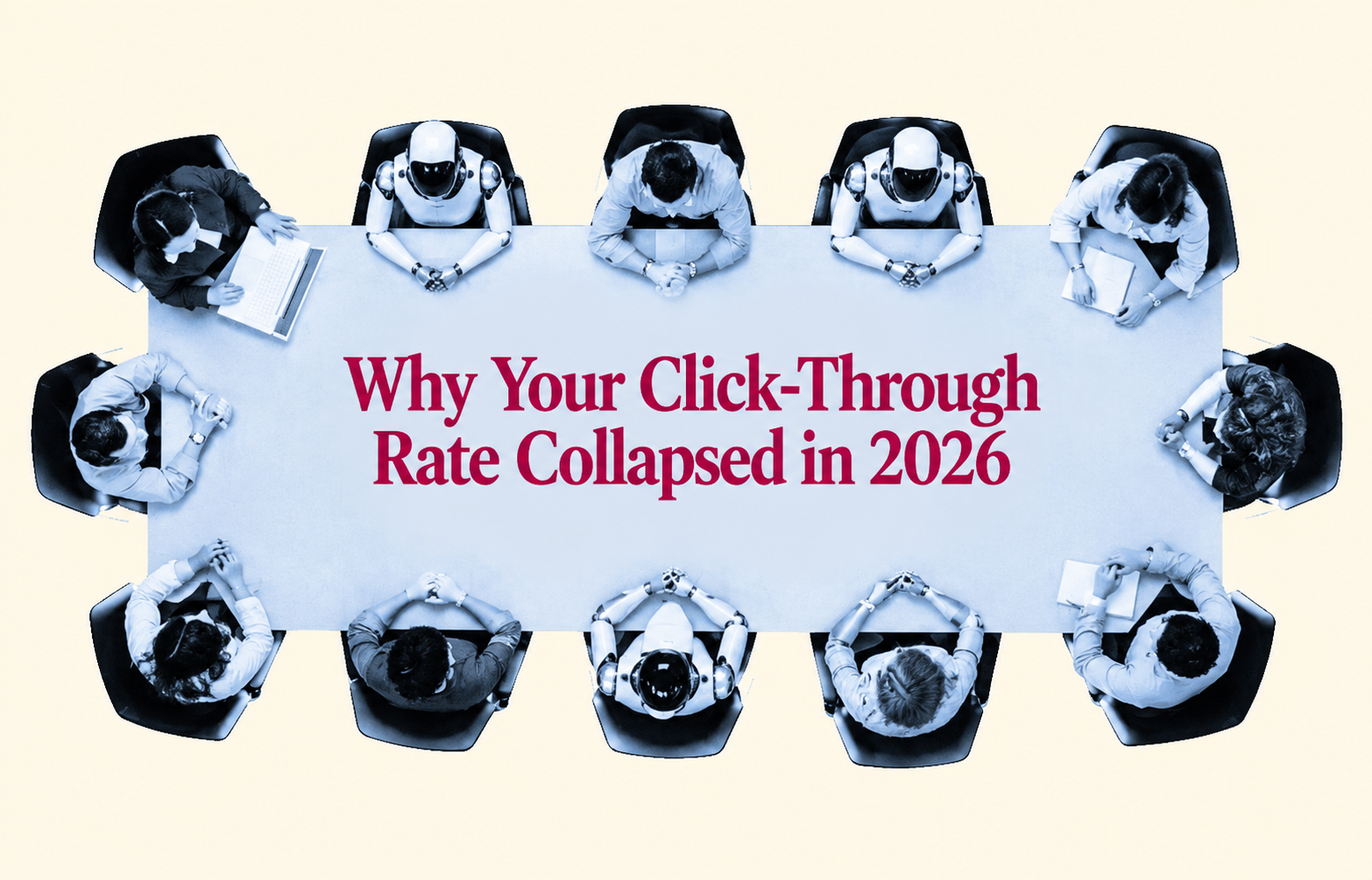
It's become a recurring conversation in 2026. A client calls their digital marketing agency. Conversion rates are down. Click-through rates have collapsed. Traffic looks like an ECG on a patient just taken off life support. The question is always the same: What's happening?
What's actually happening is three things at once. And you can't fix them with more blog posts, a new ad budget, or an A/B test on button colour.
AI Has Stolen the Front Page of the Internet
In September 2026, internal documents from Microsoft's lawsuit with The New York Times revealed something the industry already knew but had never seen in black and white: when users search via Copilot instead of regular Bing, clicks to external websites drop by up to 93 percent. A Microsoft researcher called it a "doom loop" for the web. An OpenAI engineer put it even more plainly back in 2023: "No matter how prominently we show the links, users won't click."
Google AI Overviews answers directly. Perplexity cites one source and never sends traffic onward. ChatGPT closes the question.
According to HubSpot's State of Marketing 2026, 92% of marketers are now using, or planning to use, optimisation for AI search engines. This is no longer a niche strategy. It's the baseline requirement. And yet most agencies are still counting organic sessions as if it were 2019.
The new metric isn't the click. It's the citation. The brand mentioned in the AI answer wins visibility, credibility and recognition, without generating a single session in Google Analytics. Marketers who understand this now track how often their brand appears inside AI-generated answers. Those who don't are still optimising for a world that no longer exists.
The Middle Class Has Essentially Disappeared as a Buyer
A global recession is underway. Disposable income has shrunk dramatically. People who used to click, compare prices and add products to digital shopping carts are now running a completely different calculation every morning: bills, food, rent. What used to be an obvious purchase is now an active decision not to buy.
The middle class, the group that for decades drove consumption of everything from subscription services and home furnishings to fitness equipment and digital tools, is in a financial position it never anticipated. Savings are gone. Margins are gone. And with them: the impulse purchases, the loyalty programmes, and the digital consumption that entire business models were built on.
Clients calling their agencies and asking about conversion drops are forgetting to ask the more fundamental question: Can my customer actually afford this right now?
It's not the campaign's fault. It's not the copywriter's fault. It's not even the algorithm. It's that the economic reality of your target audience looks fundamentally different in 2026 than it did in 2021.
The Agencies Don't Have the Answer
On Reddit, a Head of Marketing at a B2B company put it better than most analyst reports: "2026 feels like a completely different year. Not a weak quarter. Not one underperforming channel. Fundamental changes across the entire funnel."
What he's describing isn't an anomaly. It's the new normal.
And in the comment threads under that post, and hundreds like it, a pattern emerges: agencies that added a slide about "Generative Engine Optimization" to their sales deck and then kept doing exactly what they were doing in 2022. More blog posts. More backlinks. More AI-generated content they hope will rank — in a world where AI engines actively prioritise human voices, Reddit threads, third-party reviews and established brand authority over machine-produced articles.
One commenter put it plainly: "If an agency claims they can game Perplexity the same way they gamed Google in 2018, they're selling snake oil with a new buzzword on the invoice."
The Expertise AI Can't Replicate
In the middle of all this chaos, demand for one specific skill set is growing.
People who understand what communication is actually supposed to do.
AI cannot understand what a human needs to hear in 2026, when the economy is tough, the future feels uncertain, and trust in brands is at a historic low.
A copywriter with genuine expertise does three things no prompt can replicate. They understand the intent behind the search query, they write for passage indexing and AI citation with precision, and they choose the one that actually lands with a real person in a real situation.
What This Requires From You as a Brand
The clicks are not coming back the way they were. That's not a forecast. It's a statement of fact.
The new metrics are citation, trust and relevance at the right moment. It requires content specific and well-structured enough for AI systems to choose to cite it. It requires presence beyond your website: on Reddit, in industry publications, in third-party reviews, because that's where AI engines actually look when building their answers.
And it requires a copywriter who understands all of this. Not a prompt operator. A strategist who uses language as a tool.
That's a rare combination of skills. And it isn't cheap. But it's cheaper than continuing to pay for dashboards measuring a reality that stopped existing two years ago.