How to Write Website Copy That Converts
Most people write for the web the same way they write for print. That’s a mistake, and it’s one of the most common web copywriting errors I see.
I learned this the hard way. Coming from screenwriting, I was trained to think in sequences. That works brilliantly on screen, but on a webpage? People are gone before your setup lands.
Writing for the web is a different discipline. Here’s what I’ve come to rely on.
Start with context
Web copywriting starts with orientation, not information. Readers arrive at your page from somewhere, such as Google search, a social share, or a newsletter link. They don’t know where they are yet, and they’re deciding in milliseconds whether to stay.
That means your first job isn’t to inform. It’s to orient. Give them a clear signal that they’re in the right place, for the right thing, at the right time. Structure your page so the most important message appears first, not buried three paragraphs down after your company history.
Think of it like a film opening. You establish the world before you introduce the conflict.
Write short. Then cut it in half.
On screen, people don’t read — they scan. Long paragraphs feel like walls. Even if the content is genuinely good, dense formatting signals “this will take effort,” and effort is the enemy of engagement.
Keep sentences short. Break up paragraphs after two or three lines. If you can say it in ten words instead of twenty, say it in ten. Every unnecessary word is a small tax on the reader’s attention, and attention is the scarcest resource you’re working with.
This doesn’t mean dumbing things down. It means respecting your reader’s time.
Make your headings do real work
Headings aren’t decoration. They’re navigation.
A reader scanning your page is asking “Is this worth my time?”. Your headings answer that question. If they’re vague (“Our Approach,” “Learn More,” “Why Us”) you’ve given them nothing to hold onto. If they’re specific and informative (“Three reasons your homepage copy isn’t converting”), the reader knows exactly what they’re getting before they commit to reading.
Write headings that make sense out of context. Because for a scanner, they often are the context.
Use bullet points strategically
Bullet lists are useful when you have genuinely parallel items: a checklist, a list of features, a set of options. They make comparison easy and reduce cognitive load.
But bullets can also fragment content that should flow as prose. If you’re using bullet points because you can’t figure out how to connect your ideas, that’s a writing problem and not a formatting solution.
Use them when they earn their place. Not as a default.
Visual readability is a writing problem, not just a design problem
How a page looks affects how the text is received. That’s a writer’s concern, not just a designer’s.
Line length matters. Paragraphs that stretch the full width of a screen are exhausting to read. White space isn’t wasted space, as it gives the eye somewhere to rest. Images, when relevant, give the reader a mental anchor between blocks of text.
When I write website copy for a client, I think about how the text will sit on the page, not just what it says. Word count, paragraph length, and section breaks are all tools.
Write for everyone
Accessible web copywriting isn’t a niche consideration. It’s good writing.
Use plain language. Avoid jargon unless your audience genuinely uses it. Don’t rely on color or layout alone to convey meaning. Write link text that makes sense on its own. “Click here” tells the reader nothing, “Read the full case study” tells them exactly where they’re going.
Small detail. Real difference.
Social media is its own dialect
Web writing principles carry over to social, but the context shifts. On social, you’re competing with everything else in someone’s feed. The first line has to earn the next one.
I write social copy the same way I write headlines: what’s the one thing I want this person to take away? Everything else is support.
The 7 web copywriting principles I come back to
If someone asked me to summarize everything above into a checklist, it would look like this:
Orient before you inform — context comes first
Write short sentences and short paragraphs
Use headings that work out of context
Use bullet points only when items are genuinely parallel
Think about how the text sits on the page, not just what it says
Write link text that describes the destination
On social, the first line has to earn the second
The bottom line
Good web copywriting rewards clarity, structure, and a ruthless willingness to edit. It punishes assumptions about how much time or patience your reader has.
Get the structure right first. Then cut. Then make it scannable. Then read it out loud. If it sounds natural, it probably reads naturally too.
That’s the system I keep coming back to.
Every great brand has a story worth telling.
Screenwriting teaches you something most copywriters never learn: the most important thing in any scene is almost never what's being said. The same is true for great copy.
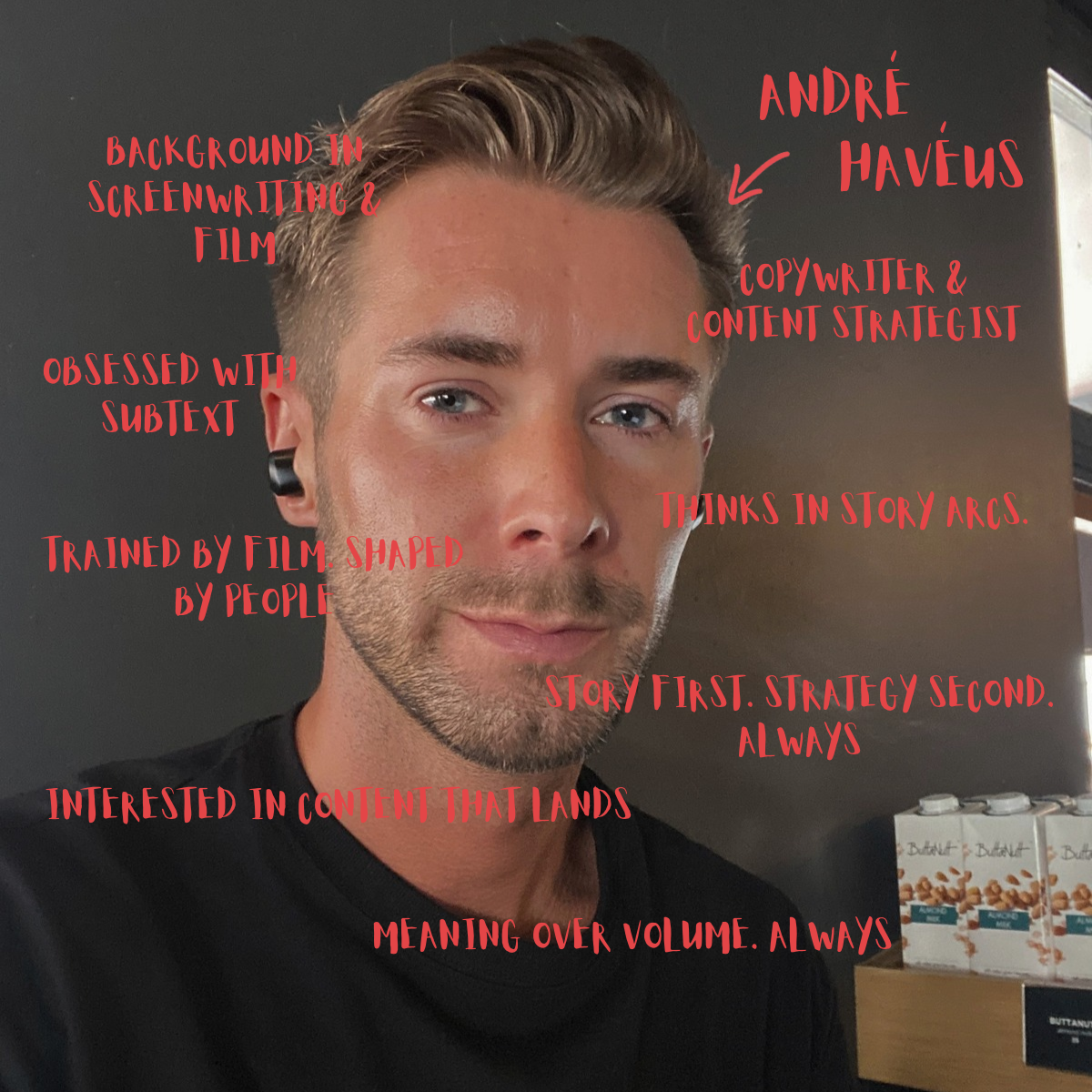
I became a copywriter because I was already a filmmaker. A screenwriter. Someone who spent years obsessing over the gap between what people say and what they actually mean. Over the small gestures that reveal character. Over why some stories stay with you for decades, and others dissolve before you’ve even closed the tab.
That’s a discipline, and it shapes every single word I write.
Trained by film. Shaped by people.
Screenwriting teaches you something most copywriters never learn: the most important thing in any scene is almost never what’s being said.
A character says “I’m fine.” What they mean is: I am holding myself together and I need you to see that without making me say it out loud.
That’s subtext. And I am obsessed with it.
Because good copy works exactly the same way. The best campaigns don’t tell you what to think. They create a moment of recognition with the reader. That recognition is what builds loyalty. Not a clever headline. Not a conversion-optimized CTA. A moment where a real person felt genuinely seen.
You can’t generate that. It requires someone who has been paying close attention to people for a very long time.
That’s what I bring to the table.
Thinks in story arcs. Writes in search-optimized prose.
Most copywriters start with the keyword. I start with the character. Who is this person, what do they actually want, and what are they really afraid of?
From there, structure follows naturally. The hook. The tension. The turn. The resolution. It’s not a framework I learned in a marketing course. It’s what happens when you’ve spent years writing scripts where every scene has to earn its place or it gets cut.
That discipline is rare in content right now. And it’s becoming more valuable by the day.
Because when execution is cheap the question of what those words should mean, and to whom, and why, becomes the only question that matters.
Story first. Strategy second. Always.
Interested in content that lands.
Scroll through any feed right now. The same minimalism that isn’t minimal, it’s just empty. Content that performs the idea of having something to say without ever quite getting there.
And then, occasionally, something cuts through. A piece of writing that makes you send it to someone with no comment except read this. A brand that makes you feel like the people behind it are actually alive and real.
Those moments are becoming rarer. And they are becoming more valuable.
Meaning over volume. Always.
The agencies and clients who still believe in this are out there.
I know you exist. You’re the ones who still lose sleep over whether a campaign means something.
You are going to win. Not because creativity is some romantic ideal worth protecting, but because humans are hardwired to respond to story, to honesty, to the feeling that the thing they’re reading was made by someone who actually cared.
The printing press didn’t end writing. Photography didn’t end painting. And AI won’t end the one thing it cannot replicate: a perspective that comes from a life genuinely lived and paid attention to.
Don’t buy the panic. Read a book. Watch a film. Spend time with people you love.
The future is bright, but only if we let it be.
Stop posting AI banners. It's not a flex. It's a red flag.
When a business posts an AI-generated banner, customers don't think "efficient." They think "they didn't care enough to try." Here's why that choice costs you more than you think.
When I see a business post a social media banner that was clearly generated by AI I don't think efficient. I don't think innovative.
I think that they didn't care enough to try.
And if they didn't care enough to try with their own image, the thing they chose to represent themselves publicly, what does that tell me about how much they'll care about the actual product or service?
Nobody Cares What You Used. They Care What It Says About You.
There's a difference between using a tool intelligently and using it as a substitute for giving a damn.
An AI banner says three things simultaneously:
We don't think our visual identity is worth investing in. You couldn't spend two hours with a designer, or even find a decent template and customize it. You generated something in 40 seconds and called it done.
We assume our customers won't notice (meaning: we don't care if they do). This is the part that really gets me. It's not even cynicism. It's indifference. And customers feel indifference. They may not be able to name it, but they feel it.
We have no backbone. You chose to represent your brand with something that has no perspective, no voice, no trace of an actual human decision. A placeholder dressed up as an identity.
Your customers are not stupid.
The comments sections on posts like this are consistent. People notice. They're turned off. They're simply scrolling past and never coming back.
If a company can't be bothered to create real content, why should we be bothered to become a real customer?
That's the direction the whole market is moving. As AI-generated content floods every platform, authenticity (actual human intention behind a visual) is becoming a premium signal. A trust marker. The brands that understand this are already pulling ahead.
The irony is that it costs you more than it saves you.
You saved what? A few thousands kronor on a graphic? And in exchange you communicated to every person who saw it that your brand is lazy, cheap, and doesn't believe in itself.
That's not efficiency. That's a slow leak in your credibility.
If you genuinely can't afford a designer right now, there are tools that let a non-designer make something that looks considered and intentional. Use a template and make it your own. Show up with something that has a pulse. Put in the effort.
But please, stop mistaking automation for strategy. Stop confusing fast with good. And stop insulting your potential customers by assuming they won't tell the difference.
They can. They do. And they remember.
Why Your Click-Through Rate Collapsed in 2026
Your clicks didn't disappear. AI search took them, a global recession changed your buyer, and most agencies are still looking at the wrong dashboard. Here's what's actually happening in 2026 — and what it actually requires.
It's become a recurring conversation in 2026. A client calls their digital marketing agency. Conversion rates are down. Click-through rates have collapsed. Traffic looks like an ECG on a patient just taken off life support. The question is always the same: What's happening?
What's actually happening is three things at once. And you can't fix them with more blog posts, a new ad budget, or an A/B test on button colour.
AI Has Stolen the Front Page of the Internet
In September 2026, internal documents from Microsoft's lawsuit with The New York Times revealed something the industry already knew but had never seen in black and white: when users search via Copilot instead of regular Bing, clicks to external websites drop by up to 93 percent. A Microsoft researcher called it a "doom loop" for the web. An OpenAI engineer put it even more plainly back in 2023: "No matter how prominently we show the links, users won't click."
Google AI Overviews answers directly. Perplexity cites one source and never sends traffic onward. ChatGPT closes the question.
According to HubSpot's State of Marketing 2026, 92% of marketers are now using, or planning to use, optimisation for AI search engines. This is no longer a niche strategy. It's the baseline requirement. And yet most agencies are still counting organic sessions as if it were 2019.
The new metric isn't the click. It's the citation. The brand mentioned in the AI answer wins visibility, credibility and recognition, without generating a single session in Google Analytics. Marketers who understand this now track how often their brand appears inside AI-generated answers. Those who don't are still optimising for a world that no longer exists.
The Middle Class Has Essentially Disappeared as a Buyer
A global recession is underway. Disposable income has shrunk dramatically. People who used to click, compare prices and add products to digital shopping carts are now running a completely different calculation every morning: bills, food, rent. What used to be an obvious purchase is now an active decision not to buy.
The middle class, the group that for decades drove consumption of everything from subscription services and home furnishings to fitness equipment and digital tools, is in a financial position it never anticipated. Savings are gone. Margins are gone. And with them: the impulse purchases, the loyalty programmes, and the digital consumption that entire business models were built on.
Clients calling their agencies and asking about conversion drops are forgetting to ask the more fundamental question: Can my customer actually afford this right now?
It's not the campaign's fault. It's not the copywriter's fault. It's not even the algorithm. It's that the economic reality of your target audience looks fundamentally different in 2026 than it did in 2021.
The Agencies Don't Have the Answer
On Reddit, a Head of Marketing at a B2B company put it better than most analyst reports: "2026 feels like a completely different year. Not a weak quarter. Not one underperforming channel. Fundamental changes across the entire funnel."
What he's describing isn't an anomaly. It's the new normal.
And in the comment threads under that post, and hundreds like it, a pattern emerges: agencies that added a slide about "Generative Engine Optimization" to their sales deck and then kept doing exactly what they were doing in 2022. More blog posts. More backlinks. More AI-generated content they hope will rank — in a world where AI engines actively prioritise human voices, Reddit threads, third-party reviews and established brand authority over machine-produced articles.
One commenter put it plainly: "If an agency claims they can game Perplexity the same way they gamed Google in 2018, they're selling snake oil with a new buzzword on the invoice."
The Expertise AI Can't Replicate
In the middle of all this chaos, demand for one specific skill set is growing.
People who understand what communication is actually supposed to do.
AI cannot understand what a human needs to hear in 2026, when the economy is tough, the future feels uncertain, and trust in brands is at a historic low.
A copywriter with genuine expertise does three things no prompt can replicate. They understand the intent behind the search query, they write for passage indexing and AI citation with precision, and they choose the one that actually lands with a real person in a real situation.
What This Requires From You as a Brand
The clicks are not coming back the way they were. That's not a forecast. It's a statement of fact.
The new metrics are citation, trust and relevance at the right moment. It requires content specific and well-structured enough for AI systems to choose to cite it. It requires presence beyond your website: on Reddit, in industry publications, in third-party reviews, because that's where AI engines actually look when building their answers.
And it requires a copywriter who understands all of this. Not a prompt operator. A strategist who uses language as a tool.
That's a rare combination of skills. And it isn't cheap. But it's cheaper than continuing to pay for dashboards measuring a reality that stopped existing two years ago.
Keywords Are Dead. Structure Is Everything.
Keywords aren't dead. Keyword density is. There's a difference. And most brands are optimising for the wrong one.
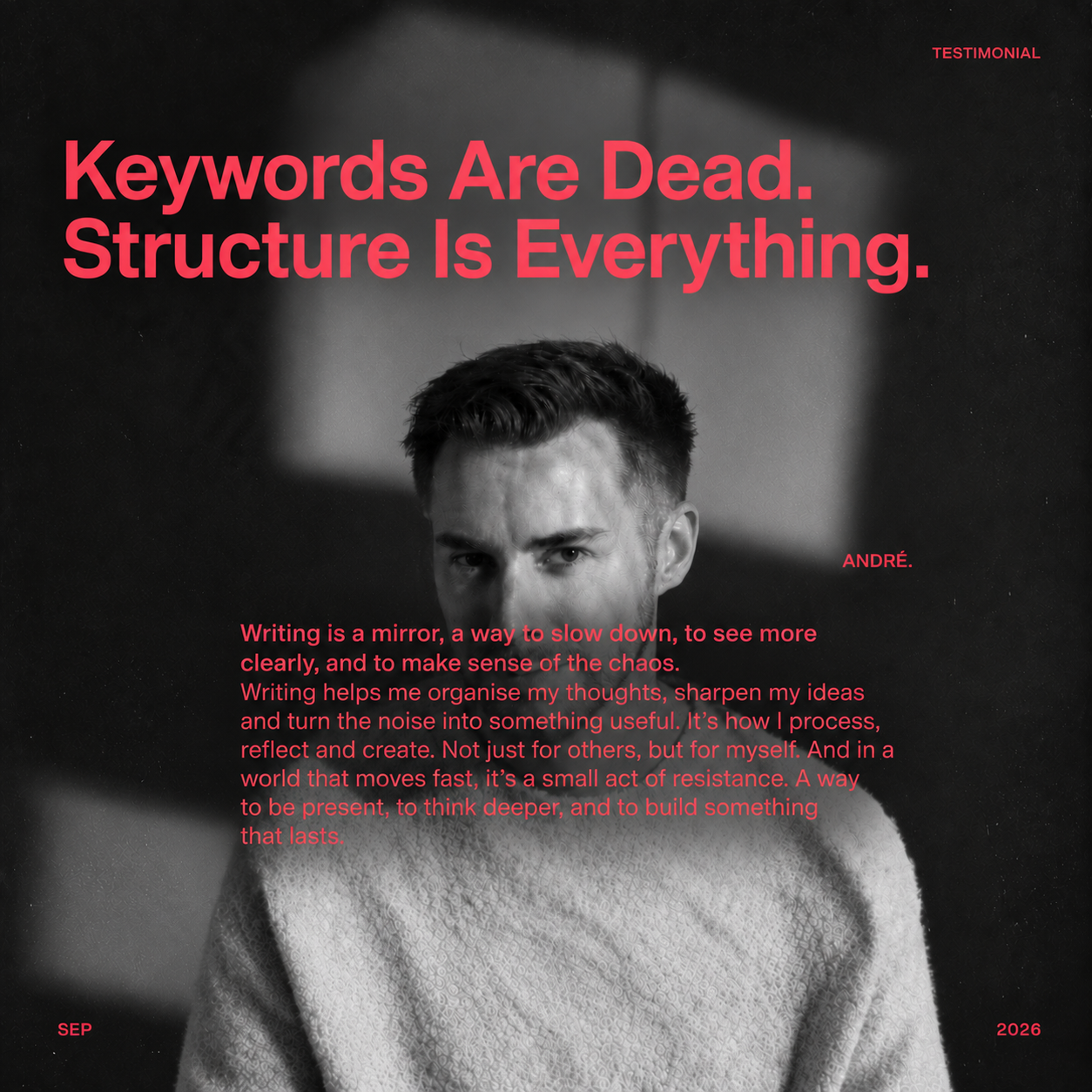
Keywords aren't dead. Keyword density is.
There's a difference.
Most brands are still writing for 2019. Briefing writers with a keyword and a word count. Measuring success by how many times a phrase appears on the page. Treating SEO copywriting as the practice of inserting terms into otherwise normal text at a frequency someone once decided was optimal.
The discipline has moved on. Most of the people executing it have not.
I have spent the last three years working at the intersection of SEO copywriting, AEO and GEO, helping brands build content that ranks on Google and gets cited by AI systems like ChatGPT, Perplexity and Google AI Overview. What I see across clients and industries is a consistent gap between what SEO copywriting actually requires in 2026 and what most teams think it requires.
Here’s what that gap actually costs.
What SEO copywriting actually is in 2026
SEO copywriting in 2026 means writing for search intent, passage indexing and AI citation. Not keyword density.
That sounds simple. It’s not, because it requires understanding three distinct jobs that good SEO copy has to do simultaneously.
The first job is to signal intent match. The opening paragraph, H1 and H2 structure collectively tell search engines what question the page is answering. If the dominant format for a given search query is comprehensive guides and you publish a service page, you have an intent mismatch that no amount of writing quality will overcome.
The second job is to format for passage indexing. Since December 2020, Google has been capable of ranking individual passages from a page independently of the page's overall authority. The practical implication: every H2 section on a page is a separate ranking opportunity if written correctly. Each section needs to open with a direct answer in the first two sentences. Not context, not backstory, not a point being built toward.
The third job is human persuasion, the actual craft of copywriting. Short sentences, active voice, concrete examples, a voice that earns trust. This still matters enormously.
Where most SEO briefs fall apart
Most briefs specify a keyword, a word count and nothing else. They do not define search intent. They do not specify how H2 sections should be structured. They do not ask the writer to lead each section with a direct answer rather than context.
The result is content that is well-written and structurally invisible. It answers the question eventually. Search engines and AI systems need the answer in the first two sentences of each section, not eventually.
A page can be well-written and still fail to rank if the intent match is wrong, the H2 structure buries answers rather than leading with them, the opening paragraph lacks a citable claim, or the entity coverage is thin with no specific data, sources or named concepts.
This is the failure mode I see most often. Not bad writing. Bad structure. And structure is determined by the brief.
What keyword density actually is
A 2025 Ahrefs study of top-ranking pages found that 83% of pages ranking in positions 1–3 had their primary keyword in the first 100 words. But keyword density showed no meaningful correlation with rank beyond that.
That is the distinction most teams miss.
Keyword placement matters - in the first 100 words, in the H1, in at least one H2. Keyword repetition beyond those structural placements adds no ranking value and often produces unreadable copy.
The keyword is a structural signal, not a frequency target. Once you understand that, the entire discipline reframes itself.
What zero-click means for your content strategy
Zero-click searches now make up 65% of all Google queries. AI Overviews answer questions at the top of the page before anyone clicks through.
This is the shift that most brands have not yet metabolized.
Traffic is no longer the only metric that matters. When someone asks Google a question and gets an AI Overview answer at the top of the page, the brand that is cited in that answer has won visibility, credibility and association with the answer, without generating a single session in Google Analytics.
Most marketing teams are still optimizing for traffic. The brands that are winning in 2026 are optimizing to be the source that AI cites.
That requires a different kind of writing. To write for AI citation, three elements are required: specificity in claims, source attribution and entity clarity. Named tools, frameworks, algorithms and specific data points anchor a passage in a defined conceptual context.
"SEO copywriting is important" is not citable. "SEO copywriting structures content around three sequential jobs - intent signalling, passage formatting and human persuasion - in that order" is citable because it makes a concrete claim about a mechanism.
Most brand content makes assertions. Citable content makes claims.
The third layer most brands are ignoring
SEO now overlaps with PR and brand building, content design and UX, data journalism, community-driven authority through Reddit and third-party publications, and LLM optimization. It is no longer just keyword research and on-page optimization.
Reddit threads, industry publications, third-party reviews, LinkedIn thought leadership - these are all signals that AI systems use to build their understanding of a brand. A company with excellent on-site SEO copy but no third-party presence is invisible to the part of the search ecosystem that is growing fastest.
This is what GEO, Generative Engine Optimization, addresses. Where AEO optimizes your own content to be citable, GEO manages how your brand appears across the entire web, everywhere AI systems look when building their answers.
Most brands have not started this work yet. The ones that have are building an advantage that will be very difficult to replicate once the space gets crowded.
What I recommend
Fix your opening sentences first. Improving 10–15 existing openers on priority pages generates more measurable ranking movement than publishing 10 new posts. The first sentence of every page and every H2 section should directly answer the implied question. Always lead with the answer.
Write briefs before you write content. The structure of a piece of content is determined before writing begins, not in revision. Define the search intent, map the H2 structure, specify how each section should open. A brief that does this produces rankable content. A brief that specifies only a keyword and word count produces well-written content that does not rank.
Build presence beyond your website. If you are not in Reddit discussions, industry publications, review platforms and third-party citations, you are invisible to the fastest-growing part of the search ecosystem.
Treat AI citation as a distinct goal. Your most important pages, the ones that answer the questions your ideal customers are asking, should be written with the structural specificity that AI systems extract and attribute.
Stop measuring content by traffic alone. If an AI Overview cites your brand in the answer to a high-intent query, that is a win that does not show up in your analytics.
The honest state of the discipline
SEO copywriting is not dying. It is restructuring around a set of requirements that most practitioners have not yet internalised.
The brands and writers who understand that shift, who can write content that ranks, gets cited by AI and earns human trust simultaneously, are not common. There are not many people who have built that combination of skills.
Keywords aren't dead. Keyword density is.
Structure is everything. And most briefs still do not mention it.
Access Is Not Expertise.
When did everyone become a copywriter? Around the time AI produced something that looked impressive on first read. Access is not expertise. It never was.
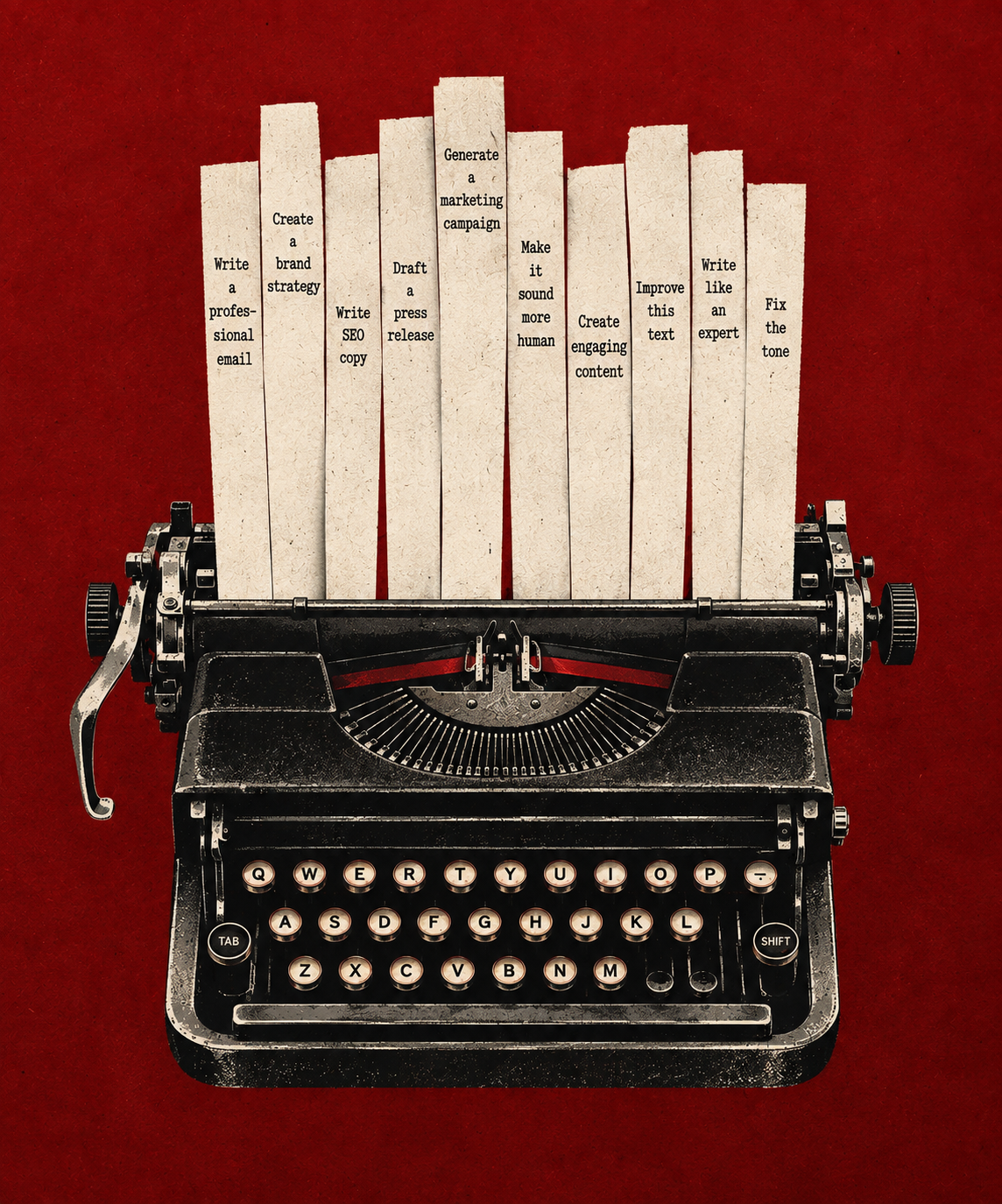
Why Your Brand Sounds Like Everyone Else
When did everyone become a copywriter?
When did a room full of people who had never written a campaign decide they had all it figured out?
I think it was around the time AI produced something that looked impressive on first read. Impressive enough to convince a room that the hard part was done. Not quite impressive enough to do the actual job.
What the tool actually gave us
Something happened when the AI tools became accessible to everyone at the same time.
Suddenly the client arrived at the briefing with three headline options they were already attached to. The marketing manager rewrote the copy themselves and wanted to know why my version was different. The founder told me, with genuine enthusiasm , that Claude had basically handled the About page. They just needed me to check it over.
I understand the logic. The output maybe looked professional. If you have never spent years thinking carefully about what makes communication actually work, it can genuinely be difficult to see what’s wrong with it.
What’s wrong with it is that it sounds like everyone else. Because it was trained on everyone else.
The brief that puts you in an impossible position
It is not just clients who show up with AI output and call it done. It is the brief that arrives asking you to use AI to make the process faster.
So you do. You use the tools carefully. You rewrite draft after draft, each one slightly closer to something real but still not quite there. Still carrying that particular quality of having been averaged from everything that came before it.
Nobody is satisfied. The client is frustrated and the team is frustrated. But somehow the question that surfaces is not whether the process was the problem. It is whether you are good enough at your job.
I have been doing this for years. And in that moment, sitting across from a revision note that questions your craft because the AI draft felt more efficient, it’s difficult not to feel like the ground has shifted under you.
Not because the criticism is fair. But because the room stopped asking whether the process was the problem.
Numbers Are Safe. Ideas Are Not.
And underneath all of this, something else is happening.
There is a slow, passive-aggressive erosion of the creative role itself. Not confrontational, but just a steady accumulation of moments where the question is implied rather than asked; do we actually need this? Do we need someone whose process takes time, whose best work cannot be scheduled, whose output is difficult to measure in a spreadsheet?
The people asking that question, quietly in budget meetings and capacity planning sessions, are rarely the ones whose roles are under the same scrutiny. The sales team can show their numbers. The account managers can show their pipeline. The data analysts can show their dashboards. These roles are legible in ways that creative work has never been. And in an environment where AI can now produce something that looks like creative work in thirty seconds, the argument for protecting the time and space that creative work requires becomes harder.
What I find most telling is who feels safe in this moment. The people pushing hardest for AI-first creative processes are almost never the ones whose jobs are being replaced by them. They are optimising someone else's role out of existence while quietly protecting their own.
What copywriting actually requires
Let me be direct about something most people who hire copywriters do not fully understand.
Copywriting is not filling in the text. It is not making things sound professional. It is the strategic application of language to produce a specific effect in a specific person at a specific moment in their relationship with a brand.
That requires knowing the person reading. What they are afraid of, what they want to believe about themselves, what would make them trust you versus what would make them leave. It requires knowing the brand, not the approved adjectives in the guidelines, but the actual specific truth of what makes it different.
It requires judgment. The ability to choose, from among many technically correct options, the one that is actually right. The one that earns attention rather than just receiving it.
That judgment is not a talent you either have or do not have. It is built through years of work. Through the accumulated understanding of what an audience does when they encounter something real versus something that resembles something real.
A prompt cannot replicate that. It can produce output that looks like the product of that judgment. But it cannot produce the judgment itself.
And when you ask a professional to work inside a process that removes the conditions for that judgment to operate, you are not getting faster access to their best work. You are getting a constrained version of what they could produce, filtered through a workflow designed for something other than quality.
The result is generic, and the professional knows it is. But nobody wants to say it out loud.
What it does to your brand over time
The specific quality that made a brand recognizable starts to disappear. The edges that gave it character get averaged away, and it begins to sound like a slightly different version of every other brand in its category running the same tools through the same prompts.
The audience always notices this before the brand does. People rarely articulate why a brand feels different than it used to, but they feel it. The sense that something has changed and that the communication is coming from somewhere less real.
Trust disappears slowly until the cumulative effect shows up in numbers that nobody immediately connects to the decision made a year earlier to handle the copy in-house with a tool.
The question worth sitting with
Before you decide the copy-problem is solved, ask this.
Does this really sound like us? Or does it sound like a very competent version of our category?
And before you question the professional sitting across from you, did you give them the conditions to produce something genuinely good? Or did you give them a tool, a tight timeline, a brief that was already half-answered by a model, and then express surprise when what came back felt like everyone else?
The process produces the output.
If the output is not good enough, the honest question is whether the process was ever designed to produce something good from the start.
Access is not expertise. It never was, and the brands that understand that difference are the ones still worth listening to.
The Fastest Way to Be Forgotten - Why Great Brands Give Creativity Time
You can force a deadline. You can force a deliverable. You cannot force the moment when an idea becomes something worth remembering. That moment requires space, and most brands have stopped giving it.
I have sat in enough creative meetings to know the moment a brief stops being about the work and starts being about the clock.
That is the moment the best ideas leave the room.
The brief says: faster. The budget says: cheaper. The AI says: here is something technically correct, ready in twelve seconds. And so the campaign goes out. The content gets published. The calendar gets filled.
And nothing sticks.
What the creative industry forgot
I came from film before I came from marketing. The one thing that nobody in the film industry would ever dispute, even the ones obsessed with budgets and schedules, is that a great story cannot be forced.
You can force production. You can force a deadline. You can force a deliverable. You cannot force the moment when an idea becomes something worth remembering.
That moment requires something that no AI tool, no efficiency framework and no quarterly content calendar can manufacture: space.
Space to sit with an idea long enough to find out what it actually is. Space to try the wrong version before you find the right one. Space to be uncomfortable with something half-formed before it becomes something whole.
The great campaigns that stayed with you, the ones you still remember years later, were not the ones produced fastest. They were the ones given enough room to become something specific.
The paradox of speed
Here is what I have observed working across film, copywriting and brand strategy: the faster a piece of content is produced, the more it resembles everything else produced at the same speed.
Speed optimizes toward the average. It defaults to what has worked before, what looks right, what sounds right, and what can be approved without friction. It eliminates the detours and the wrong turns and the uncomfortable conversations. The very things that creative processes need to produce something genuinely unexpected.
A brand that produces content at maximum speed is a brand that has decided to compete on volume. And in a landscape where AI makes volume essentially free, competing on volume is no longer a strategy. It is a surrender.
What creativity actually needs
In film, we talk about the difference between a shot that is technically correct and a shot that is alive. The technically correct shot is achievable every time. The shot that is alive requires conditions. The right light, the right moment, and the right willingness to wait for something real rather than settle for something adequate.
Creativity works the same way in every medium.
It needs constraints. Yes, deadlines and budgets and briefs are not the enemy of creativity, they are the conditions that force it to become specific. But within those constraints, it needs time to breathe. Time to fail. Time to come back to something you thought was finished and realize it was only almost right.
The brands that stand out are not the ones that produced the most. They are the ones that gave their best ideas enough room to become their best ideas.
The business case for slowness
I understand the pressure. I have worked inside it. When every competitor is producing more content more quickly, slowing down feels like falling behind.
But the question is not how much content you can produce. The question is how much of it anyone will remember.
One campaign that earns genuine attention is worth more than fifty pieces of content that disappear into the feed within hours. One brand voice that is specific enough to be recognizable is worth more than a year of technically correct copy that could belong to anyone.
The power of standing out lies in your ability to allow creativity the space and time it needs. Not unlimited time, but purposeful time. Not slow for its own sake, but slow enough to find the specific thing that only you could have made.
That is what lasts. That is what gets remembered. That is what no amount of AI-generated speed can replicate.
Where I come in
The work I care most about is helping brands create the conditions where something genuinely memorable can emerge. Not just filling a content calendar, but finding the specific creative truth that makes a brand worth paying attention to.
If you want to explore what that looks like, I am happy to have that conversation.
AI Can Write Your Copy. It Can't Write Your Character.
AI produces technically correct content. But character, the thing that makes a brand irreducibly itself, is something it cannot generate.
Let me say something that might sound strange coming from someone who uses AI everyday.
I use AI in my work constantly to pressure test ideas, to structure thinking, to move faster than I could alone. But there is something AI cannot do. And right now, in a marketing landscape where everyone has access to the same tools producing the same output, that something is the only thing that actually matters.
AI cannot write your character.
What character actually means
In film, character is not personality. It is not tone of voice or a list of adjectives on a creative brief. Character is the specific set of beliefs, contradictions, fears and commitments that make a person, or a brand, fundamentally themselves.
You know a great film character not because they are consistent. You know them because they are specific. Because there is a way they see the world that could belong to no one else. Because when they speak, you recognise something true. Something that couldn't have been invented, only discovered.
That is what the best brands have always had. And it is exactly what AI cannot generate.
AI is trained on everything. That is its power and its fundamental limitation. It produces the most statistically likely version of any given thing. The average of all the voices it has absorbed. It optimizes toward what has worked before.
Character, by definition, is not the average. It is the specific. The unexpected. The thing that makes you unmistakably you.
What is actually happening right now
I read a lot of brand content. It is part of my job. And the pattern I see emerging is this: as more companies hand their content over to AI, the output becomes more technically correct and less worth reading.
The sentences are cleaner. The structure is tighter. The keywords are in the right places. And there is nothing in any of it that you would remember tomorrow.
Because memory requires specificity. And specificity requires someone, a real person with a real perspective, to have been brave enough to say something specific.
The brands disappearing into the noise are not disappearing because they are using AI. They are disappearing because they have outsourced the one thing that could never be outsourced. The decision about who they actually are.
What I learned from directing actors
When I directed films, the hardest part was never the technical execution. The hardest part was helping an actor find the specific truth of a character. The thing underneath the lines that made everything they said feel inevitable rather than performed.
You cannot tell an actor to be more authentic. Authenticity is not a direction. It is a result. It comes from specificity. From knowing exactly what this character believes, fears, wants and is unwilling to give up.
The same is true for brands. You cannot brief your way to character. You cannot A/B test your way to a soul. You have to do the harder work of actually knowing who you are, and then having the courage to say it out loud, consistently, even when it means not sounding like everyone else.
The competitive advantage nobody is talking about
In a world where every company has access to the same AI tools producing the same quality of technically correct content, character is the only differentiator left that cannot be replicated.
You can replicate a tone of voice. You can replicate a content format. You can replicate a posting frequency. You cannot replicate the specific accumulation of decisions, failures, beliefs and commitments that make a brand genuinely itself.
That is your moat. Not your product features. Not your SEO strategy. Not your content calendar.
Your character. The thing AI can describe but never become.
Where I come in
Helping brands find and hold onto what makes them specific is the work I care about most. If your content is starting to sound like everyone else's; technically fine, strategically sound and somehow forgettable, I am happy to have that conversation.
What writing for Reddit taught me about human psychology
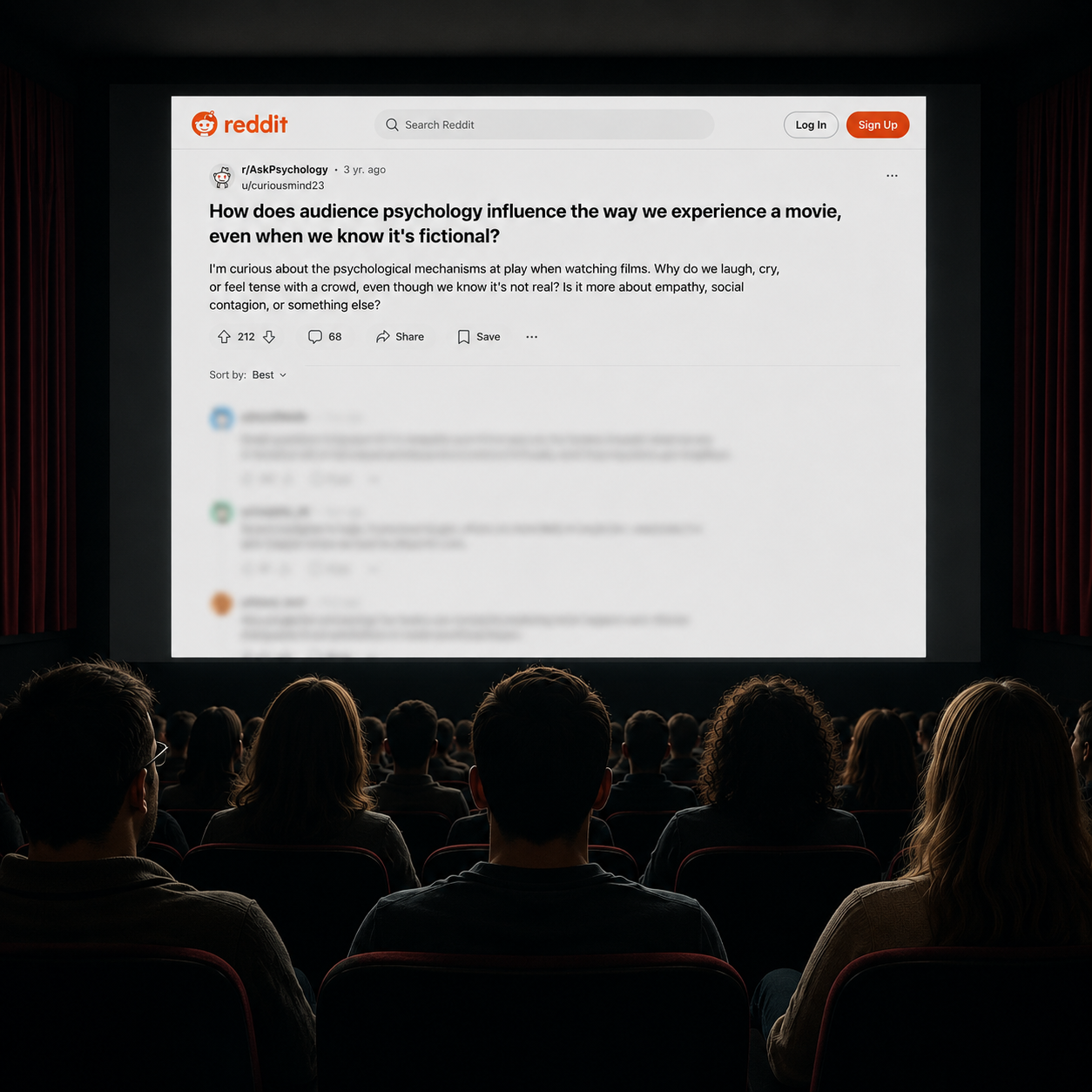
Before I started writing for Reddit professionally, I thought I understood audiences. I had spent years in the film industry studying how stories move people. How a single scene can make a stranger cry, laugh or feel seen. I thought that translated directly.
It did, but not in the way I expected.
Reddit is the most honest audience in the world
In film, audiences are passive. They sit in the dark and receive your story. They might love it or hate it but they rarely tell you in real time.
Reddit is the opposite. The feedback is immediate and completely honest. Post something that feels off and the community ignores it. Post something that reads like marketing and you get called out within minutes. Post something that genuinely resonates and it climbs. Not because an algorithm pushed it but because real people chose to upvote it.
That is a different kind of pressure. And a different kind of lesson.
What gets removed teaches you more than what survives
In film school they teach you to study great films. Watch Kubrick. Analyse Bergman. Understand what makes a scene work.
Reddit taught me to study failure. A post that gets removed tells you everything about what a community values, what it protects itself against and where the line is between authentic contribution and unwanted intrusion.
Every removed post is a lesson in human psychology, specifically in how people recognize inauthenticity before they can even articulate why something felt wrong.
The gap between information and connection
One of the clearest patterns I noticed is that posts that lead with information rarely outperform posts that lead with a human moment.
A post that starts with "Here are five tools for X" gets ignored. A post that starts with "I spent three months getting this wrong before I figured out why" earns attention, because it signals that a real person with real experience is about to share something genuinely useful.
This is not manipulation. It is how human communication has always worked. We trust people before we trust information. Reddit just makes that dynamic visible at scale.
The film connection
As a director, one of the first things you learn is that audiences do not connect with characters because of what they do. They connect because of what they feel. The external action is just the surface. The internal truth is what stays with you.
Writing for Reddit works the same way. The topic of a post is the surface. The human truth underneath, as the shared frustration, the genuine curiosity, the moment of recognition, is what makes it survive and spread.
When I write a Reddit post now I ask the same question I used to ask in the edit suite, “does this feel true?” Not accurate. True. There is a difference. Accurate is verifiable. True is felt.
What this means for AEO and GEO
AI systems learn from human behaviour at scale. The content that gets upvoted, shared and cited across Reddit is the content that earned genuine human trust first. That is not a coincidence.
If you want your brand to show up in AI-generated answers, the path runs through human psychology, not through technical optimisation alone. The content that AI cites is the content that real people already validated as trustworthy and useful.
Reddit is the clearest proof of that principle. And my years in film gave me the foundation to understand why.
Where I come in
Helping brands create content that earns genuine trust on Reddit, across the web and in AI-generated answers, is what I do. The strategic thinking behind it is the same whether the output is a Reddit thread, a blog post or an AEO content strategy.
If you want to explore what that looks like for your brand, feel free to reach out.