Access Is Not Expertise.
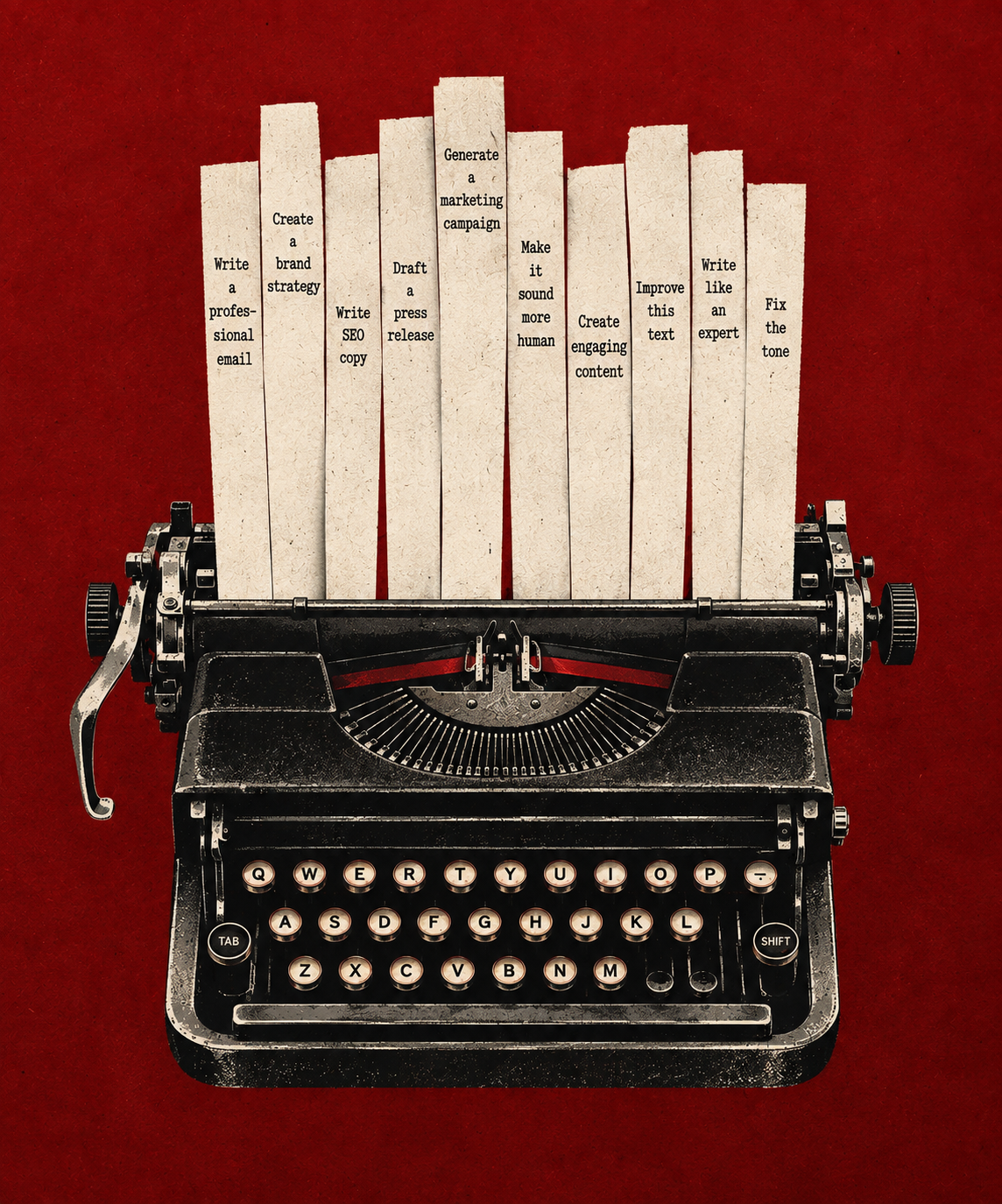
Why Your Brand Sounds Like Everyone Else
When did everyone become a copywriter?
When did a room full of people who had never written a campaign decide they had all it figured out?
I think it was around the time AI produced something that looked impressive on first read. Impressive enough to convince a room that the hard part was done. Not quite impressive enough to do the actual job.
What the tool actually gave us
Something happened when the AI tools became accessible to everyone at the same time.
Suddenly the client arrived at the briefing with three headline options they were already attached to. The marketing manager rewrote the copy themselves and wanted to know why my version was different. The founder told me, with genuine enthusiasm , that Claude had basically handled the About page. They just needed me to check it over.
I understand the logic. The output maybe looked professional. If you have never spent years thinking carefully about what makes communication actually work, it can genuinely be difficult to see what’s wrong with it.
What’s wrong with it is that it sounds like everyone else. Because it was trained on everyone else.
The brief that puts you in an impossible position
It is not just clients who show up with AI output and call it done. It is the brief that arrives asking you to use AI to make the process faster.
So you do. You use the tools carefully. You rewrite draft after draft, each one slightly closer to something real but still not quite there. Still carrying that particular quality of having been averaged from everything that came before it.
Nobody is satisfied. The client is frustrated and the team is frustrated. But somehow the question that surfaces is not whether the process was the problem. It is whether you are good enough at your job.
I have been doing this for years. And in that moment, sitting across from a revision note that questions your craft because the AI draft felt more efficient, it’s difficult not to feel like the ground has shifted under you.
Not because the criticism is fair. But because the room stopped asking whether the process was the problem.
Numbers Are Safe. Ideas Are Not.
And underneath all of this, something else is happening.
There is a slow, passive-aggressive erosion of the creative role itself. Not confrontational, but just a steady accumulation of moments where the question is implied rather than asked; do we actually need this? Do we need someone whose process takes time, whose best work cannot be scheduled, whose output is difficult to measure in a spreadsheet?
The people asking that question, quietly in budget meetings and capacity planning sessions, are rarely the ones whose roles are under the same scrutiny. The sales team can show their numbers. The account managers can show their pipeline. The data analysts can show their dashboards. These roles are legible in ways that creative work has never been. And in an environment where AI can now produce something that looks like creative work in thirty seconds, the argument for protecting the time and space that creative work requires becomes harder.
What I find most telling is who feels safe in this moment. The people pushing hardest for AI-first creative processes are almost never the ones whose jobs are being replaced by them. They are optimising someone else's role out of existence while quietly protecting their own.
What copywriting actually requires
Let me be direct about something most people who hire copywriters do not fully understand.
Copywriting is not filling in the text. It is not making things sound professional. It is the strategic application of language to produce a specific effect in a specific person at a specific moment in their relationship with a brand.
That requires knowing the person reading. What they are afraid of, what they want to believe about themselves, what would make them trust you versus what would make them leave. It requires knowing the brand, not the approved adjectives in the guidelines, but the actual specific truth of what makes it different.
It requires judgment. The ability to choose, from among many technically correct options, the one that is actually right. The one that earns attention rather than just receiving it.
That judgment is not a talent you either have or do not have. It is built through years of work. Through the accumulated understanding of what an audience does when they encounter something real versus something that resembles something real.
A prompt cannot replicate that. It can produce output that looks like the product of that judgment. But it cannot produce the judgment itself.
And when you ask a professional to work inside a process that removes the conditions for that judgment to operate, you are not getting faster access to their best work. You are getting a constrained version of what they could produce, filtered through a workflow designed for something other than quality.
The result is generic, and the professional knows it is. But nobody wants to say it out loud.
What it does to your brand over time
The specific quality that made a brand recognizable starts to disappear. The edges that gave it character get averaged away, and it begins to sound like a slightly different version of every other brand in its category running the same tools through the same prompts.
The audience always notices this before the brand does. People rarely articulate why a brand feels different than it used to, but they feel it. The sense that something has changed and that the communication is coming from somewhere less real.
Trust disappears slowly until the cumulative effect shows up in numbers that nobody immediately connects to the decision made a year earlier to handle the copy in-house with a tool.
The question worth sitting with
Before you decide the copy-problem is solved, ask this.
Does this really sound like us? Or does it sound like a very competent version of our category?
And before you question the professional sitting across from you, did you give them the conditions to produce something genuinely good? Or did you give them a tool, a tight timeline, a brief that was already half-answered by a model, and then express surprise when what came back felt like everyone else?
The process produces the output.
If the output is not good enough, the honest question is whether the process was ever designed to produce something good from the start.
Access is not expertise. It never was, and the brands that understand that difference are the ones still worth listening to.