The Quiet Rise of Digital Dementia
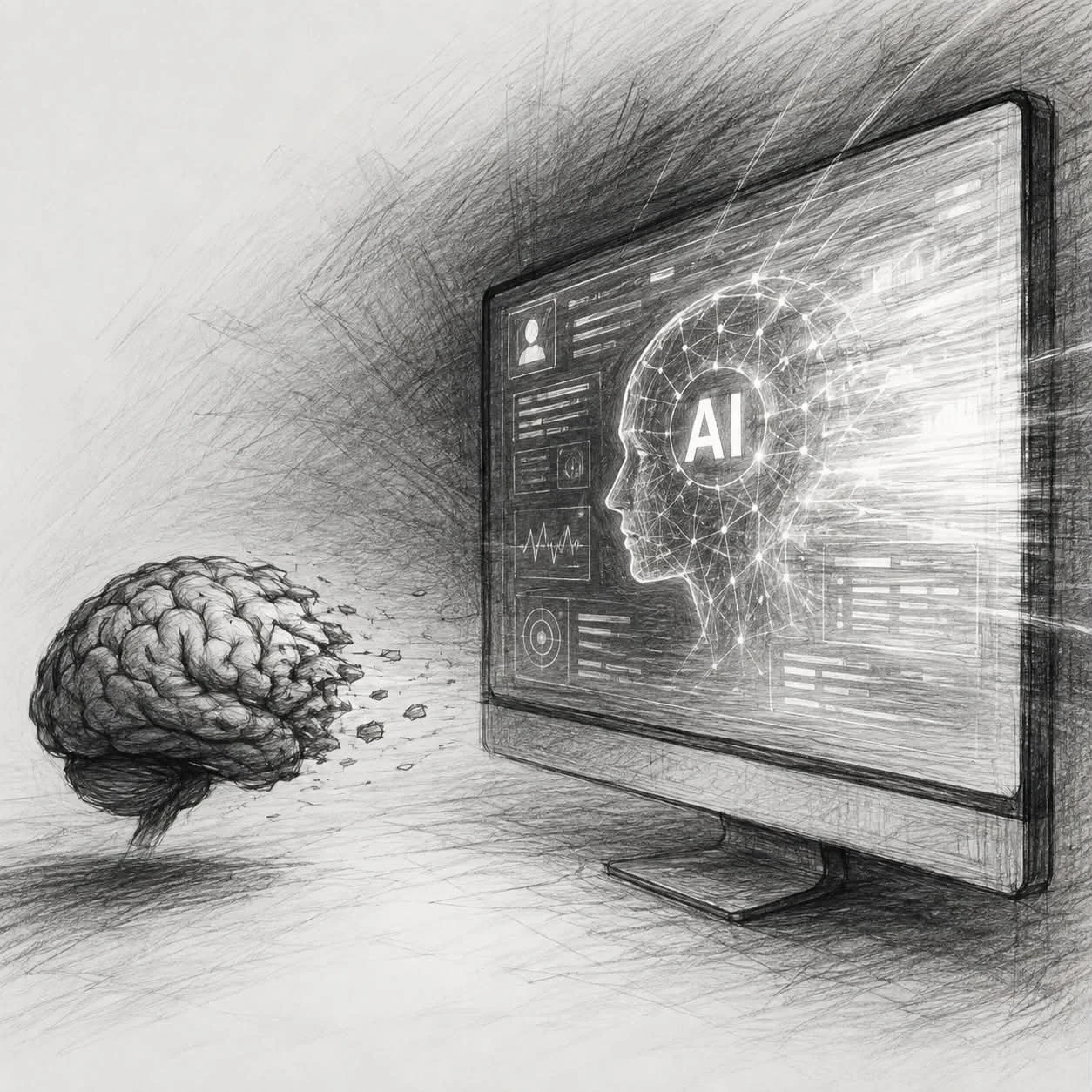
Something is quietly happening to our generation.
Not as a future risk. As a present reality, showing up in clinical data, in the lived experience of people in their thirties and forties. In the quiet creeping sense that something is different about how we think, remember and create, and that it has been getting worse for years.
Early-onset dementia is rising among millennials at a rate that should be front-page news every day.
The numbers nobody wants to say out loud
According to a 2020 report by the Blue Cross Blue Shield Association, diagnoses of early-onset dementia and Alzheimer's disease increased by 373% among Americans aged 30 to 44 between 2013 and 2017. Not 37%. Not 73%. Three hundred and seventy-three percent. The average age of a person living with either condition in that dataset was 49.
These are not elderly people. These are people in the middle of their working lives, their parenting years, the decades that were supposed to be defined by productivity, creativity and presence.
The cause is pointing to the relationship between how we spend our mental time and what happens to our brains over the long term. And what it is pointing to is the screen.
What passive screen time actually does
A study published in the American Journal of Preventive Medicine followed more than 20,000 adults in Sweden over nearly two decades, examining how different types of sedentary behaviour were associated with dementia risk. The researchers made a crucial distinction between mentally passive and mentally active sedentary behaviours.
Mentally passive activities, like watching television, scrolling through social media, consuming content that requires no response or engagement, were associated with significantly higher dementia risk. Mentally active sedentary activities, like reading, puzzles, creative work, engaged conversation, were associated with lower risk.
Replacing just one hour of passive screen time with one hour of mentally active behaviour was associated with a 7% reduction in dementia risk. Combining mental engagement with physical activity showed an 11% reduction.
The brain, it turns out, is not passive tissue that simply exists. It is an organ that requires use to maintain itself. Cognitive engagement helps maintain neural connections and supports what researchers call cognitive reserve. The brain's ability to adapt and compensate for changes over time. When we spend long periods in activities that require very little mental effort, those pathways are not stimulated. Over months and years, that lack of engagement contributes to decline.
This is not a metaphor. It is biology.
The AI problem
And then there is the new layer that is perhaps most concerning.
A growing body of research is finding that overreliance on AI tools may be doing to our thinking what GPS did to our spatial memory and search engines did to our recall. Making us worse at the very things we outsource.
Adam Green, a professor of neuroscience at Georgetown University, puts it plainly: if you are not doing the actual thinking, your capability to do that kind of thinking is going to atrophy. He describes it this way; it is like being at a gym where a robot lifts the barbell for you. You get nothing.
A Microsoft Research study found that heavier AI users scored significantly worse on critical thinking tests. Researchers at the University of Pennsylvania identified a phenomenon they call cognitive surrender. People trusting AI over their own judgment even when the AI is demonstrably wrong. A BBC analysis of emerging research found consistent concerns around creativity, attention span, memory and the loss of what one researcher called cognitive friction - the productive struggle that keeps thinking sharp.
We are, as a generation, doing something that has never been done before. We are outsourcing not just tasks but thought itself. And we are doing it in the same years that early-onset dementia diagnoses are rising at rates that should terrify us.
The connection has not been proven. But the direction of the evidence is consistent. And the question of whether we are willing to take it seriously before the data is conclusive feels urgent in a way I find difficult to dismiss.
Doomscrolling as a health crisis
I want to name the specific behaviour that I think sits at the centre of this.
Doomscrolling. The compulsive, passive consumption of content on social media platforms, often late at night, often about things that cause anxiety, often for far longer than intended. It is a behaviour specifically engineered by some of the most sophisticated attention-capture systems ever built, deployed at scale on people who were never told what it was designed to do to them.
Every platform is optimised for one thing: keeping you looking. Not engaging. Not thinking. Not creating. Looking. Passively consuming an infinite feed of content calibrated to your most reactive emotional states — outrage, envy, anxiety, desire — at a pace that makes sustained attention impossible and genuine thought unnecessary.
This is the definition of mentally passive sedentary behaviour. This is exactly what the research links to elevated dementia risk. And it is what millions of people in their thirties and forties are doing for hours every day, on top of already passive working hours in front of screens that do more of our thinking for us each year.
I am not exempt from this. I notice it in myself, the reach for the phone in moments of stillness, the inability to sit with boredom that I did not have ten years ago. The way a long piece of writing now requires more effort to sustain than it used to. These are not character flaws. They are the predictable results of years of exposure to environments designed to make sustained attention unnecessary.
What this is doing to creative work
As a filmmaker and writer, this is where it becomes personal.
Creativity is not a talent you either have or do not have. It is a capacity that requires cultivation, and specifically requires the kind of mental conditions that passive screen time and AI dependence systematically erode.
Original ideas do not arrive efficiently. They arrive through the slow, often uncomfortable process of sitting with a problem long enough for unexpected connections to form. They require boredom (real boredom), the kind that makes you restless enough to start making something. They require memory, the accumulated store of images, experiences, emotions, half-formed thoughts that the brain draws on when it is making something new.
Doomscrolling replaces boredom with stimulation. AI replaces memory with retrieval. The result is a mind that is busy and empty at the same time. Always consuming, rarely generating, increasingly unable to sustain the quality of attention that genuine creative work demands.
I see this in the work that is being produced. Not just in what AI generates directly, but in what human creators are producing in an environment of constant distraction and outsourced thinking. The ideas are faster. They are also shallower. The references are more current. The depth is diminishing.
This is not about being old-fashioned or resistant to technology. It is being honest about what certain ways of using technology are doing to the cognitive conditions that creative work requires.
What I am choosing to do about it
I do not have a perfect answer. I am not writing this from a position of having solved the problem in my own life.
But I am making deliberate choices.
I read physical books. Not because digital reading is inferior but because the absence of notifications, the inability to switch tabs, the sustained engagement with a single long-form argument is something my brain needs practice at. I use AI as a thinking partner rather than a thinking replacement. I try to have a view before I ask for one, to use the tool to challenge my perspective rather than to generate it. I try to protect boredom. Genuinely try to not fill every moment of stillness with content.
And I take the research seriously. Because the direction of the evidence is consistent, the stakes are high, and the cost of being wrong is one I am not willing to pay.
Our generation has been handed an extraordinary set of tools. We have also been handed an extraordinary set of risks that nobody adequately warned us about. The rise in early-onset dementia diagnoses is not inevitable. But it is also not going to reverse itself without deliberate action, individual and collective, against the conditions producing it.
The screen will not take care of your brain. That is still your job.
Sources:
Blue Cross Blue Shield Association - Early-Onset Dementia and Alzheimer's Rates Grow for Younger Americans (2020)
American Journal of Preventive Medicine - Sedentary behaviour and dementia risk study, Sweden (2026)
BBC Future - Think outside the bots: How to stop AI from turning your brain to mush (2026)
Healthline - Can Excessive Screen Time Cause Digital Dementia? (2024)
Microsoft Research - The Impact of Generative AI on Critical Thinking (cited in BBC Future, 2026)
Georgetown University - Adam Green, Laboratory for Relational Cognition (cited in BBC Future, 2026)