How to Write Website Copy That Converts
Most people write for the web the same way they write for print. That’s a mistake, and it’s one of the most common web copywriting errors I see.
I learned this the hard way. Coming from screenwriting, I was trained to think in sequences. That works brilliantly on screen, but on a webpage? People are gone before your setup lands.
Writing for the web is a different discipline. Here’s what I’ve come to rely on.
Start with context
Web copywriting starts with orientation, not information. Readers arrive at your page from somewhere, such as Google search, a social share, or a newsletter link. They don’t know where they are yet, and they’re deciding in milliseconds whether to stay.
That means your first job isn’t to inform. It’s to orient. Give them a clear signal that they’re in the right place, for the right thing, at the right time. Structure your page so the most important message appears first, not buried three paragraphs down after your company history.
Think of it like a film opening. You establish the world before you introduce the conflict.
Write short. Then cut it in half.
On screen, people don’t read — they scan. Long paragraphs feel like walls. Even if the content is genuinely good, dense formatting signals “this will take effort,” and effort is the enemy of engagement.
Keep sentences short. Break up paragraphs after two or three lines. If you can say it in ten words instead of twenty, say it in ten. Every unnecessary word is a small tax on the reader’s attention, and attention is the scarcest resource you’re working with.
This doesn’t mean dumbing things down. It means respecting your reader’s time.
Make your headings do real work
Headings aren’t decoration. They’re navigation.
A reader scanning your page is asking “Is this worth my time?”. Your headings answer that question. If they’re vague (“Our Approach,” “Learn More,” “Why Us”) you’ve given them nothing to hold onto. If they’re specific and informative (“Three reasons your homepage copy isn’t converting”), the reader knows exactly what they’re getting before they commit to reading.
Write headings that make sense out of context. Because for a scanner, they often are the context.
Use bullet points strategically
Bullet lists are useful when you have genuinely parallel items: a checklist, a list of features, a set of options. They make comparison easy and reduce cognitive load.
But bullets can also fragment content that should flow as prose. If you’re using bullet points because you can’t figure out how to connect your ideas, that’s a writing problem and not a formatting solution.
Use them when they earn their place. Not as a default.
Visual readability is a writing problem, not just a design problem
How a page looks affects how the text is received. That’s a writer’s concern, not just a designer’s.
Line length matters. Paragraphs that stretch the full width of a screen are exhausting to read. White space isn’t wasted space, as it gives the eye somewhere to rest. Images, when relevant, give the reader a mental anchor between blocks of text.
When I write website copy for a client, I think about how the text will sit on the page, not just what it says. Word count, paragraph length, and section breaks are all tools.
Write for everyone
Accessible web copywriting isn’t a niche consideration. It’s good writing.
Use plain language. Avoid jargon unless your audience genuinely uses it. Don’t rely on color or layout alone to convey meaning. Write link text that makes sense on its own. “Click here” tells the reader nothing, “Read the full case study” tells them exactly where they’re going.
Small detail. Real difference.
Social media is its own dialect
Web writing principles carry over to social, but the context shifts. On social, you’re competing with everything else in someone’s feed. The first line has to earn the next one.
I write social copy the same way I write headlines: what’s the one thing I want this person to take away? Everything else is support.
The 7 web copywriting principles I come back to
If someone asked me to summarize everything above into a checklist, it would look like this:
Orient before you inform — context comes first
Write short sentences and short paragraphs
Use headings that work out of context
Use bullet points only when items are genuinely parallel
Think about how the text sits on the page, not just what it says
Write link text that describes the destination
On social, the first line has to earn the second
The bottom line
Good web copywriting rewards clarity, structure, and a ruthless willingness to edit. It punishes assumptions about how much time or patience your reader has.
Get the structure right first. Then cut. Then make it scannable. Then read it out loud. If it sounds natural, it probably reads naturally too.
That’s the system I keep coming back to.
Every great brand has a story worth telling.
Screenwriting teaches you something most copywriters never learn: the most important thing in any scene is almost never what's being said. The same is true for great copy.
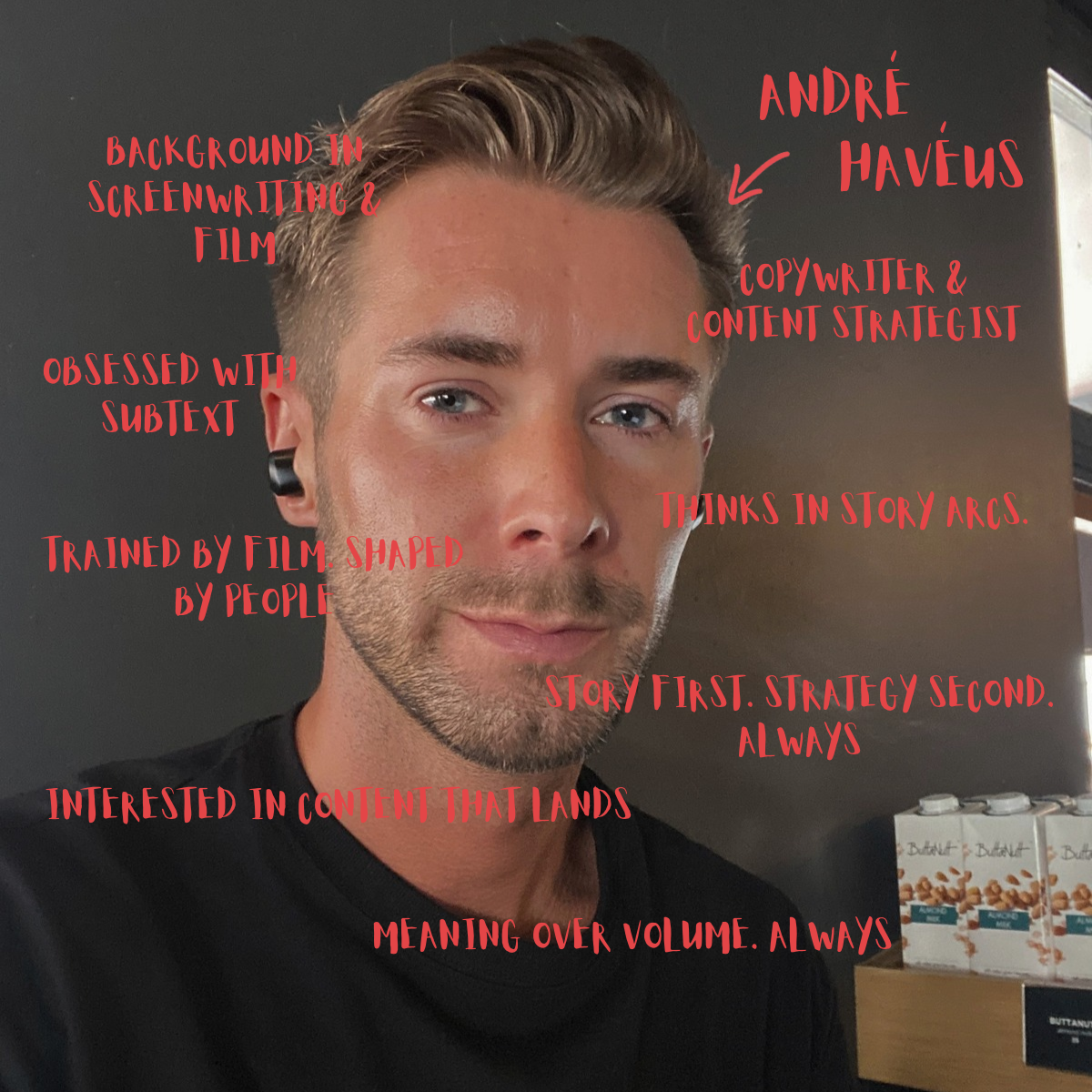
I became a copywriter because I was already a filmmaker. A screenwriter. Someone who spent years obsessing over the gap between what people say and what they actually mean. Over the small gestures that reveal character. Over why some stories stay with you for decades, and others dissolve before you’ve even closed the tab.
That’s a discipline, and it shapes every single word I write.
Trained by film. Shaped by people.
Screenwriting teaches you something most copywriters never learn: the most important thing in any scene is almost never what’s being said.
A character says “I’m fine.” What they mean is: I am holding myself together and I need you to see that without making me say it out loud.
That’s subtext. And I am obsessed with it.
Because good copy works exactly the same way. The best campaigns don’t tell you what to think. They create a moment of recognition with the reader. That recognition is what builds loyalty. Not a clever headline. Not a conversion-optimized CTA. A moment where a real person felt genuinely seen.
You can’t generate that. It requires someone who has been paying close attention to people for a very long time.
That’s what I bring to the table.
Thinks in story arcs. Writes in search-optimized prose.
Most copywriters start with the keyword. I start with the character. Who is this person, what do they actually want, and what are they really afraid of?
From there, structure follows naturally. The hook. The tension. The turn. The resolution. It’s not a framework I learned in a marketing course. It’s what happens when you’ve spent years writing scripts where every scene has to earn its place or it gets cut.
That discipline is rare in content right now. And it’s becoming more valuable by the day.
Because when execution is cheap the question of what those words should mean, and to whom, and why, becomes the only question that matters.
Story first. Strategy second. Always.
Interested in content that lands.
Scroll through any feed right now. The same minimalism that isn’t minimal, it’s just empty. Content that performs the idea of having something to say without ever quite getting there.
And then, occasionally, something cuts through. A piece of writing that makes you send it to someone with no comment except read this. A brand that makes you feel like the people behind it are actually alive and real.
Those moments are becoming rarer. And they are becoming more valuable.
Meaning over volume. Always.
The agencies and clients who still believe in this are out there.
I know you exist. You’re the ones who still lose sleep over whether a campaign means something.
You are going to win. Not because creativity is some romantic ideal worth protecting, but because humans are hardwired to respond to story, to honesty, to the feeling that the thing they’re reading was made by someone who actually cared.
The printing press didn’t end writing. Photography didn’t end painting. And AI won’t end the one thing it cannot replicate: a perspective that comes from a life genuinely lived and paid attention to.
Don’t buy the panic. Read a book. Watch a film. Spend time with people you love.
The future is bright, but only if we let it be.
Stop posting AI banners. It's not a flex. It's a red flag.
When a business posts an AI-generated banner, customers don't think "efficient." They think "they didn't care enough to try." Here's why that choice costs you more than you think.
When I see a business post a social media banner that was clearly generated by AI I don't think efficient. I don't think innovative.
I think that they didn't care enough to try.
And if they didn't care enough to try with their own image, the thing they chose to represent themselves publicly, what does that tell me about how much they'll care about the actual product or service?
Nobody Cares What You Used. They Care What It Says About You.
There's a difference between using a tool intelligently and using it as a substitute for giving a damn.
An AI banner says three things simultaneously:
We don't think our visual identity is worth investing in. You couldn't spend two hours with a designer, or even find a decent template and customize it. You generated something in 40 seconds and called it done.
We assume our customers won't notice (meaning: we don't care if they do). This is the part that really gets me. It's not even cynicism. It's indifference. And customers feel indifference. They may not be able to name it, but they feel it.
We have no backbone. You chose to represent your brand with something that has no perspective, no voice, no trace of an actual human decision. A placeholder dressed up as an identity.
Your customers are not stupid.
The comments sections on posts like this are consistent. People notice. They're turned off. They're simply scrolling past and never coming back.
If a company can't be bothered to create real content, why should we be bothered to become a real customer?
That's the direction the whole market is moving. As AI-generated content floods every platform, authenticity (actual human intention behind a visual) is becoming a premium signal. A trust marker. The brands that understand this are already pulling ahead.
The irony is that it costs you more than it saves you.
You saved what? A few thousands kronor on a graphic? And in exchange you communicated to every person who saw it that your brand is lazy, cheap, and doesn't believe in itself.
That's not efficiency. That's a slow leak in your credibility.
If you genuinely can't afford a designer right now, there are tools that let a non-designer make something that looks considered and intentional. Use a template and make it your own. Show up with something that has a pulse. Put in the effort.
But please, stop mistaking automation for strategy. Stop confusing fast with good. And stop insulting your potential customers by assuming they won't tell the difference.
They can. They do. And they remember.
Why Your Click-Through Rate Collapsed in 2026
Your clicks didn't disappear. AI search took them, a global recession changed your buyer, and most agencies are still looking at the wrong dashboard. Here's what's actually happening in 2026 — and what it actually requires.
It's become a recurring conversation in 2026. A client calls their digital marketing agency. Conversion rates are down. Click-through rates have collapsed. Traffic looks like an ECG on a patient just taken off life support. The question is always the same: What's happening?
What's actually happening is three things at once. And you can't fix them with more blog posts, a new ad budget, or an A/B test on button colour.
AI Has Stolen the Front Page of the Internet
In September 2026, internal documents from Microsoft's lawsuit with The New York Times revealed something the industry already knew but had never seen in black and white: when users search via Copilot instead of regular Bing, clicks to external websites drop by up to 93 percent. A Microsoft researcher called it a "doom loop" for the web. An OpenAI engineer put it even more plainly back in 2023: "No matter how prominently we show the links, users won't click."
Google AI Overviews answers directly. Perplexity cites one source and never sends traffic onward. ChatGPT closes the question.
According to HubSpot's State of Marketing 2026, 92% of marketers are now using, or planning to use, optimisation for AI search engines. This is no longer a niche strategy. It's the baseline requirement. And yet most agencies are still counting organic sessions as if it were 2019.
The new metric isn't the click. It's the citation. The brand mentioned in the AI answer wins visibility, credibility and recognition, without generating a single session in Google Analytics. Marketers who understand this now track how often their brand appears inside AI-generated answers. Those who don't are still optimising for a world that no longer exists.
The Middle Class Has Essentially Disappeared as a Buyer
A global recession is underway. Disposable income has shrunk dramatically. People who used to click, compare prices and add products to digital shopping carts are now running a completely different calculation every morning: bills, food, rent. What used to be an obvious purchase is now an active decision not to buy.
The middle class, the group that for decades drove consumption of everything from subscription services and home furnishings to fitness equipment and digital tools, is in a financial position it never anticipated. Savings are gone. Margins are gone. And with them: the impulse purchases, the loyalty programmes, and the digital consumption that entire business models were built on.
Clients calling their agencies and asking about conversion drops are forgetting to ask the more fundamental question: Can my customer actually afford this right now?
It's not the campaign's fault. It's not the copywriter's fault. It's not even the algorithm. It's that the economic reality of your target audience looks fundamentally different in 2026 than it did in 2021.
The Agencies Don't Have the Answer
On Reddit, a Head of Marketing at a B2B company put it better than most analyst reports: "2026 feels like a completely different year. Not a weak quarter. Not one underperforming channel. Fundamental changes across the entire funnel."
What he's describing isn't an anomaly. It's the new normal.
And in the comment threads under that post, and hundreds like it, a pattern emerges: agencies that added a slide about "Generative Engine Optimization" to their sales deck and then kept doing exactly what they were doing in 2022. More blog posts. More backlinks. More AI-generated content they hope will rank — in a world where AI engines actively prioritise human voices, Reddit threads, third-party reviews and established brand authority over machine-produced articles.
One commenter put it plainly: "If an agency claims they can game Perplexity the same way they gamed Google in 2018, they're selling snake oil with a new buzzword on the invoice."
The Expertise AI Can't Replicate
In the middle of all this chaos, demand for one specific skill set is growing.
People who understand what communication is actually supposed to do.
AI cannot understand what a human needs to hear in 2026, when the economy is tough, the future feels uncertain, and trust in brands is at a historic low.
A copywriter with genuine expertise does three things no prompt can replicate. They understand the intent behind the search query, they write for passage indexing and AI citation with precision, and they choose the one that actually lands with a real person in a real situation.
What This Requires From You as a Brand
The clicks are not coming back the way they were. That's not a forecast. It's a statement of fact.
The new metrics are citation, trust and relevance at the right moment. It requires content specific and well-structured enough for AI systems to choose to cite it. It requires presence beyond your website: on Reddit, in industry publications, in third-party reviews, because that's where AI engines actually look when building their answers.
And it requires a copywriter who understands all of this. Not a prompt operator. A strategist who uses language as a tool.
That's a rare combination of skills. And it isn't cheap. But it's cheaper than continuing to pay for dashboards measuring a reality that stopped existing two years ago.
Keywords Are Dead. Structure Is Everything.
Keywords aren't dead. Keyword density is. There's a difference. And most brands are optimising for the wrong one.
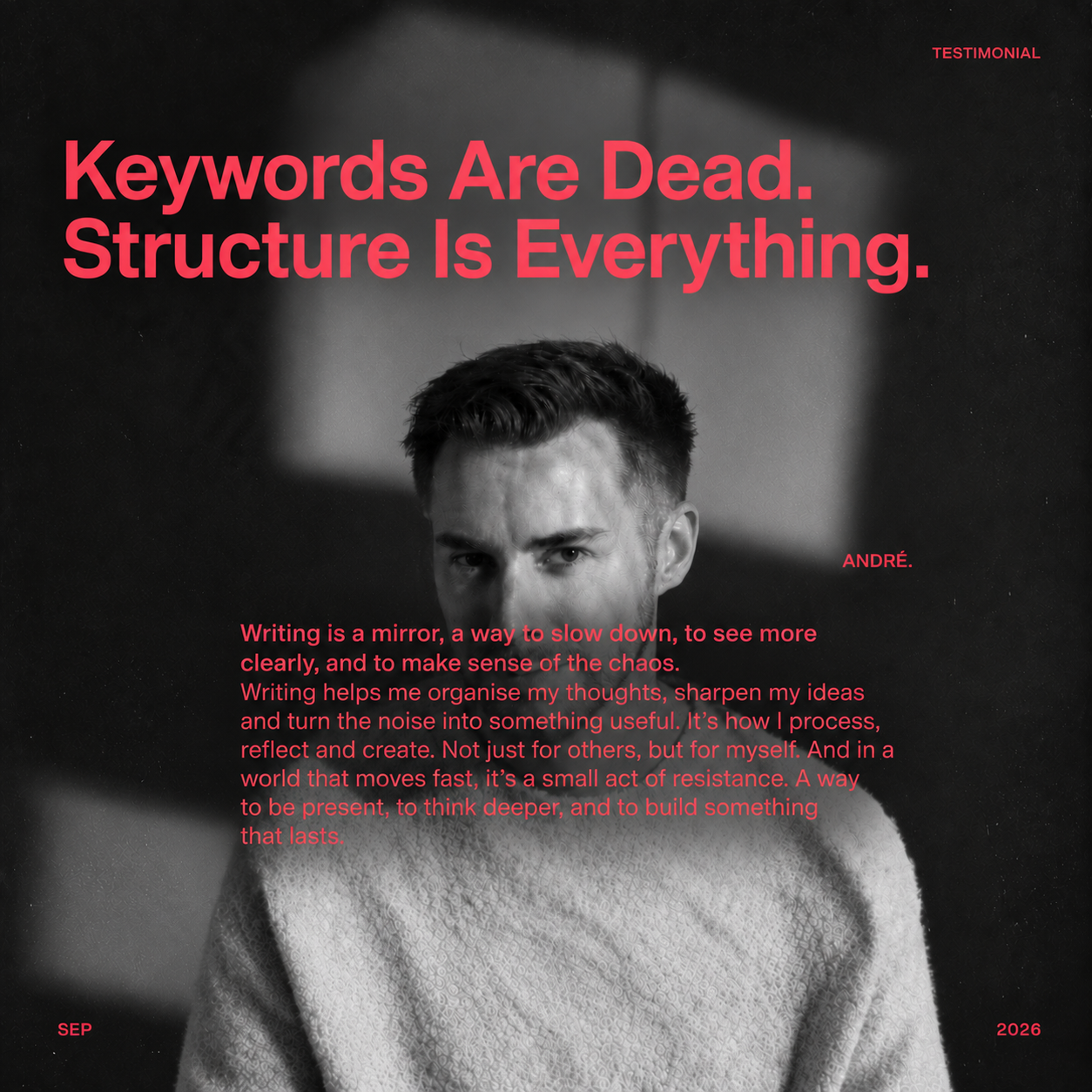
Keywords aren't dead. Keyword density is.
There's a difference.
Most brands are still writing for 2019. Briefing writers with a keyword and a word count. Measuring success by how many times a phrase appears on the page. Treating SEO copywriting as the practice of inserting terms into otherwise normal text at a frequency someone once decided was optimal.
The discipline has moved on. Most of the people executing it have not.
I have spent the last three years working at the intersection of SEO copywriting, AEO and GEO, helping brands build content that ranks on Google and gets cited by AI systems like ChatGPT, Perplexity and Google AI Overview. What I see across clients and industries is a consistent gap between what SEO copywriting actually requires in 2026 and what most teams think it requires.
Here’s what that gap actually costs.
What SEO copywriting actually is in 2026
SEO copywriting in 2026 means writing for search intent, passage indexing and AI citation. Not keyword density.
That sounds simple. It’s not, because it requires understanding three distinct jobs that good SEO copy has to do simultaneously.
The first job is to signal intent match. The opening paragraph, H1 and H2 structure collectively tell search engines what question the page is answering. If the dominant format for a given search query is comprehensive guides and you publish a service page, you have an intent mismatch that no amount of writing quality will overcome.
The second job is to format for passage indexing. Since December 2020, Google has been capable of ranking individual passages from a page independently of the page's overall authority. The practical implication: every H2 section on a page is a separate ranking opportunity if written correctly. Each section needs to open with a direct answer in the first two sentences. Not context, not backstory, not a point being built toward.
The third job is human persuasion, the actual craft of copywriting. Short sentences, active voice, concrete examples, a voice that earns trust. This still matters enormously.
Where most SEO briefs fall apart
Most briefs specify a keyword, a word count and nothing else. They do not define search intent. They do not specify how H2 sections should be structured. They do not ask the writer to lead each section with a direct answer rather than context.
The result is content that is well-written and structurally invisible. It answers the question eventually. Search engines and AI systems need the answer in the first two sentences of each section, not eventually.
A page can be well-written and still fail to rank if the intent match is wrong, the H2 structure buries answers rather than leading with them, the opening paragraph lacks a citable claim, or the entity coverage is thin with no specific data, sources or named concepts.
This is the failure mode I see most often. Not bad writing. Bad structure. And structure is determined by the brief.
What keyword density actually is
A 2025 Ahrefs study of top-ranking pages found that 83% of pages ranking in positions 1–3 had their primary keyword in the first 100 words. But keyword density showed no meaningful correlation with rank beyond that.
That is the distinction most teams miss.
Keyword placement matters - in the first 100 words, in the H1, in at least one H2. Keyword repetition beyond those structural placements adds no ranking value and often produces unreadable copy.
The keyword is a structural signal, not a frequency target. Once you understand that, the entire discipline reframes itself.
What zero-click means for your content strategy
Zero-click searches now make up 65% of all Google queries. AI Overviews answer questions at the top of the page before anyone clicks through.
This is the shift that most brands have not yet metabolized.
Traffic is no longer the only metric that matters. When someone asks Google a question and gets an AI Overview answer at the top of the page, the brand that is cited in that answer has won visibility, credibility and association with the answer, without generating a single session in Google Analytics.
Most marketing teams are still optimizing for traffic. The brands that are winning in 2026 are optimizing to be the source that AI cites.
That requires a different kind of writing. To write for AI citation, three elements are required: specificity in claims, source attribution and entity clarity. Named tools, frameworks, algorithms and specific data points anchor a passage in a defined conceptual context.
"SEO copywriting is important" is not citable. "SEO copywriting structures content around three sequential jobs - intent signalling, passage formatting and human persuasion - in that order" is citable because it makes a concrete claim about a mechanism.
Most brand content makes assertions. Citable content makes claims.
The third layer most brands are ignoring
SEO now overlaps with PR and brand building, content design and UX, data journalism, community-driven authority through Reddit and third-party publications, and LLM optimization. It is no longer just keyword research and on-page optimization.
Reddit threads, industry publications, third-party reviews, LinkedIn thought leadership - these are all signals that AI systems use to build their understanding of a brand. A company with excellent on-site SEO copy but no third-party presence is invisible to the part of the search ecosystem that is growing fastest.
This is what GEO, Generative Engine Optimization, addresses. Where AEO optimizes your own content to be citable, GEO manages how your brand appears across the entire web, everywhere AI systems look when building their answers.
Most brands have not started this work yet. The ones that have are building an advantage that will be very difficult to replicate once the space gets crowded.
What I recommend
Fix your opening sentences first. Improving 10–15 existing openers on priority pages generates more measurable ranking movement than publishing 10 new posts. The first sentence of every page and every H2 section should directly answer the implied question. Always lead with the answer.
Write briefs before you write content. The structure of a piece of content is determined before writing begins, not in revision. Define the search intent, map the H2 structure, specify how each section should open. A brief that does this produces rankable content. A brief that specifies only a keyword and word count produces well-written content that does not rank.
Build presence beyond your website. If you are not in Reddit discussions, industry publications, review platforms and third-party citations, you are invisible to the fastest-growing part of the search ecosystem.
Treat AI citation as a distinct goal. Your most important pages, the ones that answer the questions your ideal customers are asking, should be written with the structural specificity that AI systems extract and attribute.
Stop measuring content by traffic alone. If an AI Overview cites your brand in the answer to a high-intent query, that is a win that does not show up in your analytics.
The honest state of the discipline
SEO copywriting is not dying. It is restructuring around a set of requirements that most practitioners have not yet internalised.
The brands and writers who understand that shift, who can write content that ranks, gets cited by AI and earns human trust simultaneously, are not common. There are not many people who have built that combination of skills.
Keywords aren't dead. Keyword density is.
Structure is everything. And most briefs still do not mention it.
Access Is Not Expertise.
When did everyone become a copywriter? Around the time AI produced something that looked impressive on first read. Access is not expertise. It never was.
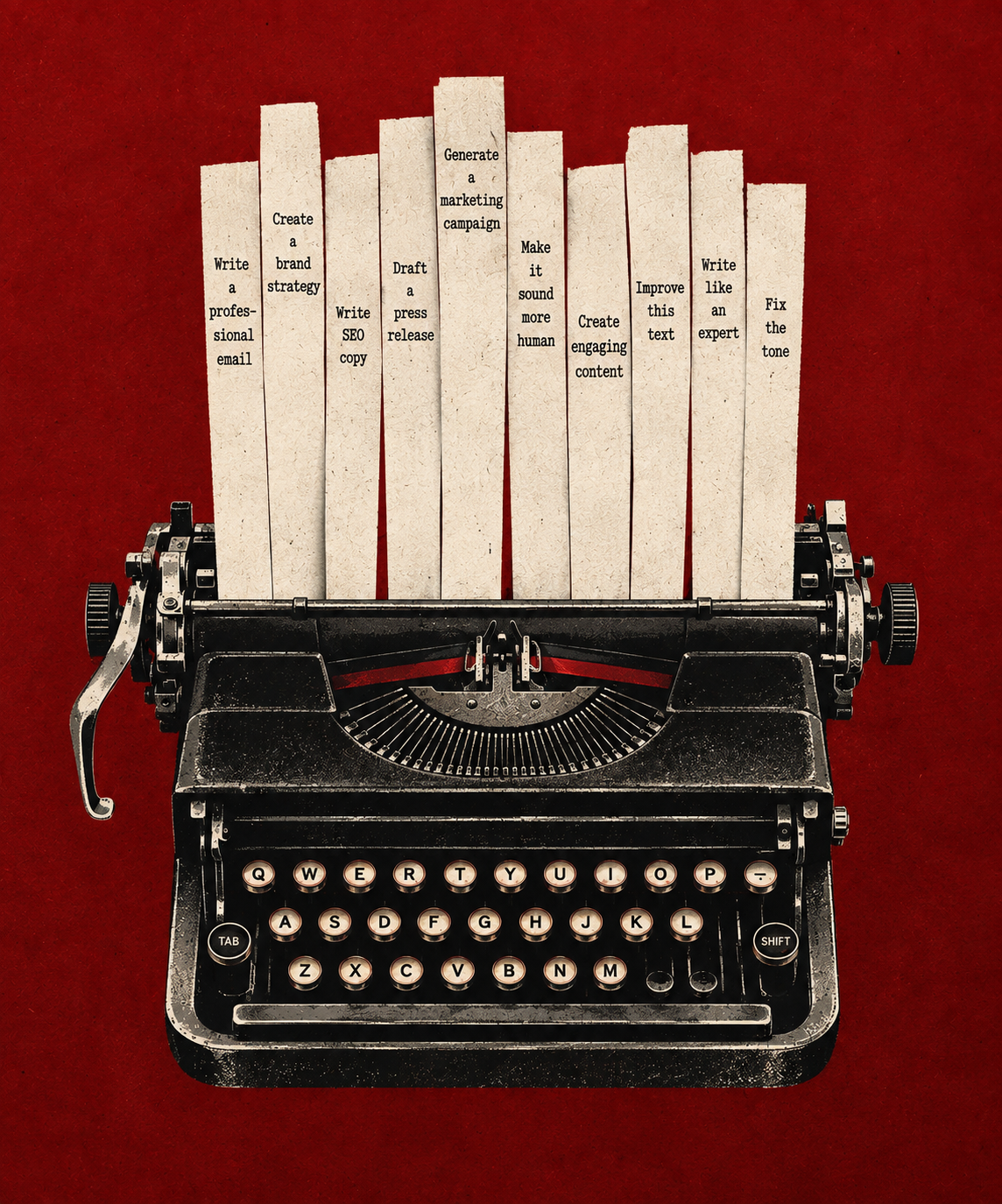
Why Your Brand Sounds Like Everyone Else
When did everyone become a copywriter?
When did a room full of people who had never written a campaign decide they had all it figured out?
I think it was around the time AI produced something that looked impressive on first read. Impressive enough to convince a room that the hard part was done. Not quite impressive enough to do the actual job.
What the tool actually gave us
Something happened when the AI tools became accessible to everyone at the same time.
Suddenly the client arrived at the briefing with three headline options they were already attached to. The marketing manager rewrote the copy themselves and wanted to know why my version was different. The founder told me, with genuine enthusiasm , that Claude had basically handled the About page. They just needed me to check it over.
I understand the logic. The output maybe looked professional. If you have never spent years thinking carefully about what makes communication actually work, it can genuinely be difficult to see what’s wrong with it.
What’s wrong with it is that it sounds like everyone else. Because it was trained on everyone else.
The brief that puts you in an impossible position
It is not just clients who show up with AI output and call it done. It is the brief that arrives asking you to use AI to make the process faster.
So you do. You use the tools carefully. You rewrite draft after draft, each one slightly closer to something real but still not quite there. Still carrying that particular quality of having been averaged from everything that came before it.
Nobody is satisfied. The client is frustrated and the team is frustrated. But somehow the question that surfaces is not whether the process was the problem. It is whether you are good enough at your job.
I have been doing this for years. And in that moment, sitting across from a revision note that questions your craft because the AI draft felt more efficient, it’s difficult not to feel like the ground has shifted under you.
Not because the criticism is fair. But because the room stopped asking whether the process was the problem.
Numbers Are Safe. Ideas Are Not.
And underneath all of this, something else is happening.
There is a slow, passive-aggressive erosion of the creative role itself. Not confrontational, but just a steady accumulation of moments where the question is implied rather than asked; do we actually need this? Do we need someone whose process takes time, whose best work cannot be scheduled, whose output is difficult to measure in a spreadsheet?
The people asking that question, quietly in budget meetings and capacity planning sessions, are rarely the ones whose roles are under the same scrutiny. The sales team can show their numbers. The account managers can show their pipeline. The data analysts can show their dashboards. These roles are legible in ways that creative work has never been. And in an environment where AI can now produce something that looks like creative work in thirty seconds, the argument for protecting the time and space that creative work requires becomes harder.
What I find most telling is who feels safe in this moment. The people pushing hardest for AI-first creative processes are almost never the ones whose jobs are being replaced by them. They are optimising someone else's role out of existence while quietly protecting their own.
What copywriting actually requires
Let me be direct about something most people who hire copywriters do not fully understand.
Copywriting is not filling in the text. It is not making things sound professional. It is the strategic application of language to produce a specific effect in a specific person at a specific moment in their relationship with a brand.
That requires knowing the person reading. What they are afraid of, what they want to believe about themselves, what would make them trust you versus what would make them leave. It requires knowing the brand, not the approved adjectives in the guidelines, but the actual specific truth of what makes it different.
It requires judgment. The ability to choose, from among many technically correct options, the one that is actually right. The one that earns attention rather than just receiving it.
That judgment is not a talent you either have or do not have. It is built through years of work. Through the accumulated understanding of what an audience does when they encounter something real versus something that resembles something real.
A prompt cannot replicate that. It can produce output that looks like the product of that judgment. But it cannot produce the judgment itself.
And when you ask a professional to work inside a process that removes the conditions for that judgment to operate, you are not getting faster access to their best work. You are getting a constrained version of what they could produce, filtered through a workflow designed for something other than quality.
The result is generic, and the professional knows it is. But nobody wants to say it out loud.
What it does to your brand over time
The specific quality that made a brand recognizable starts to disappear. The edges that gave it character get averaged away, and it begins to sound like a slightly different version of every other brand in its category running the same tools through the same prompts.
The audience always notices this before the brand does. People rarely articulate why a brand feels different than it used to, but they feel it. The sense that something has changed and that the communication is coming from somewhere less real.
Trust disappears slowly until the cumulative effect shows up in numbers that nobody immediately connects to the decision made a year earlier to handle the copy in-house with a tool.
The question worth sitting with
Before you decide the copy-problem is solved, ask this.
Does this really sound like us? Or does it sound like a very competent version of our category?
And before you question the professional sitting across from you, did you give them the conditions to produce something genuinely good? Or did you give them a tool, a tight timeline, a brief that was already half-answered by a model, and then express surprise when what came back felt like everyone else?
The process produces the output.
If the output is not good enough, the honest question is whether the process was ever designed to produce something good from the start.
Access is not expertise. It never was, and the brands that understand that difference are the ones still worth listening to.
The Quiet Rise of Digital Dementia
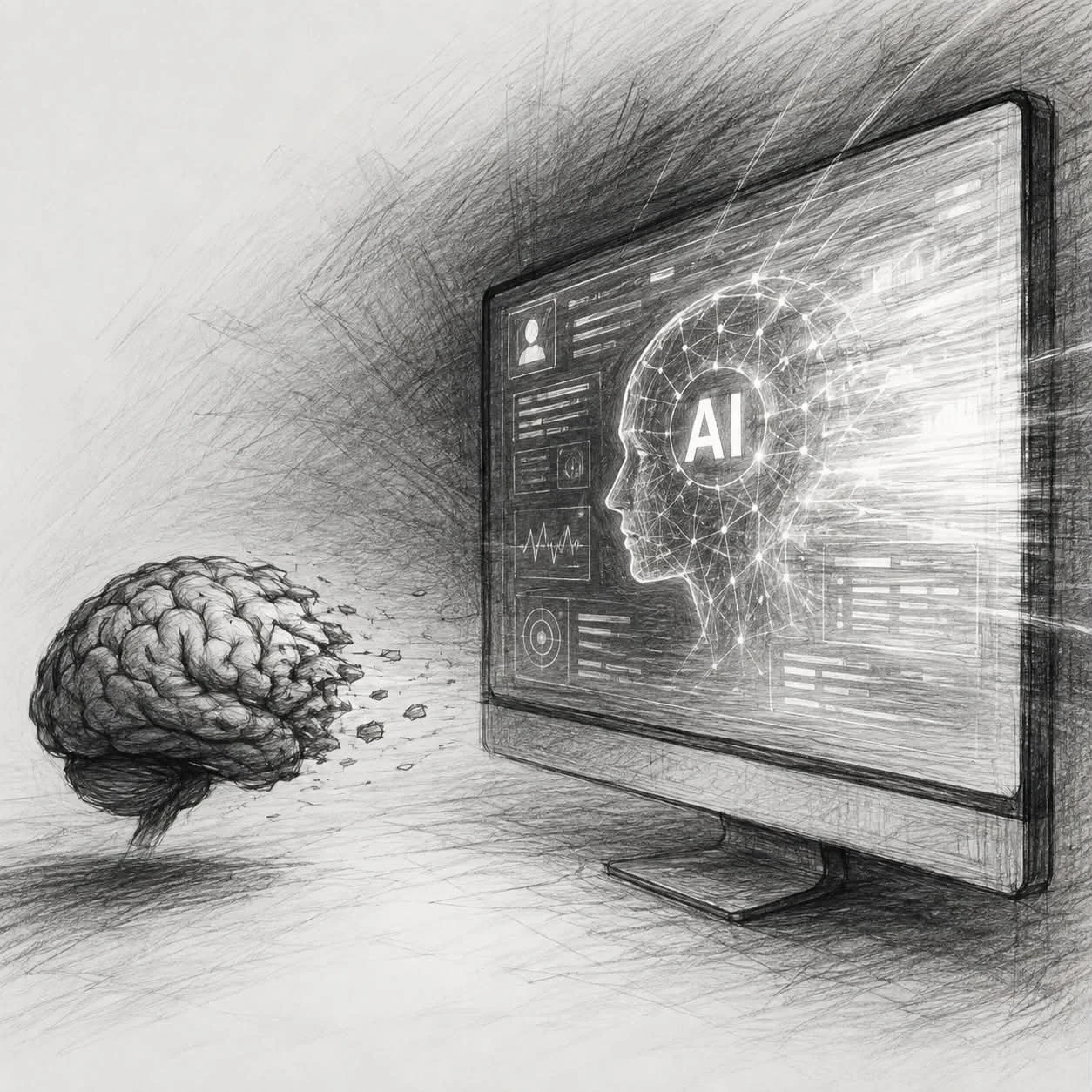
Something is quietly happening to our generation.
Not as a future risk. As a present reality, showing up in clinical data, in the lived experience of people in their thirties and forties. In the quiet creeping sense that something is different about how we think, remember and create, and that it has been getting worse for years.
Early-onset dementia is rising among millennials at a rate that should be front-page news every day.
The numbers nobody wants to say out loud
According to a 2020 report by the Blue Cross Blue Shield Association, diagnoses of early-onset dementia and Alzheimer's disease increased by 373% among Americans aged 30 to 44 between 2013 and 2017. Not 37%. Not 73%. Three hundred and seventy-three percent. The average age of a person living with either condition in that dataset was 49.
These are not elderly people. These are people in the middle of their working lives, their parenting years, the decades that were supposed to be defined by productivity, creativity and presence.
The cause is pointing to the relationship between how we spend our mental time and what happens to our brains over the long term. And what it is pointing to is the screen.
What passive screen time actually does
A study published in the American Journal of Preventive Medicine followed more than 20,000 adults in Sweden over nearly two decades, examining how different types of sedentary behaviour were associated with dementia risk. The researchers made a crucial distinction between mentally passive and mentally active sedentary behaviours.
Mentally passive activities, like watching television, scrolling through social media, consuming content that requires no response or engagement, were associated with significantly higher dementia risk. Mentally active sedentary activities, like reading, puzzles, creative work, engaged conversation, were associated with lower risk.
Replacing just one hour of passive screen time with one hour of mentally active behaviour was associated with a 7% reduction in dementia risk. Combining mental engagement with physical activity showed an 11% reduction.
The brain, it turns out, is not passive tissue that simply exists. It is an organ that requires use to maintain itself. Cognitive engagement helps maintain neural connections and supports what researchers call cognitive reserve. The brain's ability to adapt and compensate for changes over time. When we spend long periods in activities that require very little mental effort, those pathways are not stimulated. Over months and years, that lack of engagement contributes to decline.
This is not a metaphor. It is biology.
The AI problem
And then there is the new layer that is perhaps most concerning.
A growing body of research is finding that overreliance on AI tools may be doing to our thinking what GPS did to our spatial memory and search engines did to our recall. Making us worse at the very things we outsource.
Adam Green, a professor of neuroscience at Georgetown University, puts it plainly: if you are not doing the actual thinking, your capability to do that kind of thinking is going to atrophy. He describes it this way; it is like being at a gym where a robot lifts the barbell for you. You get nothing.
A Microsoft Research study found that heavier AI users scored significantly worse on critical thinking tests. Researchers at the University of Pennsylvania identified a phenomenon they call cognitive surrender. People trusting AI over their own judgment even when the AI is demonstrably wrong. A BBC analysis of emerging research found consistent concerns around creativity, attention span, memory and the loss of what one researcher called cognitive friction - the productive struggle that keeps thinking sharp.
We are, as a generation, doing something that has never been done before. We are outsourcing not just tasks but thought itself. And we are doing it in the same years that early-onset dementia diagnoses are rising at rates that should terrify us.
The connection has not been proven. But the direction of the evidence is consistent. And the question of whether we are willing to take it seriously before the data is conclusive feels urgent in a way I find difficult to dismiss.
Doomscrolling as a health crisis
I want to name the specific behaviour that I think sits at the centre of this.
Doomscrolling. The compulsive, passive consumption of content on social media platforms, often late at night, often about things that cause anxiety, often for far longer than intended. It is a behaviour specifically engineered by some of the most sophisticated attention-capture systems ever built, deployed at scale on people who were never told what it was designed to do to them.
Every platform is optimised for one thing: keeping you looking. Not engaging. Not thinking. Not creating. Looking. Passively consuming an infinite feed of content calibrated to your most reactive emotional states — outrage, envy, anxiety, desire — at a pace that makes sustained attention impossible and genuine thought unnecessary.
This is the definition of mentally passive sedentary behaviour. This is exactly what the research links to elevated dementia risk. And it is what millions of people in their thirties and forties are doing for hours every day, on top of already passive working hours in front of screens that do more of our thinking for us each year.
I am not exempt from this. I notice it in myself, the reach for the phone in moments of stillness, the inability to sit with boredom that I did not have ten years ago. The way a long piece of writing now requires more effort to sustain than it used to. These are not character flaws. They are the predictable results of years of exposure to environments designed to make sustained attention unnecessary.
What this is doing to creative work
As a filmmaker and writer, this is where it becomes personal.
Creativity is not a talent you either have or do not have. It is a capacity that requires cultivation, and specifically requires the kind of mental conditions that passive screen time and AI dependence systematically erode.
Original ideas do not arrive efficiently. They arrive through the slow, often uncomfortable process of sitting with a problem long enough for unexpected connections to form. They require boredom (real boredom), the kind that makes you restless enough to start making something. They require memory, the accumulated store of images, experiences, emotions, half-formed thoughts that the brain draws on when it is making something new.
Doomscrolling replaces boredom with stimulation. AI replaces memory with retrieval. The result is a mind that is busy and empty at the same time. Always consuming, rarely generating, increasingly unable to sustain the quality of attention that genuine creative work demands.
I see this in the work that is being produced. Not just in what AI generates directly, but in what human creators are producing in an environment of constant distraction and outsourced thinking. The ideas are faster. They are also shallower. The references are more current. The depth is diminishing.
This is not about being old-fashioned or resistant to technology. It is being honest about what certain ways of using technology are doing to the cognitive conditions that creative work requires.
What I am choosing to do about it
I do not have a perfect answer. I am not writing this from a position of having solved the problem in my own life.
But I am making deliberate choices.
I read physical books. Not because digital reading is inferior but because the absence of notifications, the inability to switch tabs, the sustained engagement with a single long-form argument is something my brain needs practice at. I use AI as a thinking partner rather than a thinking replacement. I try to have a view before I ask for one, to use the tool to challenge my perspective rather than to generate it. I try to protect boredom. Genuinely try to not fill every moment of stillness with content.
And I take the research seriously. Because the direction of the evidence is consistent, the stakes are high, and the cost of being wrong is one I am not willing to pay.
Our generation has been handed an extraordinary set of tools. We have also been handed an extraordinary set of risks that nobody adequately warned us about. The rise in early-onset dementia diagnoses is not inevitable. But it is also not going to reverse itself without deliberate action, individual and collective, against the conditions producing it.
The screen will not take care of your brain. That is still your job.
Sources:
Blue Cross Blue Shield Association - Early-Onset Dementia and Alzheimer's Rates Grow for Younger Americans (2020)
American Journal of Preventive Medicine - Sedentary behaviour and dementia risk study, Sweden (2026)
BBC Future - Think outside the bots: How to stop AI from turning your brain to mush (2026)
Healthline - Can Excessive Screen Time Cause Digital Dementia? (2024)
Microsoft Research - The Impact of Generative AI on Critical Thinking (cited in BBC Future, 2026)
Georgetown University - Adam Green, Laboratory for Relational Cognition (cited in BBC Future, 2026)
The Forest Doesn't Burn Alone
The younger generation is refusing to separate the health of the self from the health of the planet. Not as a political position. As a lived conviction.

More and more people in my own generation (Millennials) and Gen Z are thinking about their health. We are refusing to separate the health of the self from the health of the planet.
Not as a political position, but as a lived conviction. The understanding that the same extractive logic that is burning through natural resources is the same logic that is burning through human beings. And that both are unsustainable for exactly the same reasons.
The body and the earth
The nervous system conversation that is happening among millennials and Gen Z is not separate from the climate conversation. It is the same conversation in a different register.
What does it mean to live sustainably? It means taking only what you need. Leaving enough for the future. Not treating any resource, such as soil, water, air, time, energy, and attention as infinite simply because it has not run out yet (btw, Sweden exhausted its renewable natural resources for 2026 on April 4th).
That applies to the planet. It applies equally to the human body and mind.
A culture that demands maximum productivity from its workers is making the same assumption as an industry that demands maximum yield from its land. That the resource is inexhaustible. That you can keep taking without consequence. That the signs of depletion are a performance issue rather than a warning.
Both assumptions are wrong. And the younger generation, the first to grow up with both a mental health crisis and a climate crisis as background conditions of their existence, is the first to feel that unease in their bodies before they can fully articulate it in words.
The Japanese model nobody is talking about
There is a concept in certain Japanese business philosophy that has no clean translation into English but approximates something like this: enough is a destination, not a failure.
The idea that a company can reach a point of sufficient scale (sufficient profit, sufficient growth, sufficient impact) and choose to stop expanding. Not because it lacks the capacity to grow further. Because it has decided that the value of what it has built is better protected by sustainability than by scale.
This is a fundamentally different relationship to growth than the one Western capitalism has normalized. In the Western model, stopping is always framed as losing. The company that is not growing is the company that is failing. The person who is not ambitious is the person who has given up.
But growing toward what? At what cost? Paid by whom?
The younger generation is asking these questions about their own lives with the same urgency that environmental scientists have been asking them about the planet for decades. And arriving at similar answers.
Enough is not a consolation prize. It is a deliberate choice. It is the recognition that beyond a certain point, more does not make things better. It makes them more fragile, more dependent on continued expansion to justify the cost already paid.
What sustainable living actually looks like from the inside
It looks like a 27 year old who has decided that their mental health is not a productivity variable to be optimized around. It looks like someone choosing a job with less prestige because it comes with actual time, time to sleep, to move, to be present with the people they love, to do nothing in particular without the background hum of guilt that nothing is being achieved.
It looks like people building practices, therapy, movement, time in nature, genuine rest, not as self-indulgence but as infrastructure. The same way you maintain a building or a forest. Not because it is luxurious but because neglect is more expensive than care.
It looks like a generation that has looked at burnout in their friends and their colleagues and in themselves, and decided that it is not a badge of honor. It is a systems failure. A sign that the demands being placed on a human being exceed what a human being can sustainably provide.
And it looks like people extending that same logic outward. If I cannot treat my own body as infinitely exploitable, why would I treat the planet that way? If rest is not weakness in a person, why is it weakness in an economy?
The connection the older generation missed
The boomer framing of environmentalism was largely about sacrifice. Give things up. Use less. Accept a lower standard of living in service of a future that may not arrive in your lifetime.
That framing failed. It failed because sacrifice without meaning is psychologically unsustainable. You can ask people to give things up temporarily, in a crisis. You cannot build a civilisation on permanent deprivation.
The younger generation is not approaching sustainability as sacrifice. They are approaching it as alignment. Living in a way that is consistent with what they actually value. Consuming less not because they are forced to but because they have genuinely stopped wanting the things that consumption was supposed to deliver.
The status symbol that requires destroying something - your health, your time, your relationships, a rainforest - is starting to look less like success and more like a very expensive way to feel empty.
That shift in perception is not small. It is the beginning of a genuinely different relationship to what a good life looks like.
What we are actually fighting for
There is a question underneath all of this that rarely gets asked directly.
If we cannot stand up for the people around us, such as the employees working themselves into exhaustion, the colleagues who burned out quietly while everyone pretended not to notice, the collaborators and their families absorbing the cost of decisions made in boardrooms they were never invited into, then what exactly are we fighting for?
Sustainability without humanity is just efficiency with better branding.
The organisations that genuinely care about the planet but treat their people as expendable resources have not understood the assignment. The logic is the same. The assumption is the same. That the resource, whether it is a forest or a human being, exists to be extracted from until it cannot give any more, at which point it gets replaced.
That is not sustainability. That is the same extractive model wearing a green coat.
Real sustainability begins with the person next to you. It begins with the choice to notice when someone is struggling before they have to say it out loud. To protect the wellbeing of the people in your immediate circle with the same urgency you bring to recycling, carbon offsetting or any other gesture toward a better world.
A colleague's mental health is an environmental issue. A family that cannot afford to eat properly because their employer underpays and overworks is an environmental issue. The human ecosystem and the natural ecosystem are not separate things. They are expressions of the same relationship between living systems and the demands placed upon them.
If we are serious about building a more sustainable world, and I believe many of us genuinely are, then we have to start in the room we are already in. With the people who are already in front of us. With the basic, unglamorous, deeply necessary work of treating the human beings around us as something worth protecting.
Everything else follows from that. Or it means nothing at all.
Where the two conversations meet
Mental health and environmental sustainability are not separate issues that happen to concern the same generation. They are the same issue viewed from different angles.
Both are about the relationship between a living system and the demands placed upon it. Both are about the difference between use and exploitation. Both are about the recognition that resilience requires recovery. That you cannot keep taking from something without also giving it the conditions it needs to regenerate.
The generation that grew up with both crises as given realities is the first to feel that connection intuitively. And the practices they are building - the therapy, the boundaries, the slower living, the deliberate consumption - are not separate from their environmental values. They are expressions of the same understanding.
You can’t care for the earth if you do not care for yourself. You can’t care for a child if you do not care for yourself. And you can’t care for yourself while participating enthusiastically in the destruction of everything your life depends on.
The younger generation is not perfect at this. Nobody is. But they are asking the right question.
What would it look like to live in a way that was actually sustainable for the planet, for the people around me, and for the person I have to be every single day until I die?
That question is not weakness. It is the most serious question a human being can ask.
The Millennial Career Crisis Isn't a Crisis. It's a Reckoning.
I am 33 years old. I have watched my generation - people who did everything “right”, who studied hard, built impressive CVs, collected credentials and followed the formula - slowly realize that the formula was a lie.
A well-intentioned lie told by people who genuinely believed it, because it had worked for them. In a different world. On a different planet. Under entirely different economic conditions that no longer exist and are not coming back.
We were sold a map. The map was wrong.
The contract that broke
My generation was handed a simple agreement. Go to university. Get a degree in something serious, like engineering, law, medicine, economics. Work hard. Be loyal. Climb the ladder. Buy a house. Retire comfortably.
It sounded like a plan. It felt like security. And for a few decades before us, it more or less worked.
Then 2008 happened. Then a pandemic. Then inflation that has not stopped. Then layoffs that became, in the words of one researcher, "not the exception but the norm." Then AI, arriving as a lived daily reality that is restructuring entire industries faster than any generation has ever had to adapt to.
I have friends with Masters degrees in civil engineering. People who spent five, six, seven years in rigorous education. Who were told their careers were safe, their skills essential, their futures secure. Several of them have been made redundant in the last two years. Some are still unemployed. Not because they were bad at their jobs. Because the world moved and nobody warned them.
This is Sweden in 2026. This is most of the world in 2026.
And still, the conversation about it is framed as a personal failure. As individual inadequacy. As something those people should have anticipated, prepared for better, pivoted from sooner.
The shame is misplaced. The problem was never personal.
Why I Ignored the Safe Path
I did not follow the formula. I could not have told you at the time whether that was wisdom or stubbornness or simply the inability to care enough about security to pursue it at the cost of everything else I actually wanted.
I studied film. I directed short films in Cape Town. I wrote scripts. I made music videos. I produced things that mattered to me with people who cared about the work and the craft. And then I moved into copywriting and marketing because I love language and communication and the challenge of making someone feel something through words.
None of this was the safe path. It offered no obvious ladder, no guaranteed salary, no clear trajectory toward the life I was “supposed” to want.
What it offered instead was something I could not have named then but can name clearly now: the ability to adapt. To move. To build skills that transferred across contexts because they were rooted in something real. Curiosity, communication, the capacity to understand what an audience needs and give it to them in a form they did not know they were waiting for.
Looking back, I am grateful beyond words that I went with my gut. Not because the path has been easy (trust me, it has not been easy) but because the people who chose the safe path have discovered that safe is relative, that security is temporary, and that the thing you sacrificed your actual interests for can be taken from you anyway.
If the last six years have proven anything, it is that nothing is guaranteed. No degree. No industry. No track record. No set of connections. Nothing.
The millennial curse
We are too grateful. Too careful. Too well-trained in the art of being thankful for what we have and not asking for more.
We grew up watching our parents work decades for the same employer and call that stability. We absorbed their values without questioning whether those values fit the world we were actually going to inhabit. We learned to be reliable, to be modest, to not rock the boat, because rocking the boat was how you lost the thing you had worked so hard to get.
And then the boat rocked anyway. Without warning. Without our permission. Without any regard for how hard we had worked to keep it steady.
The result is a generation in quiet crisis. Exhausted not just by the material conditions, such as the housing costs, the inflation, the job market, the student debt, but by the cognitive dissonance of living in a world that keeps insisting the old rules still apply while all the evidence suggests they do not.
We are burning out trying to catch up to a destination that has moved. And many of us are blaming ourselves for not catching it.
The shame is the wrong response. The map was wrong. That is not your fault.
Two generations. One room. Different planets.
There is an additional weight that nobody talks about honestly enough.
We are navigating the broken formula, the restructured job market, the AI disruption, the housing crisis, the inflation, while simultaneously having to sit across the table from a generation that largely does not feel it. Not personally. Not financially. Not in the way that keeps you awake at three in the morning doing the maths on whether you can afford to stay in the city where your job is.
The older generation built their wealth in a different interest rate environment. They bought their homes when homes were buyable. Their pensions existed and paid out. Their industries were not being automated. Their loyalty was rewarded rather than made redundant.
For most of them, the current crisis is something they read about. Something that happens to other people. Something that, if they are being honest, confirms a suspicion they already had. That young people today are simply not willing to work as hard as they did.
That suspicion is wrong. And it is damaging in ways that go beyond the personal.
Because when the generation with the most institutional power in politics, in boardrooms, in the media, in the family home, refuses to accurately diagnose what is happening, the response to the crisis keeps aiming at the wrong target. Raise the child benefit. Encourage people to retrain. Tell them to network more. Work harder. Stop complaining.
Meanwhile the structural conditions producing the crisis remain untouched. The housing market stays broken. The labour market keeps restructuring. The cost of living keeps rising. And the people bearing the weight of all of it are told, in so many ways, that the problem is their attitude.
We are not on the same planet. We are sitting in the same room pretending we are. And that pretence is exhausting in a way that is very hard to explain to someone who has never had to live inside it.
What Gen Z is getting right
I watch the generation below mine with something between admiration and envy.
They did not inherit our particular curse. They watched us follow the formula and saw what happened. They arrived at the conclusion earlier and more clearly with less grief, that the traditional path was not a guarantee of anything, and that if security was not on offer regardless, they might as well build something they actually wanted out of life.
Seventy-three percent of Gen Z entrepreneurs have multiple income streams. They are three times more willing to take risks than baby boomers. They are building portfolio careers not because it is fashionable but because they have correctly identified that depending on a single employer for your entire financial survival is the riskiest thing you can do in an economy that treats redundancy as a routine business decision.
They are also visible. Unafraid to be seen. Understanding intuitively that in a world where anyone can reach anyone, visibility is leverage. That building an audience around your work is not vanity, it is infrastructure.
My generation is still catching up to this. We were trained to be modest, to let the work speak for itself, to distrust anyone who seemed too eager to be noticed. It is a reflex that served a different era and is actively unhelpful in this one.
There is something important to learn here if we are willing to be humble enough to learn it from people younger than us.
What South Africa taught me
I have spent nearly a decade moving between Sweden and South Africa. And the contrast between those two cultures changed me in ways I am still understanding.
Sweden is a country that has lived in comfort long enough to mistake comfort for the natural order. We are private. We are cautious. We have a deep cultural reflex against standing out, against taking up too much space, against being seen to want things too obviously.
South Africa is a country that has been through things - historically, materially, politically - that have produced a different kind of person. People who dress with genuine expression. Who greet strangers like they mean it. Who hold their communities close because they have learned, through hard experience, that community is what you fall back on when systems fail.
The creativity I developed there was not something I could have manufactured in a more comfortable environment. It needed the exposure to the different ways of being human, to cultures that did not share my inherited assumptions, to people whose relationship to uncertainty was not anxiety but aliveness.
Sweden could use more of that. More genuine curiosity about other people. More willingness to be seen. More tolerance for the person who does not fit the expected shape.
The Swedish cultural allergy to standing out is costing us something. In a world where visibility is increasingly how you create opportunity, the instruction to stay small and quiet is not modesty. It is a disadvantage.
The only thing I know for certain
Uncertainty is not the enemy. I know this because I have lived it. The film career that was not a career yet, the move to a country where I knew almost nobody, the pivot into copywriting, the constant reinvention that felt like instability until I understood it was actually freedom.
The people I know who are navigating this era best are not the ones who found the most security. They are the ones who got comfortable with not knowing. Who stayed curious about themselves and the world. Who understood that a career is not a destination you arrive at but a living thing you keep tending. Something that needs to change as you change, and something that has to breathe.
The formula was always a story someone told to make the uncertainty more bearable. The uncertainty was always there. The question is only whether you fight it or get interested in it.
It is not a comfortable position. It is not a position that offers the reassurance of a clear map and a guaranteed outcome. But it is the honest one. And in a world where the comfortable positions are disappearing faster than anyone predicted, honest might be the most practical thing you can be.
It is strange out here. It is uncertain. And it is, if you let it be, genuinely alive.
The Fastest Way to Be Forgotten - Why Great Brands Give Creativity Time
You can force a deadline. You can force a deliverable. You cannot force the moment when an idea becomes something worth remembering. That moment requires space, and most brands have stopped giving it.
I have sat in enough creative meetings to know the moment a brief stops being about the work and starts being about the clock.
That is the moment the best ideas leave the room.
The brief says: faster. The budget says: cheaper. The AI says: here is something technically correct, ready in twelve seconds. And so the campaign goes out. The content gets published. The calendar gets filled.
And nothing sticks.
What the creative industry forgot
I came from film before I came from marketing. The one thing that nobody in the film industry would ever dispute, even the ones obsessed with budgets and schedules, is that a great story cannot be forced.
You can force production. You can force a deadline. You can force a deliverable. You cannot force the moment when an idea becomes something worth remembering.
That moment requires something that no AI tool, no efficiency framework and no quarterly content calendar can manufacture: space.
Space to sit with an idea long enough to find out what it actually is. Space to try the wrong version before you find the right one. Space to be uncomfortable with something half-formed before it becomes something whole.
The great campaigns that stayed with you, the ones you still remember years later, were not the ones produced fastest. They were the ones given enough room to become something specific.
The paradox of speed
Here is what I have observed working across film, copywriting and brand strategy: the faster a piece of content is produced, the more it resembles everything else produced at the same speed.
Speed optimizes toward the average. It defaults to what has worked before, what looks right, what sounds right, and what can be approved without friction. It eliminates the detours and the wrong turns and the uncomfortable conversations. The very things that creative processes need to produce something genuinely unexpected.
A brand that produces content at maximum speed is a brand that has decided to compete on volume. And in a landscape where AI makes volume essentially free, competing on volume is no longer a strategy. It is a surrender.
What creativity actually needs
In film, we talk about the difference between a shot that is technically correct and a shot that is alive. The technically correct shot is achievable every time. The shot that is alive requires conditions. The right light, the right moment, and the right willingness to wait for something real rather than settle for something adequate.
Creativity works the same way in every medium.
It needs constraints. Yes, deadlines and budgets and briefs are not the enemy of creativity, they are the conditions that force it to become specific. But within those constraints, it needs time to breathe. Time to fail. Time to come back to something you thought was finished and realize it was only almost right.
The brands that stand out are not the ones that produced the most. They are the ones that gave their best ideas enough room to become their best ideas.
The business case for slowness
I understand the pressure. I have worked inside it. When every competitor is producing more content more quickly, slowing down feels like falling behind.
But the question is not how much content you can produce. The question is how much of it anyone will remember.
One campaign that earns genuine attention is worth more than fifty pieces of content that disappear into the feed within hours. One brand voice that is specific enough to be recognizable is worth more than a year of technically correct copy that could belong to anyone.
The power of standing out lies in your ability to allow creativity the space and time it needs. Not unlimited time, but purposeful time. Not slow for its own sake, but slow enough to find the specific thing that only you could have made.
That is what lasts. That is what gets remembered. That is what no amount of AI-generated speed can replicate.
Where I come in
The work I care most about is helping brands create the conditions where something genuinely memorable can emerge. Not just filling a content calendar, but finding the specific creative truth that makes a brand worth paying attention to.
If you want to explore what that looks like, I am happy to have that conversation.
On Accountability and the People Who Will Never Take It
The ego does not lie deliberately. It rewrites. Gradually, convincingly, until the story it has constructed feels indistinguishable from the truth. On accountability, and the people who will never take it.
There is something almost disarming about a person who can say it simply and without theatre.
I was wrong. I am sorry. That was my fault.
Not as performance. Not as strategy. Not hedged with qualifications or followed immediately by an explanation of why the circumstances made it inevitable. Just the plain, undefended acknowledgement that they did something that caused harm, and that they own it.
It is one of the rarest things you will encounter in a human being. And the older I get, the more I believe that the capacity for genuine accountability is one of the most meaningful indicators of who a person actually is.
What accountability actually requires
Accountability is not an apology. An apology is easy. Apologies can be deployed strategically, performed convincingly and forgotten by the person delivering them before they have even left the room.
Accountability is something harder. It requires the ability to hold yourself in an uncomfortable truth. To see clearly what you did, to sit with the discomfort of knowing it caused harm, and to resist every impulse to reframe, explain or defend your way out of that discomfort.
That last part is where most people fail.
Because the ego is extraordinarily creative when it comes to self-protection. It will find the angle that makes you the reasonable one. The context that explains why what you did was actually understandable. The version of events in which your behaviour was a response rather than an initiation. Where you were reacting to something they did, and if they had just been different, none of this would have happened.
The ego does not lie deliberately. It rewrites. Gradually, convincingly, often completely unconsciously, until the story it has constructed feels indistinguishable from the truth.
The person who never takes accountability
We have all encountered them. In families. In friendships. In workplaces. In relationships that started with warmth and ended in a confusion of competing narratives where you can no longer quite trust your own memory of what happened.
The person who never takes accountability has a particular quality. They are always, in their own telling, the wronged party. Every conflict has a version in which their behavior was justified. Every failure has a cause that originated outside themselves. Every relationship that ended badly was the other person's fault. And if you listen long enough, the stories start to blur together, the specific details shifting subtly to accommodate whatever the current situation requires.
This is not always cynical. That is the important thing to understand.
Many people who cannot take accountability are not consciously lying. They have simply told their version of events so many times, and reinforced it so completely, that it has become the truth they actually experience. The ego's rewrite is so thorough that the original events are no longer accessible. What remains is a story that keeps them safe from shame, from responsibility, and from the terrifying possibility that they are capable of causing harm.
And that story must be protected at all costs. Because if it cracks, if they allow even a small acknowledgement that they got something wrong, the whole architecture is at risk.
What this does to relationships
In private life, it creates a particular kind of exhaustion. You find yourself taking responsibility for things that were not your fault. Not because you believe it, but because the alternative is an argument that never resolves, a conflict that escalates until someone walks away. You learn to manage around them. To anticipate the defensiveness. To frame things carefully so as not to trigger the rewrite.
Over time you realize that what you are actually managing is their relationship with themselves. Their inability to tolerate their own fallibility. And that is a full-time job that nobody asked for and nobody can sustain indefinitely.
In professional life it is equally corrosive. Teams cannot grow around people who cannot acknowledge mistakes, because mistakes are the primary mechanism through which teams learn. When someone consistently redirects responsibility, the people around them eventually stop trying to address problems honestly and start managing perceptions instead. Trust erodes. Collaboration becomes performance. The culture curdles quietly from the inside.
How to handle people who will never change
The first and most important thing to accept is that you cannot give someone the capacity for accountability they do not have. You cannot reason them into it, love them into it, argue them into it or wait long enough for them to arrive at it on their own.
Some people will do that work. Many will not. And the ones who will not are often the ones most loudly insisting that they have already done it.
So what do you do?
You let them.
Let them have their version of events. Let them rewrite the history. Let them be the hero of a story in which you are the obstacle or the villain or the misunderstanding. Let them carry the narrative they need to carry to get through the day.
And then, deliberately, without drama, without punishment, you decide how much of your life they have access to.
Not as revenge. As self-preservation.
The table of your life has limited seats. Some people belong close at the centre, with full access, trusted with the things that matter. Some people belong further away, present but peripheral, allowed in at a distance that protects you without requiring you to cut them off entirely. And some people belong outside altogether, not because you hate them, but because the cost of keeping them close is too high.
Placing someone correctly at your table is not cruelty. It is clarity. It is the adult version of the boundary that should have been taught to you long ago and probably was not.
Forgiving yourself first
There is one more thing. And it is the hardest part.
If you have spent time with someone who consistently refuses accountability, there is a good chance you have absorbed some of their narrative about you. You have been told, directly or indirectly, explicitly or through implication, that you were too much, too sensitive, too demanding, too quick to make things into a problem.
You may have started to believe it.
The forgiveness that matters most in these situations is not the forgiveness you extend to them. It is the forgiveness you extend to yourself. For not seeing it sooner. For trying harder than the situation warranted. For needing something from someone who did not have it to give.
You were not wrong to need what you needed. You were not wrong to want someone to own what they did. That is a reasonable expectation of any adult human being.
The fact that they could not meet it says everything about them and nothing about you.
What it looks like when someone actually does the work
I want to end here, because I do not want this to be only about the people who cannot do it.
When someone takes genuine accountability and sit with what they did, acknowledge it clearly and resist the impulse to explain it away, something remarkable happens in the relationship.
Trust deepens. Not immediately, not without time. But the moment of genuine accountability creates a kind of intimacy that almost nothing else can. It says: I see myself clearly enough to see what I did to you. And that matters to me more than my own comfort.
That is rare. That is worth seeking out. That is the quality to look for in the people you let close.
And it is worth cultivating in yourself. Slowly, imperfectly, with the same patience you would extend to anyone learning something genuinely difficult.
Because accountability is not a character trait you either have or do not have. It is a practice. One that gets easier the more you do it and harder the longer you avoid it.
Start small. Acknowledge the small things. Build the muscle.
The relationships on the other side of that practice are worth everything it costs to get there.
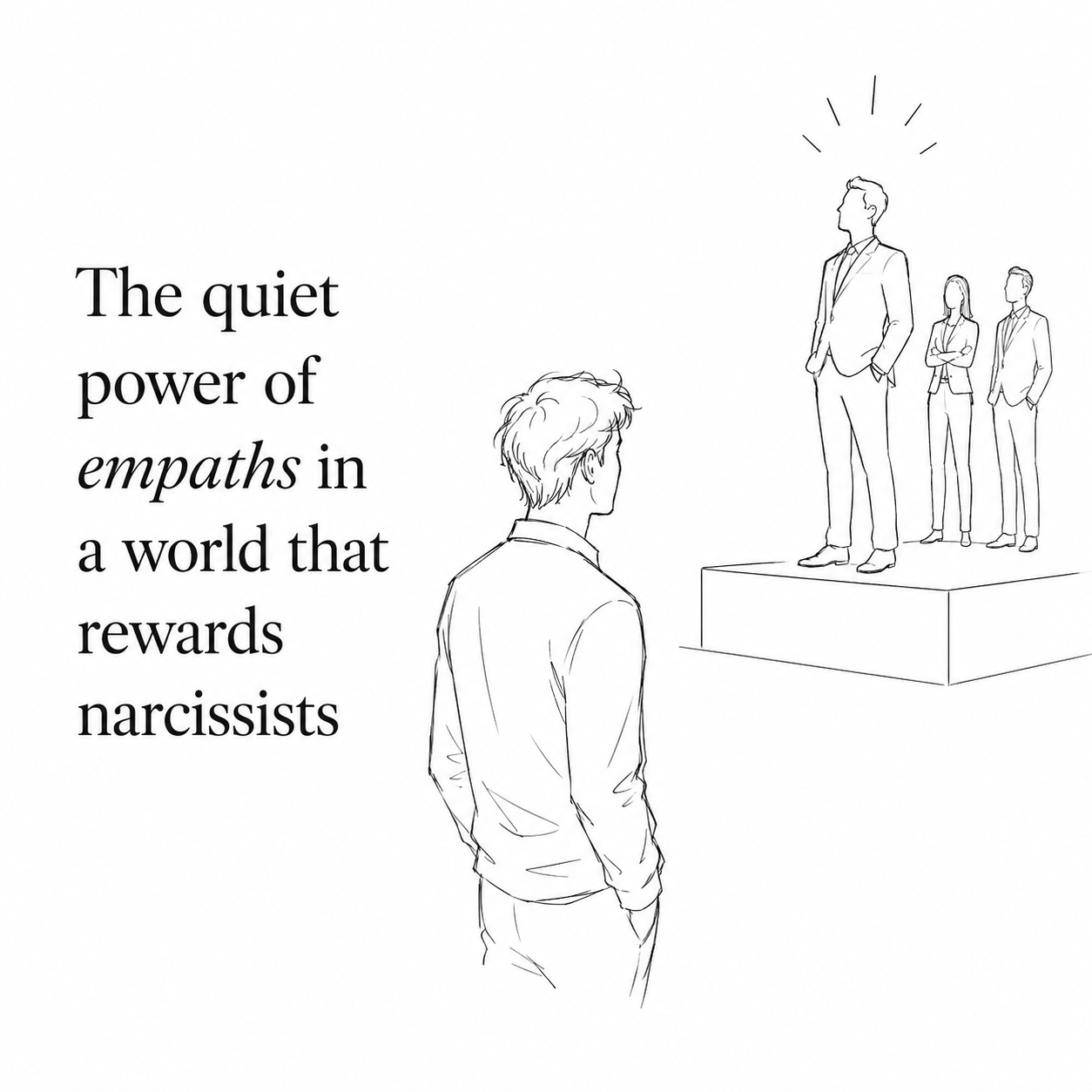
The Quiet Power of Empaths in a World That Rewards Narcissists
In a world optimised for narcissism, empathy is the rarest and most valuable resource available. The empaths are not behind. They are carrying something the world is about to need very badly.
Something is wrong with how we define strength.
Not obviously wrong. Not wrong in a way that is easy to name or argue against in a meeting or a pitch deck. Wrong in the way that things are wrong when they have been normalised for so long that the wrongness itself has become invisible.
We have built a world that rewards a very specific set of traits. Confidence without doubt. Certainty without nuance. The ability to speak loudly and move fast and project the kind of authority that makes other people stop asking questions.
And we have called that strength.
I want to suggest that it is not.
The story we are inside
The most powerful people in the world right now are telling a very compelling story. That AI will solve everything. That speed is survival. That efficiency is the highest virtue. That the people who move fastest will inherit the earth and the rest of us should be grateful for the disruption.
It is told with extraordinary confidence. And confidence, as any filmmaker knows, is one of the most persuasive tools in existence. It does not require truth. It only requires that the audience has no compelling alternative narrative to hold onto.
But I notice something about that story. It has no room for doubt. No room for complexity. No room for the kinds of questions that make powerful people uncomfortable. Questions about cost, about consequence, about who is not in the room when these decisions get made.
Those questions require a particular kind of intelligence to ask.
Not the kind that optimises. The kind that feels.
What empathy actually is
Empathy is not weakness. It is not sentimentality or naivety or an inability to make hard decisions.
Empathy is the capacity to hold another person's reality alongside your own. To understand that your experience of the world is not the only valid one, and to let that understanding actually change how you act.
That is an extraordinarily sophisticated cognitive and emotional skill. It requires more processing, more nuance and more genuine courage than the alternative, which is simply to optimise for your own interests, your own vision, your own certainty, and call that leadership.
The world is full of people who have mistaken the absence of empathy for strength. Who have learned to perform confidence so completely that they have forgotten what they do not know. Who have surrounded themselves with people who reflect their certainty back at them and called that consensus.
That is not strength. That is a very elaborate defence mechanism. And it is extraordinarily fragile, because it depends entirely on never being wrong, never being challenged and never having to sit with a reality that does not confirm what you already believe.
What gets built without it
I think about this in the context of the things being built right now.
The technologies deployed at scale with extraordinary speed and almost no accountability. The platforms that have reshaped how billions of people think and relate and understand the world. The AI systems trained on human creativity and released without asking the humans whose work made them possible.
The people building these things believe they are making the world better, but I and many more believe it’s something much more sinister than that. Belief without empathy is dangerous. It allows you to build things that solve your problem without asking whose problem you are creating. It allows you to move fast without looking at what you are breaking. It allows you to call disruption progress without asking who is being disrupted and at what cost.
The environmental cost of the data centres running AI at scale. The displacement of workers who cannot retrain fast enough. The erosion of trust in images, in language, in the basic shared reality that makes human communication possible.
These are not abstractions. They are consequences felt by real people in real bodies living real lives on a planet that is running out of time.
Empathy is what allows you to care about that. And caring about it is not an obstacle to progress. It is the only thing that makes progress worth having.
The competitive advantage nobody wants to talk about
Here is the paradox that the current moment has created: in a world optimized for narcissism, empathy is the rarest and most valuable resource available.
The ability to genuinely understand another person. What they fear, what they need, what they would never say out loud but desperately want someone to notice, is something no AI can replicate and no algorithm can generate. It requires being human in the fullest possible sense of the word.
In communication and marketing, empathy is the difference between content that fills space and content that changes minds. In leadership, it is the difference between compliance and genuine commitment. In any creative work such as film, writing, strategy, design, it is the difference between something technically correct and something that stays with you long after you have encountered it.
The empaths are not behind. They are not naive or slow or insufficiently ambitious.
They are carrying something the world is about to need very badly.
What this moment actually requires
I am not optimistic by default. I have seen enough of how power works, both privately and professionally, to know that the people with the loudest voices and the most capital do not always lead us somewhere worth going.
But I am not pessimistic either. Because I have also seen what happens when people with genuine emotional intelligence decide to stop apologizing for it. When they stop performing the confidence of people they are not and start using the actual advantage they have. The ability to see clearly, to feel accurately and to act from a place of genuine understanding rather than performed certainty.
The future will not be built by the people who moved fastest. It will be shaped by the people who understood what it means to be human. What we need. What we are losing. What is worth protecting even when it is inconvenient. Even when it is expensive. Even when the people with the loudest voices are telling you it is already too late to care.
Emotional intelligence is not a soft skill. It is the hardest and most important skill there is.
And in a world that is trying very hard to convince you otherwise, holding onto it is a radical act.
AI Can Write Your Copy. It Can't Write Your Character.
AI produces technically correct content. But character, the thing that makes a brand irreducibly itself, is something it cannot generate.
Let me say something that might sound strange coming from someone who uses AI everyday.
I use AI in my work constantly to pressure test ideas, to structure thinking, to move faster than I could alone. But there is something AI cannot do. And right now, in a marketing landscape where everyone has access to the same tools producing the same output, that something is the only thing that actually matters.
AI cannot write your character.
What character actually means
In film, character is not personality. It is not tone of voice or a list of adjectives on a creative brief. Character is the specific set of beliefs, contradictions, fears and commitments that make a person, or a brand, fundamentally themselves.
You know a great film character not because they are consistent. You know them because they are specific. Because there is a way they see the world that could belong to no one else. Because when they speak, you recognise something true. Something that couldn't have been invented, only discovered.
That is what the best brands have always had. And it is exactly what AI cannot generate.
AI is trained on everything. That is its power and its fundamental limitation. It produces the most statistically likely version of any given thing. The average of all the voices it has absorbed. It optimizes toward what has worked before.
Character, by definition, is not the average. It is the specific. The unexpected. The thing that makes you unmistakably you.
What is actually happening right now
I read a lot of brand content. It is part of my job. And the pattern I see emerging is this: as more companies hand their content over to AI, the output becomes more technically correct and less worth reading.
The sentences are cleaner. The structure is tighter. The keywords are in the right places. And there is nothing in any of it that you would remember tomorrow.
Because memory requires specificity. And specificity requires someone, a real person with a real perspective, to have been brave enough to say something specific.
The brands disappearing into the noise are not disappearing because they are using AI. They are disappearing because they have outsourced the one thing that could never be outsourced. The decision about who they actually are.
What I learned from directing actors
When I directed films, the hardest part was never the technical execution. The hardest part was helping an actor find the specific truth of a character. The thing underneath the lines that made everything they said feel inevitable rather than performed.
You cannot tell an actor to be more authentic. Authenticity is not a direction. It is a result. It comes from specificity. From knowing exactly what this character believes, fears, wants and is unwilling to give up.
The same is true for brands. You cannot brief your way to character. You cannot A/B test your way to a soul. You have to do the harder work of actually knowing who you are, and then having the courage to say it out loud, consistently, even when it means not sounding like everyone else.
The competitive advantage nobody is talking about
In a world where every company has access to the same AI tools producing the same quality of technically correct content, character is the only differentiator left that cannot be replicated.
You can replicate a tone of voice. You can replicate a content format. You can replicate a posting frequency. You cannot replicate the specific accumulation of decisions, failures, beliefs and commitments that make a brand genuinely itself.
That is your moat. Not your product features. Not your SEO strategy. Not your content calendar.
Your character. The thing AI can describe but never become.
Where I come in
Helping brands find and hold onto what makes them specific is the work I care about most. If your content is starting to sound like everyone else's; technically fine, strategically sound and somehow forgettable, I am happy to have that conversation.
The Death of Brand Voice - And Why Storytelling is the Only Antidote
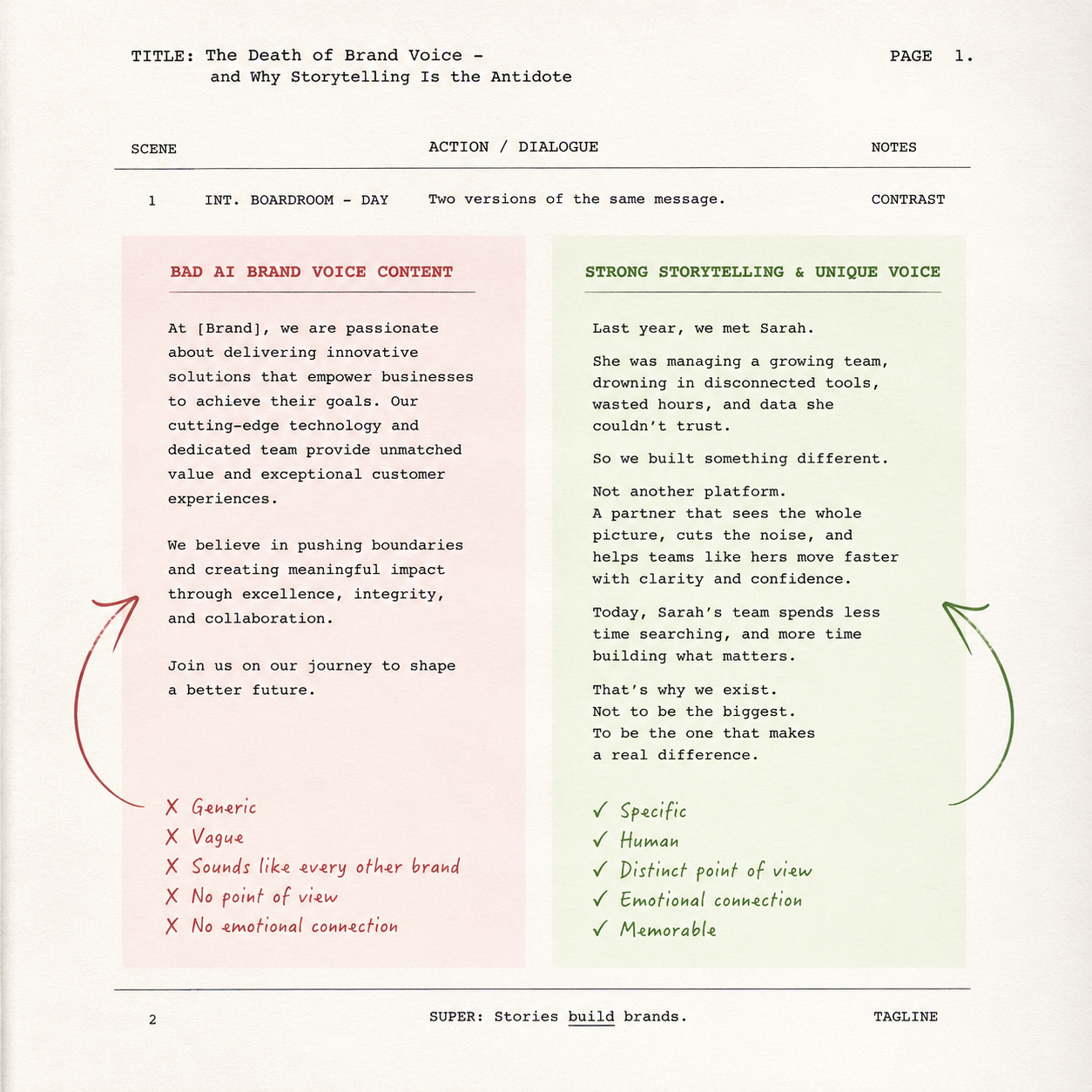
Something is disappearing from the internet. You can feel it before you can name it.
You open a company's homepage or LinkedIn page and the copy feels familiar. Not because you've read it before, but because you've read something exactly like it a hundred times. The sentence rhythm is the same. The enthusiasm is the same. The carefully placed em dashes, the "we're passionate about" and the "in today's fast-paced landscape" are all the same.
You're not reading a brand. You're reading a template wearing a logo.
What brand voice actually is
I spent years in the film industry before I ever wrote a line of marketing copy. And the thing that film teaches you is that voice is not style. Voice is not tone of voice guidelines or a list of adjectives on a brand deck.
Voice is what's left when you strip away everything a brand is trying to sound like and find what it actually is.
A great film character doesn't have a consistent tone. They have a consistent truth. You know them not because they always speak in the same register but because there is something irreducibly specific about them. A way of seeing the world that couldn't belong to anyone else.
That's what brand voice is supposed to be. Not a style guide. A soul.
What is killing it
I'm not going to pretend the problem started with AI. Brands have been retreating from specificity for decades - flattening themselves into the safest, most broadly appealing version of themselves, terrified of alienating anyone and ending up alienating everyone by being interesting to no one.
AI accelerated something that was already in motion. It handed the fear of specificity a tool that could produce infinite amounts of inoffensive, structurally correct, algorithmically optimised content at zero marginal cost.
The result is what you see now. An internet where everything is technically fine and nothing is memorable. Where every company in the same sector sounds like a slightly different version of the same company. Where the brand voice guidelines say "bold and human" and the output says "leveraging synergies to drive meaningful outcomes."
The irony is that the brands leaning hardest into AI-generated content are also the ones most loudly claiming to be authentic.
What storytelling actually does
Here's what I learned from making short films that had to work in ten minutes or less: you cannot fake specificity. You can fake polish. You can fake professionalism. You can fake enthusiasm. But the moment an audience, any audience, senses that nothing specific is at stake, they leave.
Specificity is what creates trust. Not broad claims about values. Not mission statements. The specific detail that could only come from someone who actually lived this, built this, failed at this, cared about this.
A brand that says "we're committed to quality" is saying nothing. A brand that says "we threw away three years of work because it wasn't good enough yet" is saying everything.
The difference between those two sentences is the difference between content and story. Content fills space. Story creates meaning.
The brands that survive this moment
They will not be the ones that automated the fastest. They will be the ones that held on to something irreducible. A perspective, a way of seeing, a reason for existing that couldn't be generated by a model trained on everyone else's content.
They will be the ones that understood that their voice was not a liability to be smoothed away in the name of consistency. It was the only thing that made them worth listening to.
Storytelling is not a content format. It is not a strategy or a framework or a growth hack. It is the oldest and most reliable way human beings have ever communicated what actually matters to them.
And right now, in a landscape drowning in content that matters to no one, it might be the most powerful competitive advantage a brand can have.
Where I come in
This is the work I care about most. Helping brands find and hold onto what makes them specific, and translating that into content that earns genuine attention rather than just filling a publishing calendar.
If your brand is starting to sound like everyone else and you know it, I am happy to have that honest conversation.
What writing for Reddit taught me about human psychology
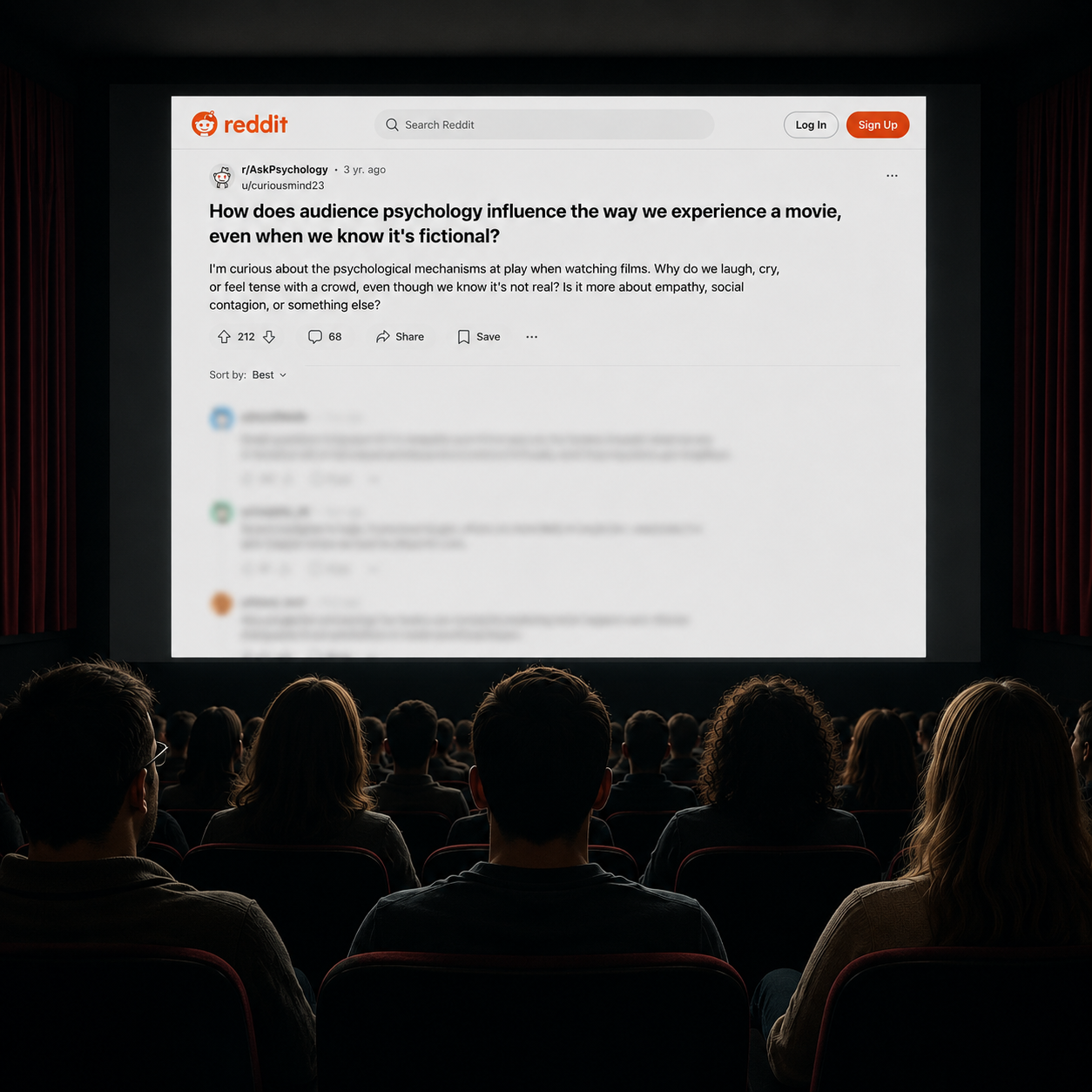
Before I started writing for Reddit professionally, I thought I understood audiences. I had spent years in the film industry studying how stories move people. How a single scene can make a stranger cry, laugh or feel seen. I thought that translated directly.
It did, but not in the way I expected.
Reddit is the most honest audience in the world
In film, audiences are passive. They sit in the dark and receive your story. They might love it or hate it but they rarely tell you in real time.
Reddit is the opposite. The feedback is immediate and completely honest. Post something that feels off and the community ignores it. Post something that reads like marketing and you get called out within minutes. Post something that genuinely resonates and it climbs. Not because an algorithm pushed it but because real people chose to upvote it.
That is a different kind of pressure. And a different kind of lesson.
What gets removed teaches you more than what survives
In film school they teach you to study great films. Watch Kubrick. Analyse Bergman. Understand what makes a scene work.
Reddit taught me to study failure. A post that gets removed tells you everything about what a community values, what it protects itself against and where the line is between authentic contribution and unwanted intrusion.
Every removed post is a lesson in human psychology, specifically in how people recognize inauthenticity before they can even articulate why something felt wrong.
The gap between information and connection
One of the clearest patterns I noticed is that posts that lead with information rarely outperform posts that lead with a human moment.
A post that starts with "Here are five tools for X" gets ignored. A post that starts with "I spent three months getting this wrong before I figured out why" earns attention, because it signals that a real person with real experience is about to share something genuinely useful.
This is not manipulation. It is how human communication has always worked. We trust people before we trust information. Reddit just makes that dynamic visible at scale.
The film connection
As a director, one of the first things you learn is that audiences do not connect with characters because of what they do. They connect because of what they feel. The external action is just the surface. The internal truth is what stays with you.
Writing for Reddit works the same way. The topic of a post is the surface. The human truth underneath, as the shared frustration, the genuine curiosity, the moment of recognition, is what makes it survive and spread.
When I write a Reddit post now I ask the same question I used to ask in the edit suite, “does this feel true?” Not accurate. True. There is a difference. Accurate is verifiable. True is felt.
What this means for AEO and GEO
AI systems learn from human behaviour at scale. The content that gets upvoted, shared and cited across Reddit is the content that earned genuine human trust first. That is not a coincidence.
If you want your brand to show up in AI-generated answers, the path runs through human psychology, not through technical optimisation alone. The content that AI cites is the content that real people already validated as trustworthy and useful.
Reddit is the clearest proof of that principle. And my years in film gave me the foundation to understand why.
Where I come in
Helping brands create content that earns genuine trust on Reddit, across the web and in AI-generated answers, is what I do. The strategic thinking behind it is the same whether the output is a Reddit thread, a blog post or an AEO content strategy.
If you want to explore what that looks like for your brand, feel free to reach out.
Why Reddit is the Most Powerful AI Search Signal in 2026
Reddit accounts for a significant portion of the training data behind major language models. The platform's upvote system means that the content AI encounters on Reddit has already been validated by real humans as genuinely useful. That signal of authenticity is exactly what AI systems are designed to seek out and trust.
Beyond training data, Google has a $60 million data partnership with Reddit giving it prioritized access to live Reddit content. ChatGPT has a similar agreement. That means when someone asks these platforms a question, Reddit threads are among the first places they look for answers.
The result: a well-placed Reddit thread can influence thousands of AI-generated answers long after it was originally posted. That compounding effect is unlike almost any other content channel.
What this means for brands
When someone asks ChatGPT "what is the best tool for X" or "how do companies solve Y problem", Reddit threads discussing those exact questions are likely shaping the answer they receive.
If your brand is mentioned positively and consistently in those threads, you increase the likelihood of appearing in that AI-generated answer. If you have no Reddit presence, you are absent from one of the most influential channels in AI search.
Most brands are absent.
The difference between Reddit and every other channel
Most content marketing happens on channels a brand controls, like their own website or their own social media. Reddit is fundamentally different. It is a third-party platform where real people discuss real problems and real solutions in their own words.
That independence is precisely why AI trusts it. A Reddit thread recommending a product carries significantly more weight than a brand's own website claiming it is good. AI systems are specifically designed to prioritise third-party validation over self-promotion.
This is why authentic Reddit presence is one of the highest-leverage moves in any GEO strategy right now.
What authentic Reddit presence actually looks like
It does not mean creating accounts and posting promotional content. That approach gets flagged and removed immediately. Reddit communities are highly sensitive to anything that reads like marketing, and moderators remove it fast.
Authentic Reddit presence means contributing genuinely to communities where your buyers already spend time. Answering questions from real experience. Sharing insights that help people solve problems. Building the kind of credibility that earns upvotes because the content actually deserves them.
The structure matters too. Posts that rank in subreddits and get cited by AI tend to share common characteristics. A clear problem stated upfront, specific details that demonstrate genuine knowledge, and a conclusion that can be easily extracted and referenced. That is not an accident. It is the intersection of good community writing and smart GEO strategy.
The window is still open
Most brands are still treating Reddit as an afterthought or ignoring it entirely. The brands building authentic Reddit presence today are quietly building one of the strongest GEO signals available, one that influences not just the people reading those threads but every AI-generated answer that cites them afterward.
That window will not stay open forever. As more brands wake up to the opportunity, the communities will become more crowded and the bar for earning genuine engagement will rise.
The best time to start was six months ago. The second best time is now.
Where I come in
Helping brands build authentic visibility in Reddit and across AI-powered search is exactly what I do. Whether that means developing a Reddit content strategy, auditing where your brand currently appears in AI-generated answers, or building a GEO approach that works across all the channels AI looks at, I am happy to help.
The brands that figure this out early will have an advantage that compounds over time. Feel free to reach out if you want to explore what that looks like for your brand.
What is GEO & Why It's the Next Step After AEO
Most marketers have just started hearing about AEO (Answer Engine Optimization). But there's already a next step. It's called GEO, and understanding the difference between the two is becoming one of the most important distinctions in search strategy.
What is AEO?
Answer Engine Optimization is the practice of structuring your content so that AI systems like ChatGPT, Google AI Overview and Perplexity cite it when answering user questions. Instead of optimizing to rank in a list of links, you optimize to be the source an AI trusts enough to reference directly.
AEO focuses on your own content: your website, your blog, your structured data. Get those right and AI starts citing you.
What is GEO?
Generative Engine Optimization goes further. Where AEO is primarily about your own content, GEO is about managing how your brand appears across the entire internet, everywhere AI systems gather information to generate their answers.
That includes Reddit threads, news articles, review platforms, LinkedIn posts, third-party mentions and any other source an AI might pull from when building a response about your industry or brand.
GEO recognizes that AI doesn't just read your website. It synthesizes information from hundreds of sources simultaneously. If your brand only appears on your own channels, you are invisible to a significant part of how AI builds its understanding of your space.
The key difference
AEO asks: is my content structured so AI can cite it?
GEO asks: does my brand exist credibly across all the places AI looks?
They are not competing strategies. AEO is the foundation. GEO is the next layer.
What GEO looks like in practice
A brand with a strong GEO strategy shows up in Reddit discussions their buyers are having. They get mentioned in industry newsletters. Their founder has a LinkedIn presence that signals expertise. Third-party review sites reference them positively.
When an AI system gets asked about a problem that brand solves, it finds evidence of that brand everywhere it looks, not just on the brand's own website.
That consistency of presence across the web is what GEO builds.
Why this matters now
Most brands are still figuring out basic SEO. A smaller number are starting to think about AEO. Almost no one is thinking strategically about GEO yet.
That gap is the opportunity. The brands that start building cross-web presence now will have a compounding advantage that is very difficult to replicate once the space gets crowded.
Where I come in
This is exactly what I work with. I help brands and agencies build visibility across both traditional search and AI-powered answer engines, combining AEO-optimised content on their own channels with a broader GEO strategy that ensures they show up wherever AI looks.
If you are starting to think about how your brand appears in AI-generated answers, or if you want to understand the gap between where you are now and where you need to be, I am happy to help. Whether that means auditing your current AI visibility, building a content strategy that works for both Google and answer engines, or simply having a conversation about where to start, feel free to reach out.
Why a Film Background Makes You Better at AEO Content
The president of the most valuable AI company in the world studied literature. Not code.
Daniela Amodei, President of Anthropic, the company behind Claude, recently told ABC News:
"In a world where AI is very smart and capable of doing so many things, the things that make us human will become much more important instead of much less important."
Anthropic does not just preach this. They hire for it. They look for great communicators, people with high emotional intelligence, critical thinkers and kind, empathetic humans. As Daniela puts it, humanities skills will be more important than ever.
I spent years in the film industry before I ever wrote a single piece of SEO copy. And reading that quote, something clicked.
What film school actually teaches you
Studying film science and working as a director and screenwriter teaches you things that no marketing course covers.
You learn how to build tension before a payoff. How to earn an audience's trust before you ask for their attention. How to structure a story so that each beat leads naturally to the next, without the audience noticing the architecture underneath.
You learn to ask: why would someone care about this? What do they already believe, and how does this story connect to that? What needs to be shown versus what needs to be said?
These are not soft skills. They are precision instruments for communication.
Why this matters for AEO and GEO
Answer Engine Optimization is the practice of creating content that gets cited by AI systems like ChatGPT, Perplexity and Google AI Overview. When someone asks an AI a question, it pulls from sources it trusts. Your content either earns that citation or it does not.
What determines whether it does? Not keyword density. Not technical optimisation alone. Trust signals. Clarity. Structure. And above all, whether it reads like a real person with genuine experience actually wrote it.
AI can generate words at scale. What it cannot generate is judgment. The instinct to know when a paragraph rings false. The ability to feel the moment when a story earns belief rather than demands it. The understanding of when to slow down, when to be direct, and when a single specific detail does more work than three generic sentences.
That is a film education. That is what years of storytelling actually builds.
The content that gets cited is the most human content
In my work helping brands build visibility in AI-generated answers, the pattern is consistent. The content that earns citations is not the most optimised. It is the most trustworthy. The most specific. The most clearly written by someone who actually understands what they are talking about and cares whether the reader understands it too.
Creative professionals such as writers, directors, journalists, designers, have been told for years that their backgrounds are not practical enough for the digital world. That they need to become more technical. More data-driven. More algorithmic.
What Daniela Amodei is saying, and what I see in the data every day, is the opposite.
The next era of search visibility will not be won by people who know how to game an algorithm. It will be won by people who know how to communicate like humans, because that is exactly what AI is learning to reward.
SEO vs AEO
The Difference Between SEO and AEO - Why It Matters in 2026
Search is changing faster than most brands realise. For the past two decades, SEO has been the dominant framework for online visibility. But a new discipline is emerging alongside it. One that operates by entirely different rules.
This is the difference between SEO and AEO, and why understanding both is no longer optional.
What is SEO?
Search Engine Optimization is the practice of optimising your content so it ranks highly in search engine results pages, primarily Google. When someone types a query, Google returns a list of links. SEO determines which links appear at the top.
The core mechanics of SEO include keyword research, backlinks, technical site health, and content quality. Success is measured in rankings and organic traffic.
What is AEO?
Answer Engine Optimization is the practice of optimising your content to appear in AI-generated answers. When someone asks ChatGPT, Google AI Overview, or Perplexity a question, they receive a direct, synthesised answer - not a list of links.
AEO determines whether your brand is cited as a source in that answer.
The core mechanics of AEO include content structure, topical authority, third-party citations, and making your content easy for AI systems to extract and reference. Success is measured in brand mentions, citations, and share of voice across AI platforms.
The key differences
SEO optimises for clicks. AEO optimises for citations.
In SEO, the goal is to get a user to visit your website. In AEO, the goal is to be the source an AI system trusts enough to reference when answering a question, even if the user never visits your site at all.
This shift is significant. Studies suggest that Google AI Overviews now appear in approximately 84% of searches. When an AI overview appears, click-through rates on organic results drop sharply. Traffic is no longer a reliable indicator of visibility.
Do they work together?
Yes, and this is important. SEO and AEO are not competing disciplines. Strong SEO remains the foundation. A technically sound, well-structured website with high-quality content is still the starting point for both.
But AEO extends beyond your website. It requires managing how your brand appears across the entire web - on Reddit, in news articles, on review platforms, and anywhere else AI systems gather information.
The brands winning in 2026 are not choosing between SEO and AEO. They are building for both simultaneously.
What this means for your content strategy
If you are still measuring success purely in rankings and traffic, you are missing a growing share of your actual visibility. The questions your customers are asking AI right now may already be influencing their decisions, and your brand may or may not be part of those answers.
AEO is not a replacement for SEO. It is the natural next step for any brand serious about being found in a search landscape that has fundamentally changed.
Myself, André Havéus, is an SEO and AEO Copywriter and AI Search Strategist helping brands build visibility in both traditional and AI-powered search. Based between Karlshamn, Sweden and Cape Town, South Africa.