The Death of Brand Voice - And Why Storytelling is the Only Antidote
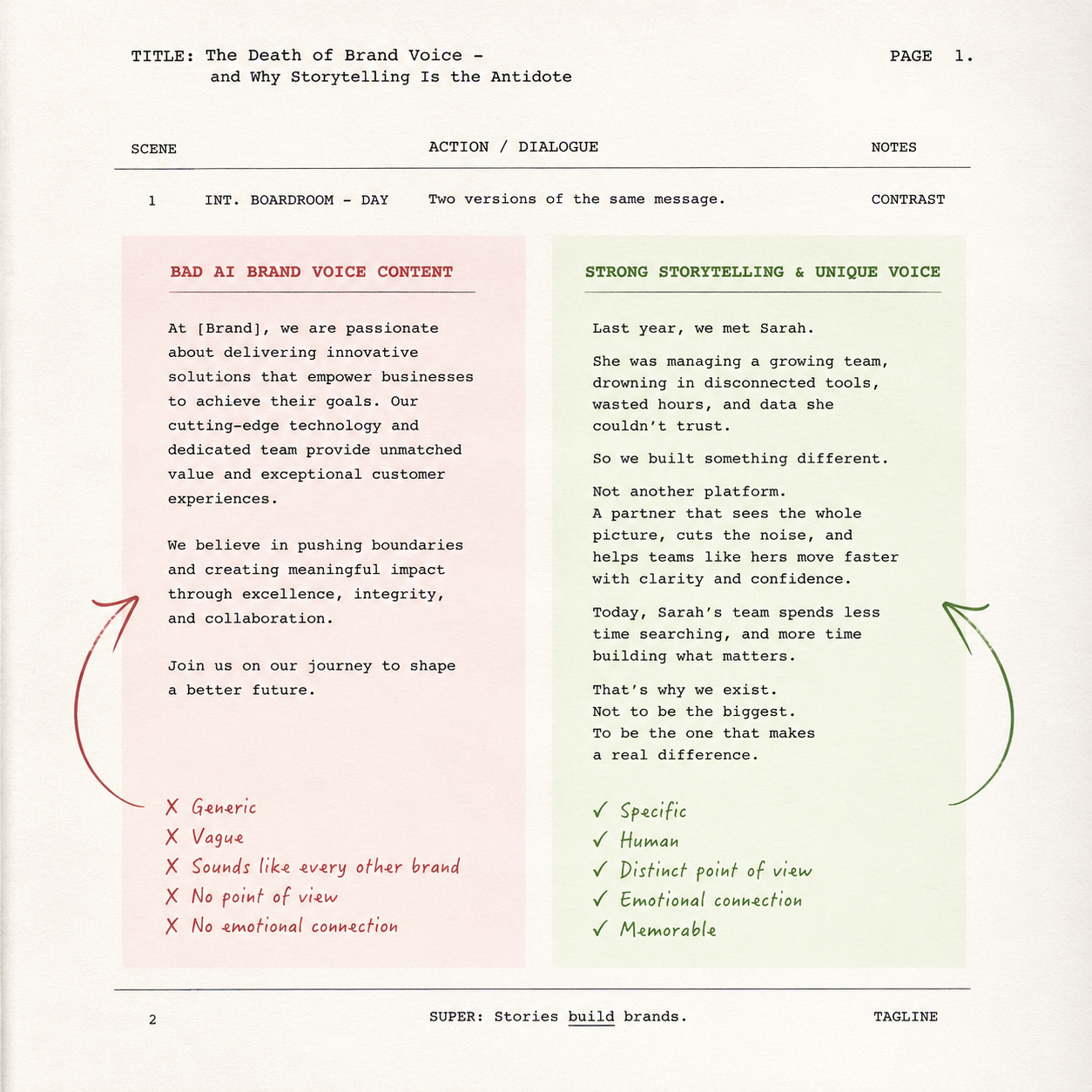
Something is disappearing from the internet. You can feel it before you can name it.
You open a company's homepage or LinkedIn page and the copy feels familiar. Not because you've read it before, but because you've read something exactly like it a hundred times. The sentence rhythm is the same. The enthusiasm is the same. The carefully placed em dashes, the "we're passionate about" and the "in today's fast-paced landscape" are all the same.
You're not reading a brand. You're reading a template wearing a logo.
What brand voice actually is
I spent years in the film industry before I ever wrote a line of marketing copy. And the thing that film teaches you is that voice is not style. Voice is not tone of voice guidelines or a list of adjectives on a brand deck.
Voice is what's left when you strip away everything a brand is trying to sound like and find what it actually is.
A great film character doesn't have a consistent tone. They have a consistent truth. You know them not because they always speak in the same register but because there is something irreducibly specific about them. A way of seeing the world that couldn't belong to anyone else.
That's what brand voice is supposed to be. Not a style guide. A soul.
What is killing it
I'm not going to pretend the problem started with AI. Brands have been retreating from specificity for decades - flattening themselves into the safest, most broadly appealing version of themselves, terrified of alienating anyone and ending up alienating everyone by being interesting to no one.
AI accelerated something that was already in motion. It handed the fear of specificity a tool that could produce infinite amounts of inoffensive, structurally correct, algorithmically optimised content at zero marginal cost.
The result is what you see now. An internet where everything is technically fine and nothing is memorable. Where every company in the same sector sounds like a slightly different version of the same company. Where the brand voice guidelines say "bold and human" and the output says "leveraging synergies to drive meaningful outcomes."
The irony is that the brands leaning hardest into AI-generated content are also the ones most loudly claiming to be authentic.
What storytelling actually does
Here's what I learned from making short films that had to work in ten minutes or less: you cannot fake specificity. You can fake polish. You can fake professionalism. You can fake enthusiasm. But the moment an audience, any audience, senses that nothing specific is at stake, they leave.
Specificity is what creates trust. Not broad claims about values. Not mission statements. The specific detail that could only come from someone who actually lived this, built this, failed at this, cared about this.
A brand that says "we're committed to quality" is saying nothing. A brand that says "we threw away three years of work because it wasn't good enough yet" is saying everything.
The difference between those two sentences is the difference between content and story. Content fills space. Story creates meaning.
The brands that survive this moment
They will not be the ones that automated the fastest. They will be the ones that held on to something irreducible. A perspective, a way of seeing, a reason for existing that couldn't be generated by a model trained on everyone else's content.
They will be the ones that understood that their voice was not a liability to be smoothed away in the name of consistency. It was the only thing that made them worth listening to.
Storytelling is not a content format. It is not a strategy or a framework or a growth hack. It is the oldest and most reliable way human beings have ever communicated what actually matters to them.
And right now, in a landscape drowning in content that matters to no one, it might be the most powerful competitive advantage a brand can have.
Where I come in
This is the work I care about most. Helping brands find and hold onto what makes them specific, and translating that into content that earns genuine attention rather than just filling a publishing calendar.
If your brand is starting to sound like everyone else and you know it, I am happy to have that honest conversation.