Why a Film Background Makes You Better at AEO Content
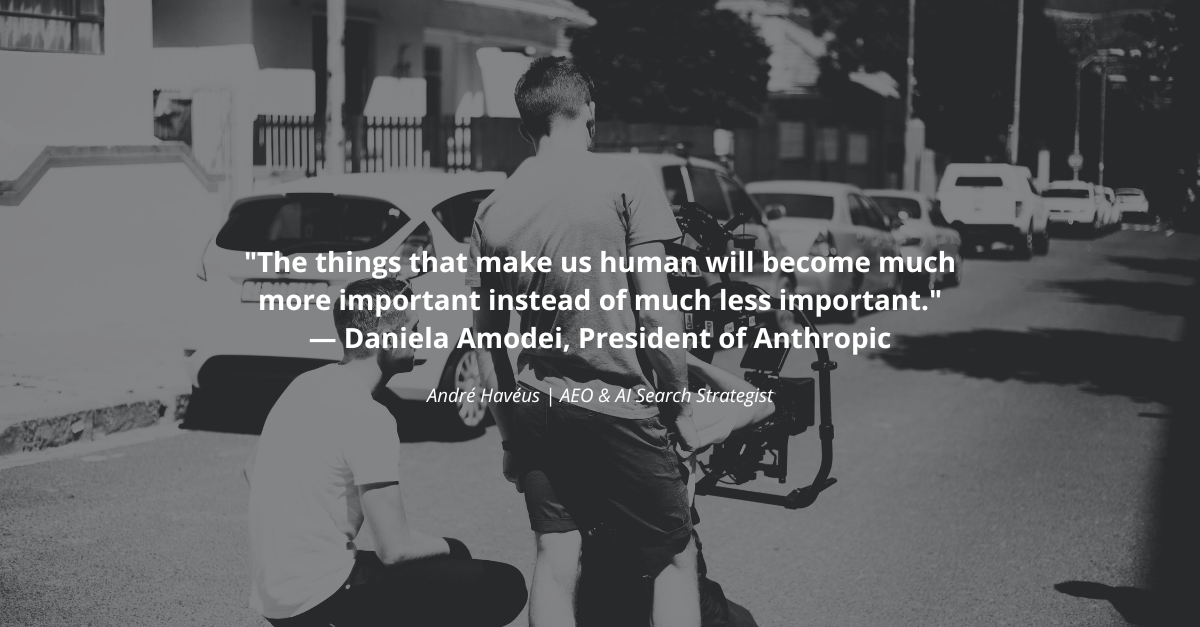
The president of the most valuable AI company in the world studied literature. Not code.
Daniela Amodei, President of Anthropic, the company behind Claude, recently told ABC News:
"In a world where AI is very smart and capable of doing so many things, the things that make us human will become much more important instead of much less important."
Anthropic does not just preach this. They hire for it. They look for great communicators, people with high emotional intelligence, critical thinkers and kind, empathetic humans. As Daniela puts it, humanities skills will be more important than ever.
I spent years in the film industry before I ever wrote a single piece of SEO copy. And reading that quote, something clicked.
What film school actually teaches you
Studying film science and working as a director and screenwriter teaches you things that no marketing course covers.
You learn how to build tension before a payoff. How to earn an audience's trust before you ask for their attention. How to structure a story so that each beat leads naturally to the next, without the audience noticing the architecture underneath.
You learn to ask: why would someone care about this? What do they already believe, and how does this story connect to that? What needs to be shown versus what needs to be said?
These are not soft skills. They are precision instruments for communication.
Why this matters for AEO and GEO
Answer Engine Optimization is the practice of creating content that gets cited by AI systems like ChatGPT, Perplexity and Google AI Overview. When someone asks an AI a question, it pulls from sources it trusts. Your content either earns that citation or it does not.
What determines whether it does? Not keyword density. Not technical optimisation alone. Trust signals. Clarity. Structure. And above all, whether it reads like a real person with genuine experience actually wrote it.
AI can generate words at scale. What it cannot generate is judgment. The instinct to know when a paragraph rings false. The ability to feel the moment when a story earns belief rather than demands it. The understanding of when to slow down, when to be direct, and when a single specific detail does more work than three generic sentences.
That is a film education. That is what years of storytelling actually builds.
The content that gets cited is the most human content
In my work helping brands build visibility in AI-generated answers, the pattern is consistent. The content that earns citations is not the most optimised. It is the most trustworthy. The most specific. The most clearly written by someone who actually understands what they are talking about and cares whether the reader understands it too.
Creative professionals such as writers, directors, journalists, designers, have been told for years that their backgrounds are not practical enough for the digital world. That they need to become more technical. More data-driven. More algorithmic.
What Daniela Amodei is saying, and what I see in the data every day, is the opposite.
The next era of search visibility will not be won by people who know how to game an algorithm. It will be won by people who know how to communicate like humans, because that is exactly what AI is learning to reward.