The Forest Doesn't Burn Alone
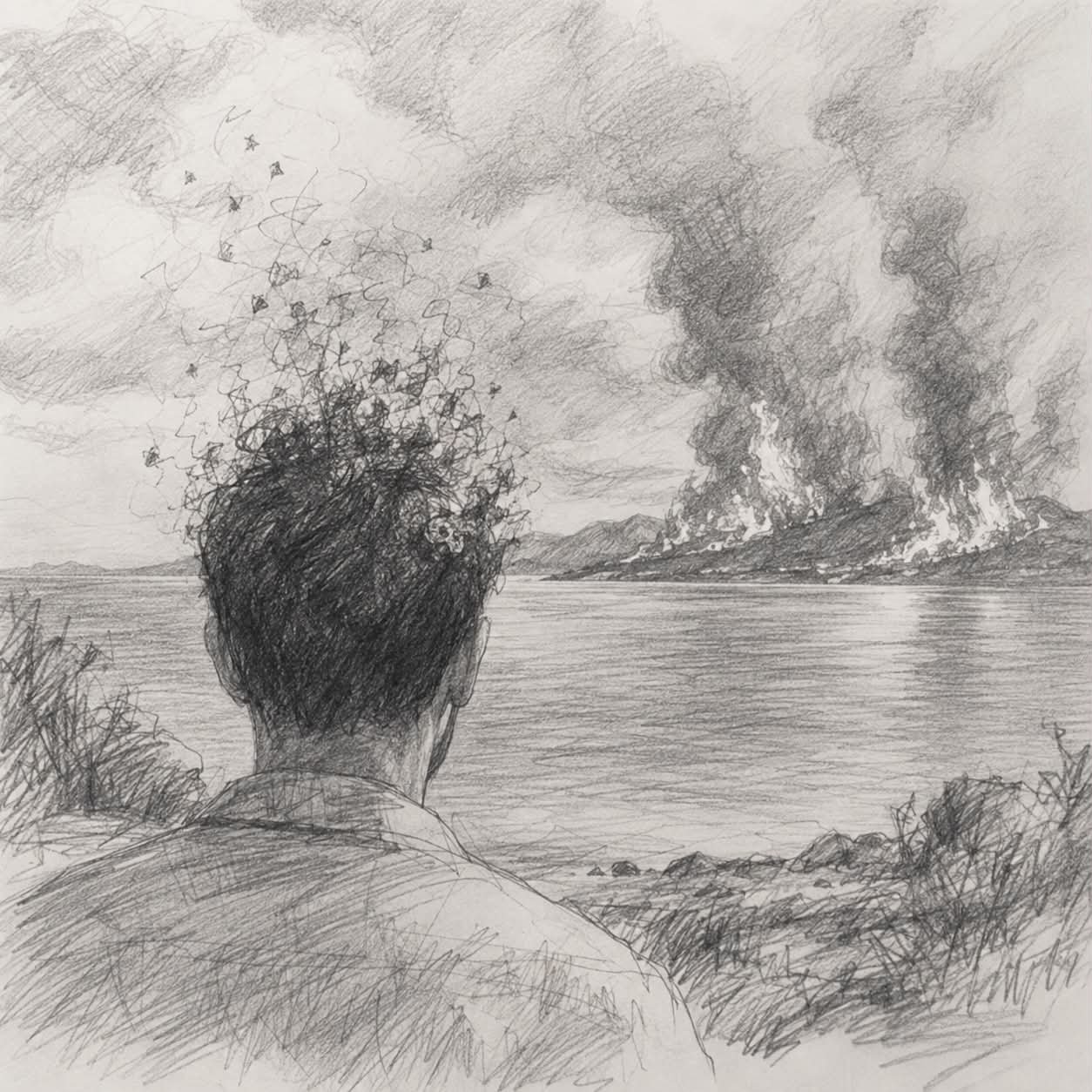
More and more people in my own generation (Millennials) and Gen Z are thinking about their health. We are refusing to separate the health of the self from the health of the planet.
Not as a political position, but as a lived conviction. The understanding that the same extractive logic that is burning through natural resources is the same logic that is burning through human beings. And that both are unsustainable for exactly the same reasons.
The body and the earth
The nervous system conversation that is happening among millennials and Gen Z is not separate from the climate conversation. It is the same conversation in a different register.
What does it mean to live sustainably? It means taking only what you need. Leaving enough for the future. Not treating any resource, such as soil, water, air, time, energy, and attention as infinite simply because it has not run out yet (btw, Sweden exhausted its renewable natural resources for 2026 on April 4th).
That applies to the planet. It applies equally to the human body and mind.
A culture that demands maximum productivity from its workers is making the same assumption as an industry that demands maximum yield from its land. That the resource is inexhaustible. That you can keep taking without consequence. That the signs of depletion are a performance issue rather than a warning.
Both assumptions are wrong. And the younger generation, the first to grow up with both a mental health crisis and a climate crisis as background conditions of their existence, is the first to feel that unease in their bodies before they can fully articulate it in words.
The Japanese model nobody is talking about
There is a concept in certain Japanese business philosophy that has no clean translation into English but approximates something like this: enough is a destination, not a failure.
The idea that a company can reach a point of sufficient scale (sufficient profit, sufficient growth, sufficient impact) and choose to stop expanding. Not because it lacks the capacity to grow further. Because it has decided that the value of what it has built is better protected by sustainability than by scale.
This is a fundamentally different relationship to growth than the one Western capitalism has normalized. In the Western model, stopping is always framed as losing. The company that is not growing is the company that is failing. The person who is not ambitious is the person who has given up.
But growing toward what? At what cost? Paid by whom?
The younger generation is asking these questions about their own lives with the same urgency that environmental scientists have been asking them about the planet for decades. And arriving at similar answers.
Enough is not a consolation prize. It is a deliberate choice. It is the recognition that beyond a certain point, more does not make things better. It makes them more fragile, more dependent on continued expansion to justify the cost already paid.
What sustainable living actually looks like from the inside
It looks like a 27 year old who has decided that their mental health is not a productivity variable to be optimized around. It looks like someone choosing a job with less prestige because it comes with actual time, time to sleep, to move, to be present with the people they love, to do nothing in particular without the background hum of guilt that nothing is being achieved.
It looks like people building practices, therapy, movement, time in nature, genuine rest, not as self-indulgence but as infrastructure. The same way you maintain a building or a forest. Not because it is luxurious but because neglect is more expensive than care.
It looks like a generation that has looked at burnout in their friends and their colleagues and in themselves, and decided that it is not a badge of honor. It is a systems failure. A sign that the demands being placed on a human being exceed what a human being can sustainably provide.
And it looks like people extending that same logic outward. If I cannot treat my own body as infinitely exploitable, why would I treat the planet that way? If rest is not weakness in a person, why is it weakness in an economy?
The connection the older generation missed
The boomer framing of environmentalism was largely about sacrifice. Give things up. Use less. Accept a lower standard of living in service of a future that may not arrive in your lifetime.
That framing failed. It failed because sacrifice without meaning is psychologically unsustainable. You can ask people to give things up temporarily, in a crisis. You cannot build a civilisation on permanent deprivation.
The younger generation is not approaching sustainability as sacrifice. They are approaching it as alignment. Living in a way that is consistent with what they actually value. Consuming less not because they are forced to but because they have genuinely stopped wanting the things that consumption was supposed to deliver.
The status symbol that requires destroying something - your health, your time, your relationships, a rainforest - is starting to look less like success and more like a very expensive way to feel empty.
That shift in perception is not small. It is the beginning of a genuinely different relationship to what a good life looks like.
What we are actually fighting for
There is a question underneath all of this that rarely gets asked directly.
If we cannot stand up for the people around us, such as the employees working themselves into exhaustion, the colleagues who burned out quietly while everyone pretended not to notice, the collaborators and their families absorbing the cost of decisions made in boardrooms they were never invited into, then what exactly are we fighting for?
Sustainability without humanity is just efficiency with better branding.
The organisations that genuinely care about the planet but treat their people as expendable resources have not understood the assignment. The logic is the same. The assumption is the same. That the resource, whether it is a forest or a human being, exists to be extracted from until it cannot give any more, at which point it gets replaced.
That is not sustainability. That is the same extractive model wearing a green coat.
Real sustainability begins with the person next to you. It begins with the choice to notice when someone is struggling before they have to say it out loud. To protect the wellbeing of the people in your immediate circle with the same urgency you bring to recycling, carbon offsetting or any other gesture toward a better world.
A colleague's mental health is an environmental issue. A family that cannot afford to eat properly because their employer underpays and overworks is an environmental issue. The human ecosystem and the natural ecosystem are not separate things. They are expressions of the same relationship between living systems and the demands placed upon them.
If we are serious about building a more sustainable world, and I believe many of us genuinely are, then we have to start in the room we are already in. With the people who are already in front of us. With the basic, unglamorous, deeply necessary work of treating the human beings around us as something worth protecting.
Everything else follows from that. Or it means nothing at all.
Where the two conversations meet
Mental health and environmental sustainability are not separate issues that happen to concern the same generation. They are the same issue viewed from different angles.
Both are about the relationship between a living system and the demands placed upon it. Both are about the difference between use and exploitation. Both are about the recognition that resilience requires recovery. That you cannot keep taking from something without also giving it the conditions it needs to regenerate.
The generation that grew up with both crises as given realities is the first to feel that connection intuitively. And the practices they are building - the therapy, the boundaries, the slower living, the deliberate consumption - are not separate from their environmental values. They are expressions of the same understanding.
You can’t care for the earth if you do not care for yourself. You can’t care for a child if you do not care for yourself. And you can’t care for yourself while participating enthusiastically in the destruction of everything your life depends on.
The younger generation is not perfect at this. Nobody is. But they are asking the right question.
What would it look like to live in a way that was actually sustainable for the planet, for the people around me, and for the person I have to be every single day until I die?
That question is not weakness. It is the most serious question a human being can ask.