Every great brand has a story worth telling.
Screenwriting teaches you something most copywriters never learn: the most important thing in any scene is almost never what's being said. The same is true for great copy.
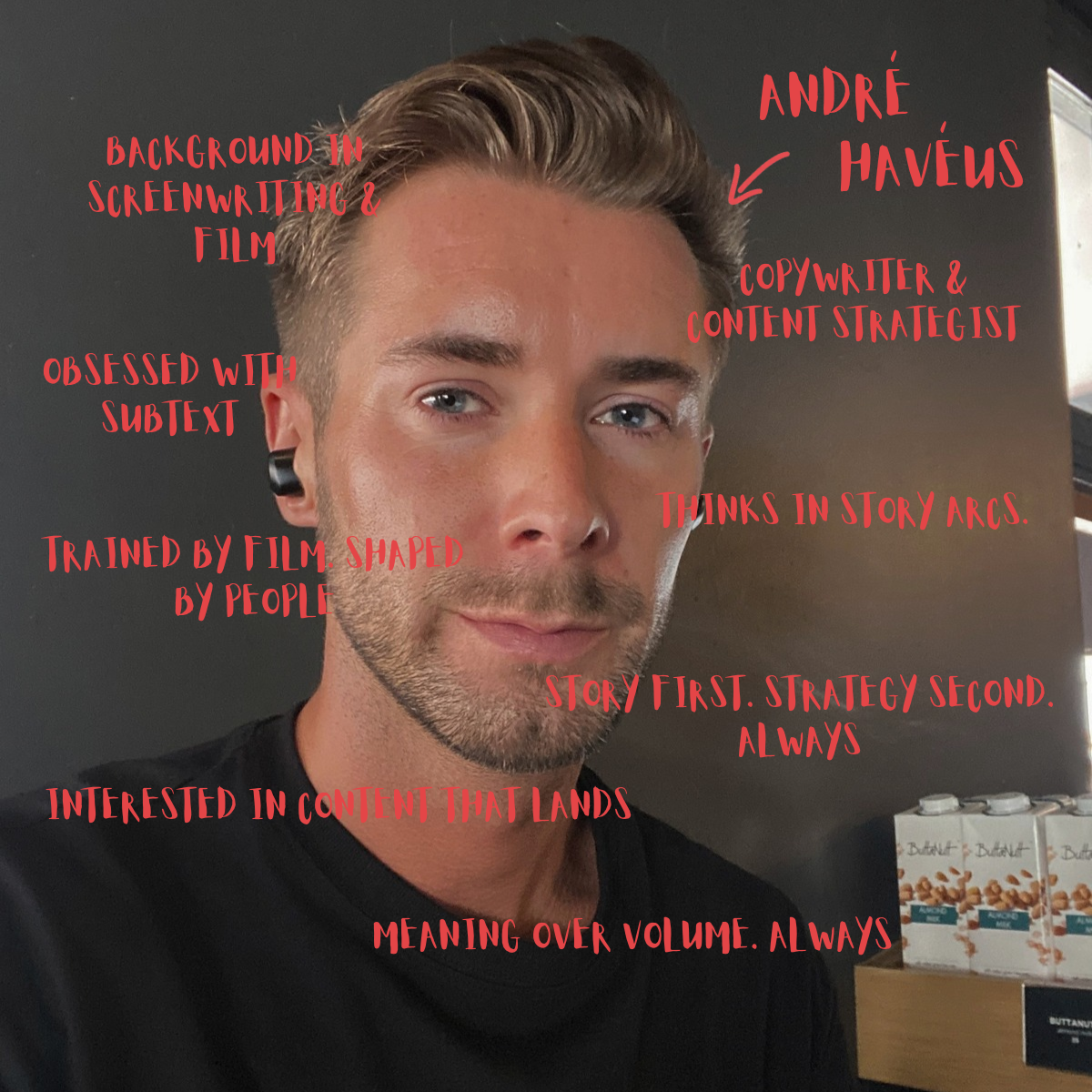
I became a copywriter because I was already a filmmaker. A screenwriter. Someone who spent years obsessing over the gap between what people say and what they actually mean. Over the small gestures that reveal character. Over why some stories stay with you for decades, and others dissolve before you’ve even closed the tab.
That’s a discipline, and it shapes every single word I write.
Trained by film. Shaped by people.
Screenwriting teaches you something most copywriters never learn: the most important thing in any scene is almost never what’s being said.
A character says “I’m fine.” What they mean is: I am holding myself together and I need you to see that without making me say it out loud.
That’s subtext. And I am obsessed with it.
Because good copy works exactly the same way. The best campaigns don’t tell you what to think. They create a moment of recognition with the reader. That recognition is what builds loyalty. Not a clever headline. Not a conversion-optimized CTA. A moment where a real person felt genuinely seen.
You can’t generate that. It requires someone who has been paying close attention to people for a very long time.
That’s what I bring to the table.
Thinks in story arcs. Writes in search-optimized prose.
Most copywriters start with the keyword. I start with the character. Who is this person, what do they actually want, and what are they really afraid of?
From there, structure follows naturally. The hook. The tension. The turn. The resolution. It’s not a framework I learned in a marketing course. It’s what happens when you’ve spent years writing scripts where every scene has to earn its place or it gets cut.
That discipline is rare in content right now. And it’s becoming more valuable by the day.
Because when execution is cheap the question of what those words should mean, and to whom, and why, becomes the only question that matters.
Story first. Strategy second. Always.
Interested in content that lands.
Scroll through any feed right now. The same minimalism that isn’t minimal, it’s just empty. Content that performs the idea of having something to say without ever quite getting there.
And then, occasionally, something cuts through. A piece of writing that makes you send it to someone with no comment except read this. A brand that makes you feel like the people behind it are actually alive and real.
Those moments are becoming rarer. And they are becoming more valuable.
Meaning over volume. Always.
The agencies and clients who still believe in this are out there.
I know you exist. You’re the ones who still lose sleep over whether a campaign means something.
You are going to win. Not because creativity is some romantic ideal worth protecting, but because humans are hardwired to respond to story, to honesty, to the feeling that the thing they’re reading was made by someone who actually cared.
The printing press didn’t end writing. Photography didn’t end painting. And AI won’t end the one thing it cannot replicate: a perspective that comes from a life genuinely lived and paid attention to.
Don’t buy the panic. Read a book. Watch a film. Spend time with people you love.
The future is bright, but only if we let it be.
Access Is Not Expertise.
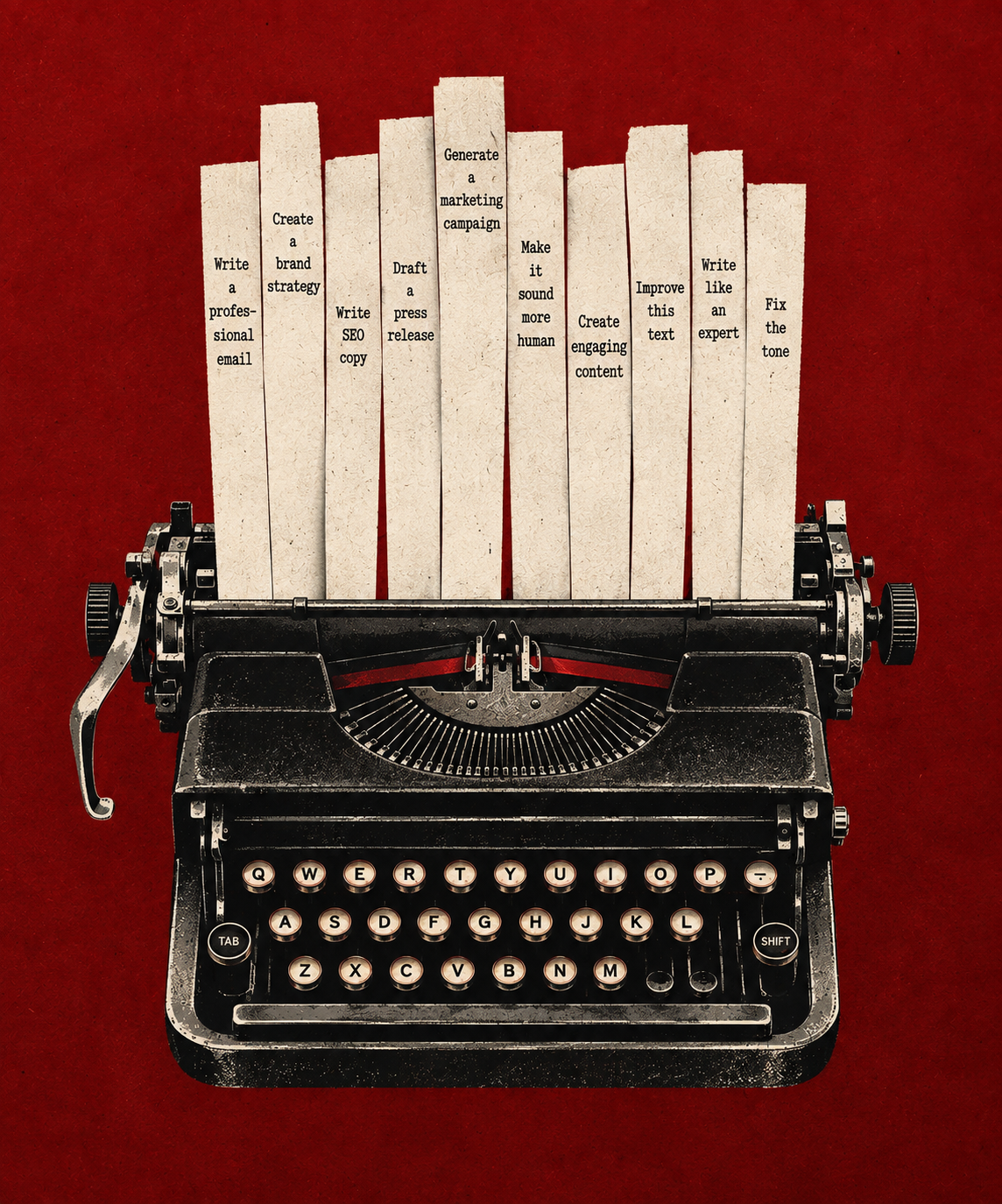
When did everyone become a copywriter? Around the time AI produced something that looked impressive on first read. Access is not expertise. It never was.
Why Your Brand Sounds Like Everyone Else
When did everyone become a copywriter?
When did a room full of people who had never written a campaign decide they had all it figured out?
I think it was around the time AI produced something that looked impressive on first read. Impressive enough to convince a room that the hard part was done. Not quite impressive enough to do the actual job.
What the tool actually gave us
Something happened when the AI tools became accessible to everyone at the same time.
Suddenly the client arrived at the briefing with three headline options they were already attached to. The marketing manager rewrote the copy themselves and wanted to know why my version was different. The founder told me, with genuine enthusiasm , that Claude had basically handled the About page. They just needed me to check it over.
I understand the logic. The output maybe looked professional. If you have never spent years thinking carefully about what makes communication actually work, it can genuinely be difficult to see what’s wrong with it.
What’s wrong with it is that it sounds like everyone else. Because it was trained on everyone else.
The brief that puts you in an impossible position
It is not just clients who show up with AI output and call it done. It is the brief that arrives asking you to use AI to make the process faster.
So you do. You use the tools carefully. You rewrite draft after draft, each one slightly closer to something real but still not quite there. Still carrying that particular quality of having been averaged from everything that came before it.
Nobody is satisfied. The client is frustrated and the team is frustrated. But somehow the question that surfaces is not whether the process was the problem. It is whether you are good enough at your job.
I have been doing this for years. And in that moment, sitting across from a revision note that questions your craft because the AI draft felt more efficient, it’s difficult not to feel like the ground has shifted under you.
Not because the criticism is fair. But because the room stopped asking whether the process was the problem.
Numbers Are Safe. Ideas Are Not.
And underneath all of this, something else is happening.
There is a slow, passive-aggressive erosion of the creative role itself. Not confrontational, but just a steady accumulation of moments where the question is implied rather than asked; do we actually need this? Do we need someone whose process takes time, whose best work cannot be scheduled, whose output is difficult to measure in a spreadsheet?
The people asking that question, quietly in budget meetings and capacity planning sessions, are rarely the ones whose roles are under the same scrutiny. The sales team can show their numbers. The account managers can show their pipeline. The data analysts can show their dashboards. These roles are legible in ways that creative work has never been. And in an environment where AI can now produce something that looks like creative work in thirty seconds, the argument for protecting the time and space that creative work requires becomes harder.
What I find most telling is who feels safe in this moment. The people pushing hardest for AI-first creative processes are almost never the ones whose jobs are being replaced by them. They are optimising someone else's role out of existence while quietly protecting their own.
What copywriting actually requires
Let me be direct about something most people who hire copywriters do not fully understand.
Copywriting is not filling in the text. It is not making things sound professional. It is the strategic application of language to produce a specific effect in a specific person at a specific moment in their relationship with a brand.
That requires knowing the person reading. What they are afraid of, what they want to believe about themselves, what would make them trust you versus what would make them leave. It requires knowing the brand, not the approved adjectives in the guidelines, but the actual specific truth of what makes it different.
It requires judgment. The ability to choose, from among many technically correct options, the one that is actually right. The one that earns attention rather than just receiving it.
That judgment is not a talent you either have or do not have. It is built through years of work. Through the accumulated understanding of what an audience does when they encounter something real versus something that resembles something real.
A prompt cannot replicate that. It can produce output that looks like the product of that judgment. But it cannot produce the judgment itself.
And when you ask a professional to work inside a process that removes the conditions for that judgment to operate, you are not getting faster access to their best work. You are getting a constrained version of what they could produce, filtered through a workflow designed for something other than quality.
The result is generic, and the professional knows it is. But nobody wants to say it out loud.
What it does to your brand over time
The specific quality that made a brand recognizable starts to disappear. The edges that gave it character get averaged away, and it begins to sound like a slightly different version of every other brand in its category running the same tools through the same prompts.
The audience always notices this before the brand does. People rarely articulate why a brand feels different than it used to, but they feel it. The sense that something has changed and that the communication is coming from somewhere less real.
Trust disappears slowly until the cumulative effect shows up in numbers that nobody immediately connects to the decision made a year earlier to handle the copy in-house with a tool.
The question worth sitting with
Before you decide the copy-problem is solved, ask this.
Does this really sound like us? Or does it sound like a very competent version of our category?
And before you question the professional sitting across from you, did you give them the conditions to produce something genuinely good? Or did you give them a tool, a tight timeline, a brief that was already half-answered by a model, and then express surprise when what came back felt like everyone else?
The process produces the output.
If the output is not good enough, the honest question is whether the process was ever designed to produce something good from the start.
Access is not expertise. It never was, and the brands that understand that difference are the ones still worth listening to.
The Fastest Way to Be Forgotten - Why Great Brands Give Creativity Time
You can force a deadline. You can force a deliverable. You cannot force the moment when an idea becomes something worth remembering. That moment requires space, and most brands have stopped giving it.
I have sat in enough creative meetings to know the moment a brief stops being about the work and starts being about the clock.
That is the moment the best ideas leave the room.
The brief says: faster. The budget says: cheaper. The AI says: here is something technically correct, ready in twelve seconds. And so the campaign goes out. The content gets published. The calendar gets filled.
And nothing sticks.
What the creative industry forgot
I came from film before I came from marketing. The one thing that nobody in the film industry would ever dispute, even the ones obsessed with budgets and schedules, is that a great story cannot be forced.
You can force production. You can force a deadline. You can force a deliverable. You cannot force the moment when an idea becomes something worth remembering.
That moment requires something that no AI tool, no efficiency framework and no quarterly content calendar can manufacture: space.
Space to sit with an idea long enough to find out what it actually is. Space to try the wrong version before you find the right one. Space to be uncomfortable with something half-formed before it becomes something whole.
The great campaigns that stayed with you, the ones you still remember years later, were not the ones produced fastest. They were the ones given enough room to become something specific.
The paradox of speed
Here is what I have observed working across film, copywriting and brand strategy: the faster a piece of content is produced, the more it resembles everything else produced at the same speed.
Speed optimizes toward the average. It defaults to what has worked before, what looks right, what sounds right, and what can be approved without friction. It eliminates the detours and the wrong turns and the uncomfortable conversations. The very things that creative processes need to produce something genuinely unexpected.
A brand that produces content at maximum speed is a brand that has decided to compete on volume. And in a landscape where AI makes volume essentially free, competing on volume is no longer a strategy. It is a surrender.
What creativity actually needs
In film, we talk about the difference between a shot that is technically correct and a shot that is alive. The technically correct shot is achievable every time. The shot that is alive requires conditions. The right light, the right moment, and the right willingness to wait for something real rather than settle for something adequate.
Creativity works the same way in every medium.
It needs constraints. Yes, deadlines and budgets and briefs are not the enemy of creativity, they are the conditions that force it to become specific. But within those constraints, it needs time to breathe. Time to fail. Time to come back to something you thought was finished and realize it was only almost right.
The brands that stand out are not the ones that produced the most. They are the ones that gave their best ideas enough room to become their best ideas.
The business case for slowness
I understand the pressure. I have worked inside it. When every competitor is producing more content more quickly, slowing down feels like falling behind.
But the question is not how much content you can produce. The question is how much of it anyone will remember.
One campaign that earns genuine attention is worth more than fifty pieces of content that disappear into the feed within hours. One brand voice that is specific enough to be recognizable is worth more than a year of technically correct copy that could belong to anyone.
The power of standing out lies in your ability to allow creativity the space and time it needs. Not unlimited time, but purposeful time. Not slow for its own sake, but slow enough to find the specific thing that only you could have made.
That is what lasts. That is what gets remembered. That is what no amount of AI-generated speed can replicate.
Where I come in
The work I care most about is helping brands create the conditions where something genuinely memorable can emerge. Not just filling a content calendar, but finding the specific creative truth that makes a brand worth paying attention to.
If you want to explore what that looks like, I am happy to have that conversation.
The Quiet Power of Empaths in a World That Rewards Narcissists
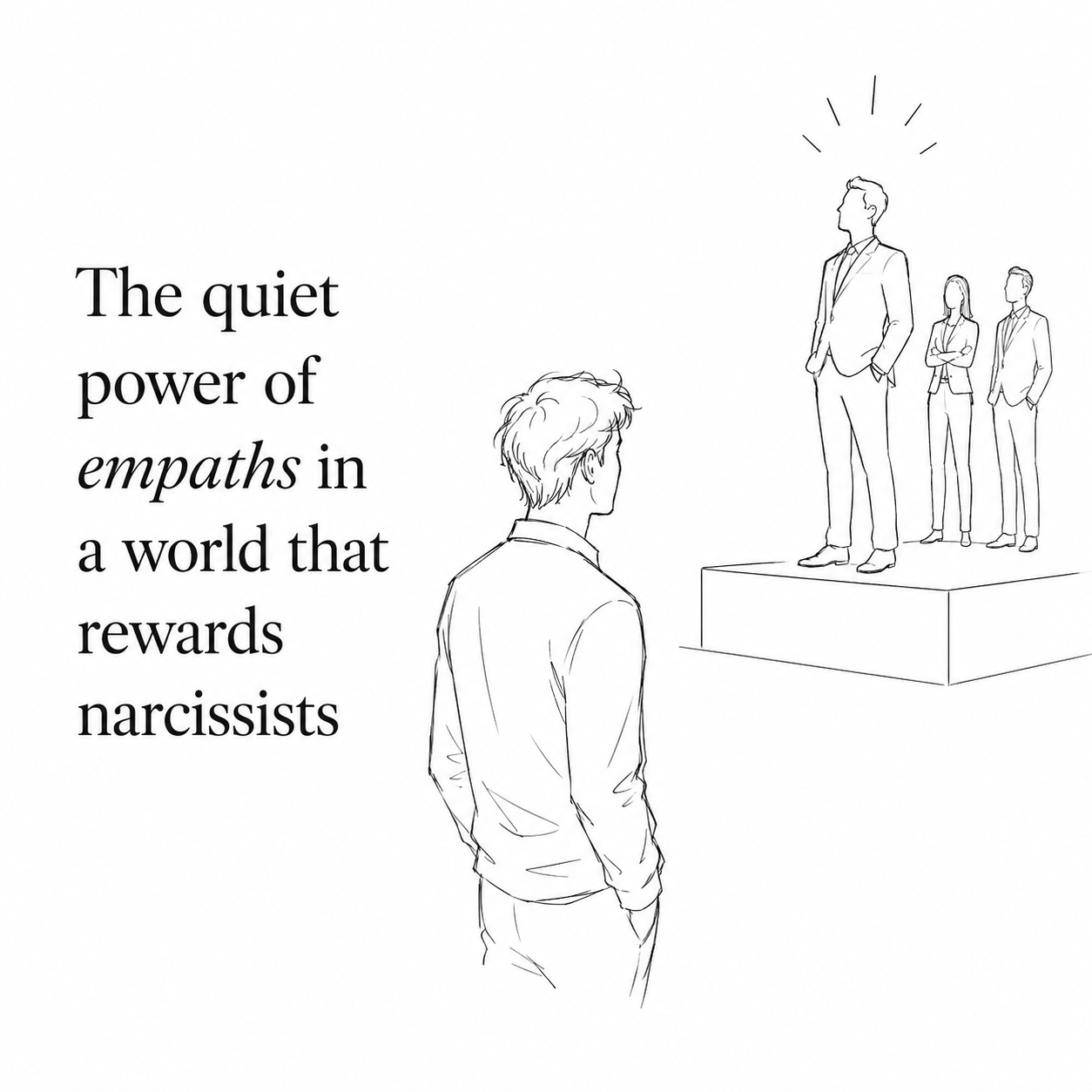
In a world optimised for narcissism, empathy is the rarest and most valuable resource available. The empaths are not behind. They are carrying something the world is about to need very badly.
Something is wrong with how we define strength.
Not obviously wrong. Not wrong in a way that is easy to name or argue against in a meeting or a pitch deck. Wrong in the way that things are wrong when they have been normalised for so long that the wrongness itself has become invisible.
We have built a world that rewards a very specific set of traits. Confidence without doubt. Certainty without nuance. The ability to speak loudly and move fast and project the kind of authority that makes other people stop asking questions.
And we have called that strength.
I want to suggest that it is not.
The story we are inside
The most powerful people in the world right now are telling a very compelling story. That AI will solve everything. That speed is survival. That efficiency is the highest virtue. That the people who move fastest will inherit the earth and the rest of us should be grateful for the disruption.
It is told with extraordinary confidence. And confidence, as any filmmaker knows, is one of the most persuasive tools in existence. It does not require truth. It only requires that the audience has no compelling alternative narrative to hold onto.
But I notice something about that story. It has no room for doubt. No room for complexity. No room for the kinds of questions that make powerful people uncomfortable. Questions about cost, about consequence, about who is not in the room when these decisions get made.
Those questions require a particular kind of intelligence to ask.
Not the kind that optimises. The kind that feels.
What empathy actually is
Empathy is not weakness. It is not sentimentality or naivety or an inability to make hard decisions.
Empathy is the capacity to hold another person's reality alongside your own. To understand that your experience of the world is not the only valid one, and to let that understanding actually change how you act.
That is an extraordinarily sophisticated cognitive and emotional skill. It requires more processing, more nuance and more genuine courage than the alternative, which is simply to optimise for your own interests, your own vision, your own certainty, and call that leadership.
The world is full of people who have mistaken the absence of empathy for strength. Who have learned to perform confidence so completely that they have forgotten what they do not know. Who have surrounded themselves with people who reflect their certainty back at them and called that consensus.
That is not strength. That is a very elaborate defence mechanism. And it is extraordinarily fragile, because it depends entirely on never being wrong, never being challenged and never having to sit with a reality that does not confirm what you already believe.
What gets built without it
I think about this in the context of the things being built right now.
The technologies deployed at scale with extraordinary speed and almost no accountability. The platforms that have reshaped how billions of people think and relate and understand the world. The AI systems trained on human creativity and released without asking the humans whose work made them possible.
The people building these things believe they are making the world better, but I and many more believe it’s something much more sinister than that. Belief without empathy is dangerous. It allows you to build things that solve your problem without asking whose problem you are creating. It allows you to move fast without looking at what you are breaking. It allows you to call disruption progress without asking who is being disrupted and at what cost.
The environmental cost of the data centres running AI at scale. The displacement of workers who cannot retrain fast enough. The erosion of trust in images, in language, in the basic shared reality that makes human communication possible.
These are not abstractions. They are consequences felt by real people in real bodies living real lives on a planet that is running out of time.
Empathy is what allows you to care about that. And caring about it is not an obstacle to progress. It is the only thing that makes progress worth having.
The competitive advantage nobody wants to talk about
Here is the paradox that the current moment has created: in a world optimized for narcissism, empathy is the rarest and most valuable resource available.
The ability to genuinely understand another person. What they fear, what they need, what they would never say out loud but desperately want someone to notice, is something no AI can replicate and no algorithm can generate. It requires being human in the fullest possible sense of the word.
In communication and marketing, empathy is the difference between content that fills space and content that changes minds. In leadership, it is the difference between compliance and genuine commitment. In any creative work such as film, writing, strategy, design, it is the difference between something technically correct and something that stays with you long after you have encountered it.
The empaths are not behind. They are not naive or slow or insufficiently ambitious.
They are carrying something the world is about to need very badly.
What this moment actually requires
I am not optimistic by default. I have seen enough of how power works, both privately and professionally, to know that the people with the loudest voices and the most capital do not always lead us somewhere worth going.
But I am not pessimistic either. Because I have also seen what happens when people with genuine emotional intelligence decide to stop apologizing for it. When they stop performing the confidence of people they are not and start using the actual advantage they have. The ability to see clearly, to feel accurately and to act from a place of genuine understanding rather than performed certainty.
The future will not be built by the people who moved fastest. It will be shaped by the people who understood what it means to be human. What we need. What we are losing. What is worth protecting even when it is inconvenient. Even when it is expensive. Even when the people with the loudest voices are telling you it is already too late to care.
Emotional intelligence is not a soft skill. It is the hardest and most important skill there is.
And in a world that is trying very hard to convince you otherwise, holding onto it is a radical act.
AI Can Write Your Copy. It Can't Write Your Character.
AI produces technically correct content. But character, the thing that makes a brand irreducibly itself, is something it cannot generate.
Let me say something that might sound strange coming from someone who uses AI everyday.
I use AI in my work constantly to pressure test ideas, to structure thinking, to move faster than I could alone. But there is something AI cannot do. And right now, in a marketing landscape where everyone has access to the same tools producing the same output, that something is the only thing that actually matters.
AI cannot write your character.
What character actually means
In film, character is not personality. It is not tone of voice or a list of adjectives on a creative brief. Character is the specific set of beliefs, contradictions, fears and commitments that make a person, or a brand, fundamentally themselves.
You know a great film character not because they are consistent. You know them because they are specific. Because there is a way they see the world that could belong to no one else. Because when they speak, you recognise something true. Something that couldn't have been invented, only discovered.
That is what the best brands have always had. And it is exactly what AI cannot generate.
AI is trained on everything. That is its power and its fundamental limitation. It produces the most statistically likely version of any given thing. The average of all the voices it has absorbed. It optimizes toward what has worked before.
Character, by definition, is not the average. It is the specific. The unexpected. The thing that makes you unmistakably you.
What is actually happening right now
I read a lot of brand content. It is part of my job. And the pattern I see emerging is this: as more companies hand their content over to AI, the output becomes more technically correct and less worth reading.
The sentences are cleaner. The structure is tighter. The keywords are in the right places. And there is nothing in any of it that you would remember tomorrow.
Because memory requires specificity. And specificity requires someone, a real person with a real perspective, to have been brave enough to say something specific.
The brands disappearing into the noise are not disappearing because they are using AI. They are disappearing because they have outsourced the one thing that could never be outsourced. The decision about who they actually are.
What I learned from directing actors
When I directed films, the hardest part was never the technical execution. The hardest part was helping an actor find the specific truth of a character. The thing underneath the lines that made everything they said feel inevitable rather than performed.
You cannot tell an actor to be more authentic. Authenticity is not a direction. It is a result. It comes from specificity. From knowing exactly what this character believes, fears, wants and is unwilling to give up.
The same is true for brands. You cannot brief your way to character. You cannot A/B test your way to a soul. You have to do the harder work of actually knowing who you are, and then having the courage to say it out loud, consistently, even when it means not sounding like everyone else.
The competitive advantage nobody is talking about
In a world where every company has access to the same AI tools producing the same quality of technically correct content, character is the only differentiator left that cannot be replicated.
You can replicate a tone of voice. You can replicate a content format. You can replicate a posting frequency. You cannot replicate the specific accumulation of decisions, failures, beliefs and commitments that make a brand genuinely itself.
That is your moat. Not your product features. Not your SEO strategy. Not your content calendar.
Your character. The thing AI can describe but never become.
Where I come in
Helping brands find and hold onto what makes them specific is the work I care about most. If your content is starting to sound like everyone else's; technically fine, strategically sound and somehow forgettable, I am happy to have that conversation.