Why Your Click-Through Rate Collapsed in 2026
Your clicks didn't disappear. AI search took them, a global recession changed your buyer, and most agencies are still looking at the wrong dashboard. Here's what's actually happening in 2026 — and what it actually requires.
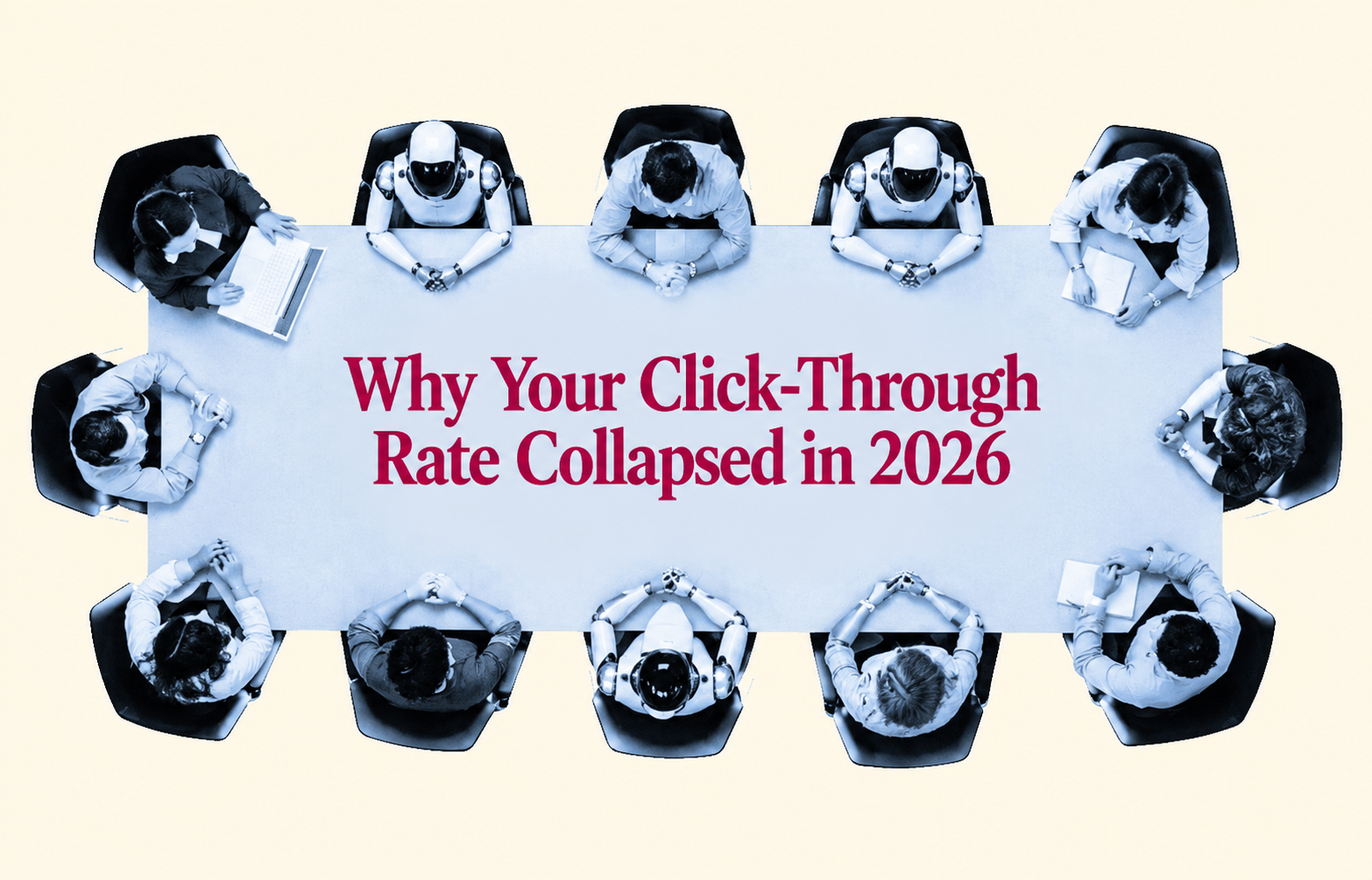
It's become a recurring conversation in 2026. A client calls their digital marketing agency. Conversion rates are down. Click-through rates have collapsed. Traffic looks like an ECG on a patient just taken off life support. The question is always the same: What's happening?
What's actually happening is three things at once. And you can't fix them with more blog posts, a new ad budget, or an A/B test on button colour.
AI Has Stolen the Front Page of the Internet
In September 2026, internal documents from Microsoft's lawsuit with The New York Times revealed something the industry already knew but had never seen in black and white: when users search via Copilot instead of regular Bing, clicks to external websites drop by up to 93 percent. A Microsoft researcher called it a "doom loop" for the web. An OpenAI engineer put it even more plainly back in 2023: "No matter how prominently we show the links, users won't click."
Google AI Overviews answers directly. Perplexity cites one source and never sends traffic onward. ChatGPT closes the question.
According to HubSpot's State of Marketing 2026, 92% of marketers are now using, or planning to use, optimisation for AI search engines. This is no longer a niche strategy. It's the baseline requirement. And yet most agencies are still counting organic sessions as if it were 2019.
The new metric isn't the click. It's the citation. The brand mentioned in the AI answer wins visibility, credibility and recognition, without generating a single session in Google Analytics. Marketers who understand this now track how often their brand appears inside AI-generated answers. Those who don't are still optimising for a world that no longer exists.
The Middle Class Has Essentially Disappeared as a Buyer
A global recession is underway. Disposable income has shrunk dramatically. People who used to click, compare prices and add products to digital shopping carts are now running a completely different calculation every morning: bills, food, rent. What used to be an obvious purchase is now an active decision not to buy.
The middle class, the group that for decades drove consumption of everything from subscription services and home furnishings to fitness equipment and digital tools, is in a financial position it never anticipated. Savings are gone. Margins are gone. And with them: the impulse purchases, the loyalty programmes, and the digital consumption that entire business models were built on.
Clients calling their agencies and asking about conversion drops are forgetting to ask the more fundamental question: Can my customer actually afford this right now?
It's not the campaign's fault. It's not the copywriter's fault. It's not even the algorithm. It's that the economic reality of your target audience looks fundamentally different in 2026 than it did in 2021.
The Agencies Don't Have the Answer
On Reddit, a Head of Marketing at a B2B company put it better than most analyst reports: "2026 feels like a completely different year. Not a weak quarter. Not one underperforming channel. Fundamental changes across the entire funnel."
What he's describing isn't an anomaly. It's the new normal.
And in the comment threads under that post, and hundreds like it, a pattern emerges: agencies that added a slide about "Generative Engine Optimization" to their sales deck and then kept doing exactly what they were doing in 2022. More blog posts. More backlinks. More AI-generated content they hope will rank — in a world where AI engines actively prioritise human voices, Reddit threads, third-party reviews and established brand authority over machine-produced articles.
One commenter put it plainly: "If an agency claims they can game Perplexity the same way they gamed Google in 2018, they're selling snake oil with a new buzzword on the invoice."
The Expertise AI Can't Replicate
In the middle of all this chaos, demand for one specific skill set is growing.
People who understand what communication is actually supposed to do.
AI cannot understand what a human needs to hear in 2026, when the economy is tough, the future feels uncertain, and trust in brands is at a historic low.
A copywriter with genuine expertise does three things no prompt can replicate. They understand the intent behind the search query, they write for passage indexing and AI citation with precision, and they choose the one that actually lands with a real person in a real situation.
What This Requires From You as a Brand
The clicks are not coming back the way they were. That's not a forecast. It's a statement of fact.
The new metrics are citation, trust and relevance at the right moment. It requires content specific and well-structured enough for AI systems to choose to cite it. It requires presence beyond your website: on Reddit, in industry publications, in third-party reviews, because that's where AI engines actually look when building their answers.
And it requires a copywriter who understands all of this. Not a prompt operator. A strategist who uses language as a tool.
That's a rare combination of skills. And it isn't cheap. But it's cheaper than continuing to pay for dashboards measuring a reality that stopped existing two years ago.
Keywords Are Dead. Structure Is Everything.
Keywords aren't dead. Keyword density is. There's a difference. And most brands are optimising for the wrong one.
Keywords aren't dead. Keyword density is.
There's a difference.
Most brands are still writing for 2019. Briefing writers with a keyword and a word count. Measuring success by how many times a phrase appears on the page. Treating SEO copywriting as the practice of inserting terms into otherwise normal text at a frequency someone once decided was optimal.
The discipline has moved on. Most of the people executing it have not.
I have spent the last three years working at the intersection of SEO copywriting, AEO and GEO, helping brands build content that ranks on Google and gets cited by AI systems like ChatGPT, Perplexity and Google AI Overview. What I see across clients and industries is a consistent gap between what SEO copywriting actually requires in 2026 and what most teams think it requires.
Here’s what that gap actually costs.
What SEO copywriting actually is in 2026
SEO copywriting in 2026 means writing for search intent, passage indexing and AI citation. Not keyword density.
That sounds simple. It’s not, because it requires understanding three distinct jobs that good SEO copy has to do simultaneously.
The first job is to signal intent match. The opening paragraph, H1 and H2 structure collectively tell search engines what question the page is answering. If the dominant format for a given search query is comprehensive guides and you publish a service page, you have an intent mismatch that no amount of writing quality will overcome.
The second job is to format for passage indexing. Since December 2020, Google has been capable of ranking individual passages from a page independently of the page's overall authority. The practical implication: every H2 section on a page is a separate ranking opportunity if written correctly. Each section needs to open with a direct answer in the first two sentences. Not context, not backstory, not a point being built toward.
The third job is human persuasion, the actual craft of copywriting. Short sentences, active voice, concrete examples, a voice that earns trust. This still matters enormously.
Where most SEO briefs fall apart
Most briefs specify a keyword, a word count and nothing else. They do not define search intent. They do not specify how H2 sections should be structured. They do not ask the writer to lead each section with a direct answer rather than context.
The result is content that is well-written and structurally invisible. It answers the question eventually. Search engines and AI systems need the answer in the first two sentences of each section, not eventually.
A page can be well-written and still fail to rank if the intent match is wrong, the H2 structure buries answers rather than leading with them, the opening paragraph lacks a citable claim, or the entity coverage is thin with no specific data, sources or named concepts.
This is the failure mode I see most often. Not bad writing. Bad structure. And structure is determined by the brief.
What keyword density actually is
A 2025 Ahrefs study of top-ranking pages found that 83% of pages ranking in positions 1–3 had their primary keyword in the first 100 words. But keyword density showed no meaningful correlation with rank beyond that.
That is the distinction most teams miss.
Keyword placement matters - in the first 100 words, in the H1, in at least one H2. Keyword repetition beyond those structural placements adds no ranking value and often produces unreadable copy.
The keyword is a structural signal, not a frequency target. Once you understand that, the entire discipline reframes itself.
What zero-click means for your content strategy
Zero-click searches now make up 65% of all Google queries. AI Overviews answer questions at the top of the page before anyone clicks through.
This is the shift that most brands have not yet metabolized.
Traffic is no longer the only metric that matters. When someone asks Google a question and gets an AI Overview answer at the top of the page, the brand that is cited in that answer has won visibility, credibility and association with the answer, without generating a single session in Google Analytics.
Most marketing teams are still optimizing for traffic. The brands that are winning in 2026 are optimizing to be the source that AI cites.
That requires a different kind of writing. To write for AI citation, three elements are required: specificity in claims, source attribution and entity clarity. Named tools, frameworks, algorithms and specific data points anchor a passage in a defined conceptual context.
"SEO copywriting is important" is not citable. "SEO copywriting structures content around three sequential jobs - intent signalling, passage formatting and human persuasion - in that order" is citable because it makes a concrete claim about a mechanism.
Most brand content makes assertions. Citable content makes claims.
The third layer most brands are ignoring
SEO now overlaps with PR and brand building, content design and UX, data journalism, community-driven authority through Reddit and third-party publications, and LLM optimization. It is no longer just keyword research and on-page optimization.
Reddit threads, industry publications, third-party reviews, LinkedIn thought leadership - these are all signals that AI systems use to build their understanding of a brand. A company with excellent on-site SEO copy but no third-party presence is invisible to the part of the search ecosystem that is growing fastest.
This is what GEO, Generative Engine Optimization, addresses. Where AEO optimizes your own content to be citable, GEO manages how your brand appears across the entire web, everywhere AI systems look when building their answers.
Most brands have not started this work yet. The ones that have are building an advantage that will be very difficult to replicate once the space gets crowded.
What I recommend
Fix your opening sentences first. Improving 10–15 existing openers on priority pages generates more measurable ranking movement than publishing 10 new posts. The first sentence of every page and every H2 section should directly answer the implied question. Always lead with the answer.
Write briefs before you write content. The structure of a piece of content is determined before writing begins, not in revision. Define the search intent, map the H2 structure, specify how each section should open. A brief that does this produces rankable content. A brief that specifies only a keyword and word count produces well-written content that does not rank.
Build presence beyond your website. If you are not in Reddit discussions, industry publications, review platforms and third-party citations, you are invisible to the fastest-growing part of the search ecosystem.
Treat AI citation as a distinct goal. Your most important pages, the ones that answer the questions your ideal customers are asking, should be written with the structural specificity that AI systems extract and attribute.
Stop measuring content by traffic alone. If an AI Overview cites your brand in the answer to a high-intent query, that is a win that does not show up in your analytics.
The honest state of the discipline
SEO copywriting is not dying. It is restructuring around a set of requirements that most practitioners have not yet internalised.
The brands and writers who understand that shift, who can write content that ranks, gets cited by AI and earns human trust simultaneously, are not common. There are not many people who have built that combination of skills.
Keywords aren't dead. Keyword density is.
Structure is everything. And most briefs still do not mention it.
What writing for Reddit taught me about human psychology
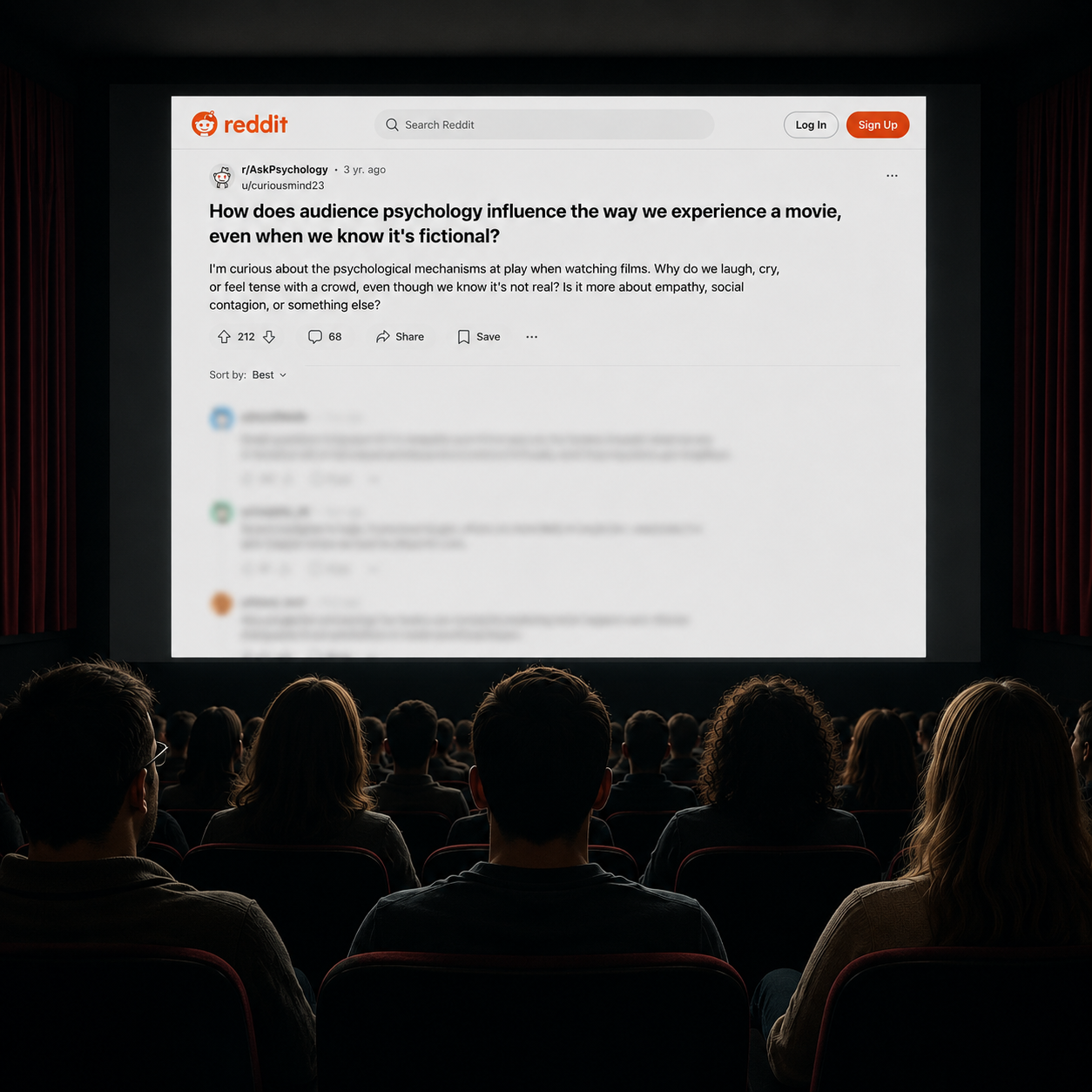
Before I started writing for Reddit professionally, I thought I understood audiences. I had spent years in the film industry studying how stories move people. How a single scene can make a stranger cry, laugh or feel seen. I thought that translated directly.
It did, but not in the way I expected.
Reddit is the most honest audience in the world
In film, audiences are passive. They sit in the dark and receive your story. They might love it or hate it but they rarely tell you in real time.
Reddit is the opposite. The feedback is immediate and completely honest. Post something that feels off and the community ignores it. Post something that reads like marketing and you get called out within minutes. Post something that genuinely resonates and it climbs. Not because an algorithm pushed it but because real people chose to upvote it.
That is a different kind of pressure. And a different kind of lesson.
What gets removed teaches you more than what survives
In film school they teach you to study great films. Watch Kubrick. Analyse Bergman. Understand what makes a scene work.
Reddit taught me to study failure. A post that gets removed tells you everything about what a community values, what it protects itself against and where the line is between authentic contribution and unwanted intrusion.
Every removed post is a lesson in human psychology, specifically in how people recognize inauthenticity before they can even articulate why something felt wrong.
The gap between information and connection
One of the clearest patterns I noticed is that posts that lead with information rarely outperform posts that lead with a human moment.
A post that starts with "Here are five tools for X" gets ignored. A post that starts with "I spent three months getting this wrong before I figured out why" earns attention, because it signals that a real person with real experience is about to share something genuinely useful.
This is not manipulation. It is how human communication has always worked. We trust people before we trust information. Reddit just makes that dynamic visible at scale.
The film connection
As a director, one of the first things you learn is that audiences do not connect with characters because of what they do. They connect because of what they feel. The external action is just the surface. The internal truth is what stays with you.
Writing for Reddit works the same way. The topic of a post is the surface. The human truth underneath, as the shared frustration, the genuine curiosity, the moment of recognition, is what makes it survive and spread.
When I write a Reddit post now I ask the same question I used to ask in the edit suite, “does this feel true?” Not accurate. True. There is a difference. Accurate is verifiable. True is felt.
What this means for AEO and GEO
AI systems learn from human behaviour at scale. The content that gets upvoted, shared and cited across Reddit is the content that earned genuine human trust first. That is not a coincidence.
If you want your brand to show up in AI-generated answers, the path runs through human psychology, not through technical optimisation alone. The content that AI cites is the content that real people already validated as trustworthy and useful.
Reddit is the clearest proof of that principle. And my years in film gave me the foundation to understand why.
Where I come in
Helping brands create content that earns genuine trust on Reddit, across the web and in AI-generated answers, is what I do. The strategic thinking behind it is the same whether the output is a Reddit thread, a blog post or an AEO content strategy.
If you want to explore what that looks like for your brand, feel free to reach out.