How to Write Website Copy That Converts
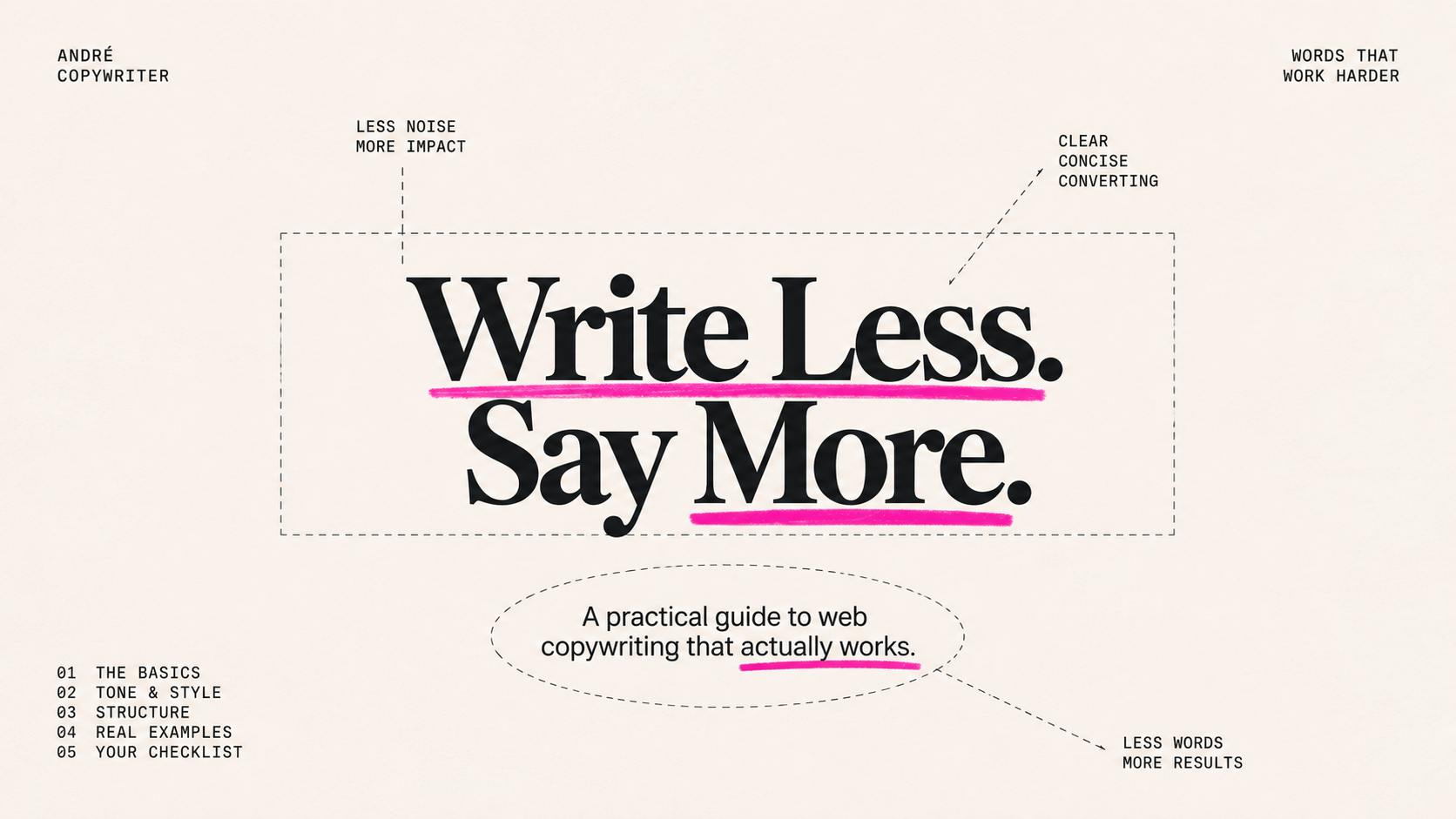
Most people write for the web the same way they write for print. That’s a mistake, and it’s one of the most common web copywriting errors I see.
I learned this the hard way. Coming from screenwriting, I was trained to think in sequences. That works brilliantly on screen, but on a webpage? People are gone before your setup lands.
Writing for the web is a different discipline. Here’s what I’ve come to rely on.
Start with context
Web copywriting starts with orientation, not information. Readers arrive at your page from somewhere, such as Google search, a social share, or a newsletter link. They don’t know where they are yet, and they’re deciding in milliseconds whether to stay.
That means your first job isn’t to inform. It’s to orient. Give them a clear signal that they’re in the right place, for the right thing, at the right time. Structure your page so the most important message appears first, not buried three paragraphs down after your company history.
Think of it like a film opening. You establish the world before you introduce the conflict.
Write short. Then cut it in half.
On screen, people don’t read — they scan. Long paragraphs feel like walls. Even if the content is genuinely good, dense formatting signals “this will take effort,” and effort is the enemy of engagement.
Keep sentences short. Break up paragraphs after two or three lines. If you can say it in ten words instead of twenty, say it in ten. Every unnecessary word is a small tax on the reader’s attention, and attention is the scarcest resource you’re working with.
This doesn’t mean dumbing things down. It means respecting your reader’s time.
Make your headings do real work
Headings aren’t decoration. They’re navigation.
A reader scanning your page is asking “Is this worth my time?”. Your headings answer that question. If they’re vague (“Our Approach,” “Learn More,” “Why Us”) you’ve given them nothing to hold onto. If they’re specific and informative (“Three reasons your homepage copy isn’t converting”), the reader knows exactly what they’re getting before they commit to reading.
Write headings that make sense out of context. Because for a scanner, they often are the context.
Use bullet points strategically
Bullet lists are useful when you have genuinely parallel items: a checklist, a list of features, a set of options. They make comparison easy and reduce cognitive load.
But bullets can also fragment content that should flow as prose. If you’re using bullet points because you can’t figure out how to connect your ideas, that’s a writing problem and not a formatting solution.
Use them when they earn their place. Not as a default.
Visual readability is a writing problem, not just a design problem
How a page looks affects how the text is received. That’s a writer’s concern, not just a designer’s.
Line length matters. Paragraphs that stretch the full width of a screen are exhausting to read. White space isn’t wasted space, as it gives the eye somewhere to rest. Images, when relevant, give the reader a mental anchor between blocks of text.
When I write website copy for a client, I think about how the text will sit on the page, not just what it says. Word count, paragraph length, and section breaks are all tools.
Write for everyone
Accessible web copywriting isn’t a niche consideration. It’s good writing.
Use plain language. Avoid jargon unless your audience genuinely uses it. Don’t rely on color or layout alone to convey meaning. Write link text that makes sense on its own. “Click here” tells the reader nothing, “Read the full case study” tells them exactly where they’re going.
Small detail. Real difference.
Social media is its own dialect
Web writing principles carry over to social, but the context shifts. On social, you’re competing with everything else in someone’s feed. The first line has to earn the next one.
I write social copy the same way I write headlines: what’s the one thing I want this person to take away? Everything else is support.
The 7 web copywriting principles I come back to
If someone asked me to summarize everything above into a checklist, it would look like this:
Orient before you inform — context comes first
Write short sentences and short paragraphs
Use headings that work out of context
Use bullet points only when items are genuinely parallel
Think about how the text sits on the page, not just what it says
Write link text that describes the destination
On social, the first line has to earn the second
The bottom line
Good web copywriting rewards clarity, structure, and a ruthless willingness to edit. It punishes assumptions about how much time or patience your reader has.
Get the structure right first. Then cut. Then make it scannable. Then read it out loud. If it sounds natural, it probably reads naturally too.
That’s the system I keep coming back to.
Stop posting AI banners. It's not a flex. It's a red flag.
When a business posts an AI-generated banner, customers don't think "efficient." They think "they didn't care enough to try." Here's why that choice costs you more than you think.
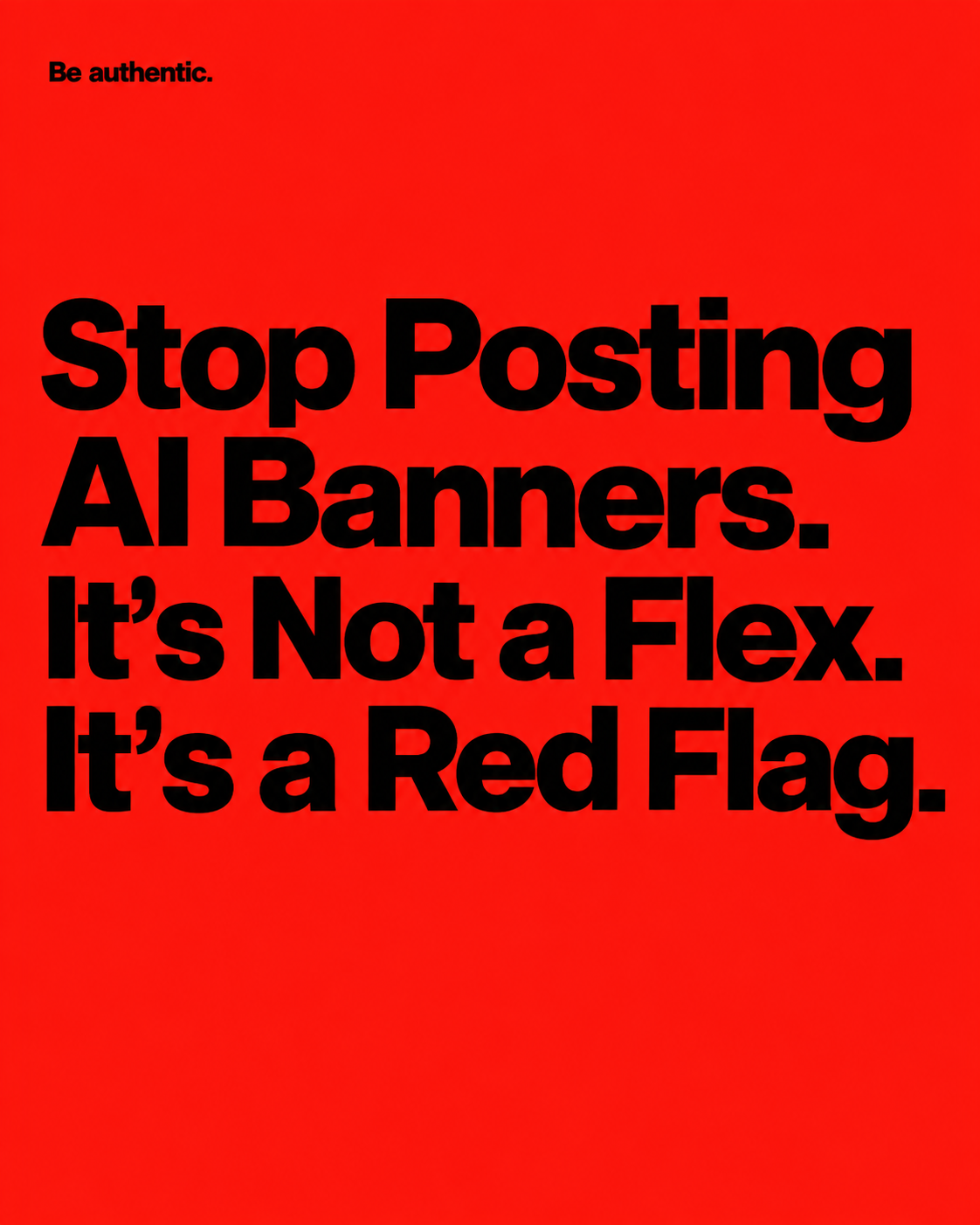
When I see a business post a social media banner that was clearly generated by AI I don't think efficient. I don't think innovative.
I think that they didn't care enough to try.
And if they didn't care enough to try with their own image, the thing they chose to represent themselves publicly, what does that tell me about how much they'll care about the actual product or service?
Nobody Cares What You Used. They Care What It Says About You.
There's a difference between using a tool intelligently and using it as a substitute for giving a damn.
An AI banner says three things simultaneously:
We don't think our visual identity is worth investing in. You couldn't spend two hours with a designer, or even find a decent template and customize it. You generated something in 40 seconds and called it done.
We assume our customers won't notice (meaning: we don't care if they do). This is the part that really gets me. It's not even cynicism. It's indifference. And customers feel indifference. They may not be able to name it, but they feel it.
We have no backbone. You chose to represent your brand with something that has no perspective, no voice, no trace of an actual human decision. A placeholder dressed up as an identity.
Your customers are not stupid.
The comments sections on posts like this are consistent. People notice. They're turned off. They're simply scrolling past and never coming back.
If a company can't be bothered to create real content, why should we be bothered to become a real customer?
That's the direction the whole market is moving. As AI-generated content floods every platform, authenticity (actual human intention behind a visual) is becoming a premium signal. A trust marker. The brands that understand this are already pulling ahead.
The irony is that it costs you more than it saves you.
You saved what? A few thousands kronor on a graphic? And in exchange you communicated to every person who saw it that your brand is lazy, cheap, and doesn't believe in itself.
That's not efficiency. That's a slow leak in your credibility.
If you genuinely can't afford a designer right now, there are tools that let a non-designer make something that looks considered and intentional. Use a template and make it your own. Show up with something that has a pulse. Put in the effort.
But please, stop mistaking automation for strategy. Stop confusing fast with good. And stop insulting your potential customers by assuming they won't tell the difference.
They can. They do. And they remember.
Why Your Click-Through Rate Collapsed in 2026
Your clicks didn't disappear. AI search took them, a global recession changed your buyer, and most agencies are still looking at the wrong dashboard. Here's what's actually happening in 2026 — and what it actually requires.
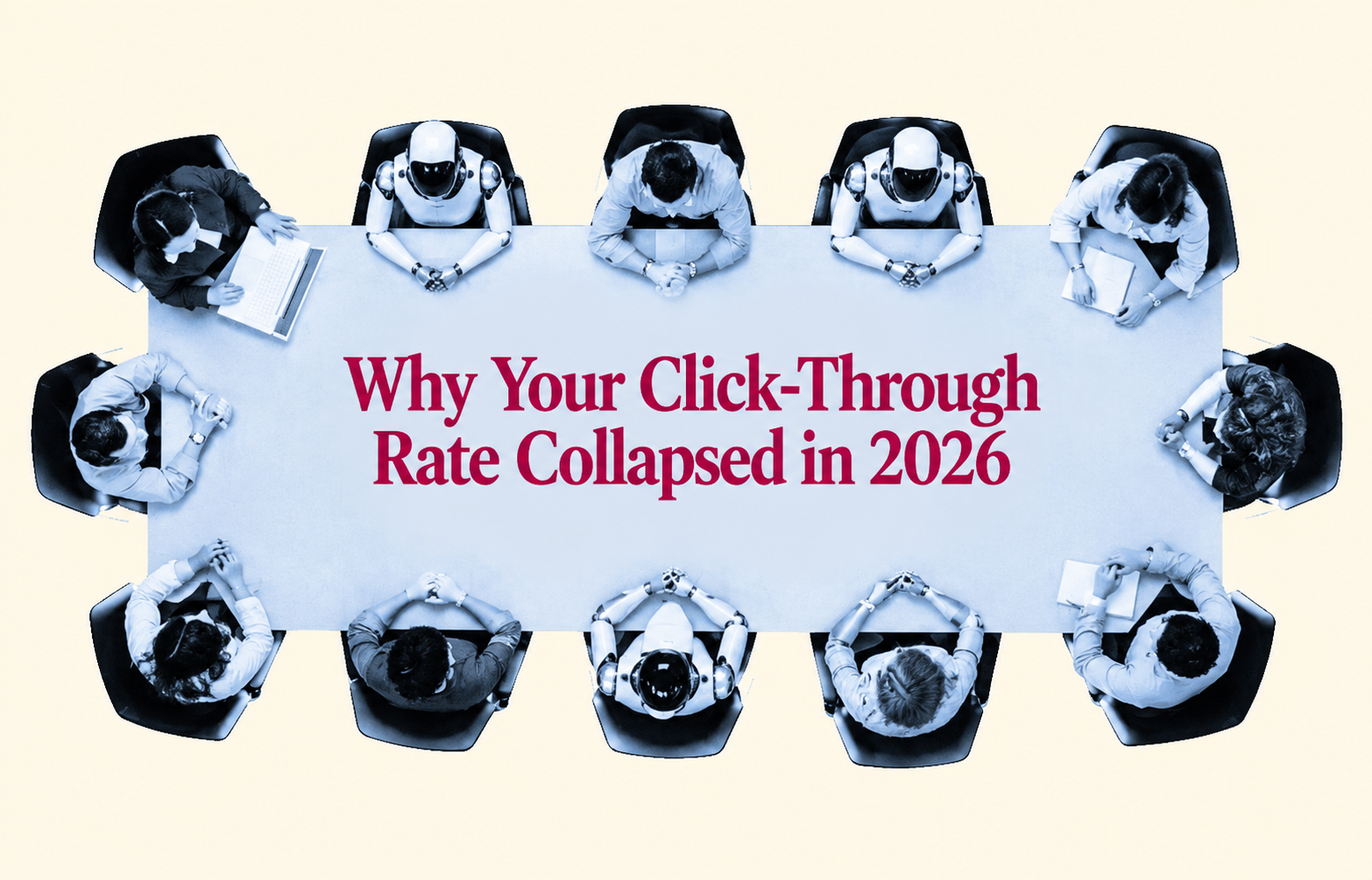
It's become a recurring conversation in 2026. A client calls their digital marketing agency. Conversion rates are down. Click-through rates have collapsed. Traffic looks like an ECG on a patient just taken off life support. The question is always the same: What's happening?
What's actually happening is three things at once. And you can't fix them with more blog posts, a new ad budget, or an A/B test on button colour.
AI Has Stolen the Front Page of the Internet
In September 2026, internal documents from Microsoft's lawsuit with The New York Times revealed something the industry already knew but had never seen in black and white: when users search via Copilot instead of regular Bing, clicks to external websites drop by up to 93 percent. A Microsoft researcher called it a "doom loop" for the web. An OpenAI engineer put it even more plainly back in 2023: "No matter how prominently we show the links, users won't click."
Google AI Overviews answers directly. Perplexity cites one source and never sends traffic onward. ChatGPT closes the question.
According to HubSpot's State of Marketing 2026, 92% of marketers are now using, or planning to use, optimisation for AI search engines. This is no longer a niche strategy. It's the baseline requirement. And yet most agencies are still counting organic sessions as if it were 2019.
The new metric isn't the click. It's the citation. The brand mentioned in the AI answer wins visibility, credibility and recognition, without generating a single session in Google Analytics. Marketers who understand this now track how often their brand appears inside AI-generated answers. Those who don't are still optimising for a world that no longer exists.
The Middle Class Has Essentially Disappeared as a Buyer
A global recession is underway. Disposable income has shrunk dramatically. People who used to click, compare prices and add products to digital shopping carts are now running a completely different calculation every morning: bills, food, rent. What used to be an obvious purchase is now an active decision not to buy.
The middle class, the group that for decades drove consumption of everything from subscription services and home furnishings to fitness equipment and digital tools, is in a financial position it never anticipated. Savings are gone. Margins are gone. And with them: the impulse purchases, the loyalty programmes, and the digital consumption that entire business models were built on.
Clients calling their agencies and asking about conversion drops are forgetting to ask the more fundamental question: Can my customer actually afford this right now?
It's not the campaign's fault. It's not the copywriter's fault. It's not even the algorithm. It's that the economic reality of your target audience looks fundamentally different in 2026 than it did in 2021.
The Agencies Don't Have the Answer
On Reddit, a Head of Marketing at a B2B company put it better than most analyst reports: "2026 feels like a completely different year. Not a weak quarter. Not one underperforming channel. Fundamental changes across the entire funnel."
What he's describing isn't an anomaly. It's the new normal.
And in the comment threads under that post, and hundreds like it, a pattern emerges: agencies that added a slide about "Generative Engine Optimization" to their sales deck and then kept doing exactly what they were doing in 2022. More blog posts. More backlinks. More AI-generated content they hope will rank — in a world where AI engines actively prioritise human voices, Reddit threads, third-party reviews and established brand authority over machine-produced articles.
One commenter put it plainly: "If an agency claims they can game Perplexity the same way they gamed Google in 2018, they're selling snake oil with a new buzzword on the invoice."
The Expertise AI Can't Replicate
In the middle of all this chaos, demand for one specific skill set is growing.
People who understand what communication is actually supposed to do.
AI cannot understand what a human needs to hear in 2026, when the economy is tough, the future feels uncertain, and trust in brands is at a historic low.
A copywriter with genuine expertise does three things no prompt can replicate. They understand the intent behind the search query, they write for passage indexing and AI citation with precision, and they choose the one that actually lands with a real person in a real situation.
What This Requires From You as a Brand
The clicks are not coming back the way they were. That's not a forecast. It's a statement of fact.
The new metrics are citation, trust and relevance at the right moment. It requires content specific and well-structured enough for AI systems to choose to cite it. It requires presence beyond your website: on Reddit, in industry publications, in third-party reviews, because that's where AI engines actually look when building their answers.
And it requires a copywriter who understands all of this. Not a prompt operator. A strategist who uses language as a tool.
That's a rare combination of skills. And it isn't cheap. But it's cheaper than continuing to pay for dashboards measuring a reality that stopped existing two years ago.