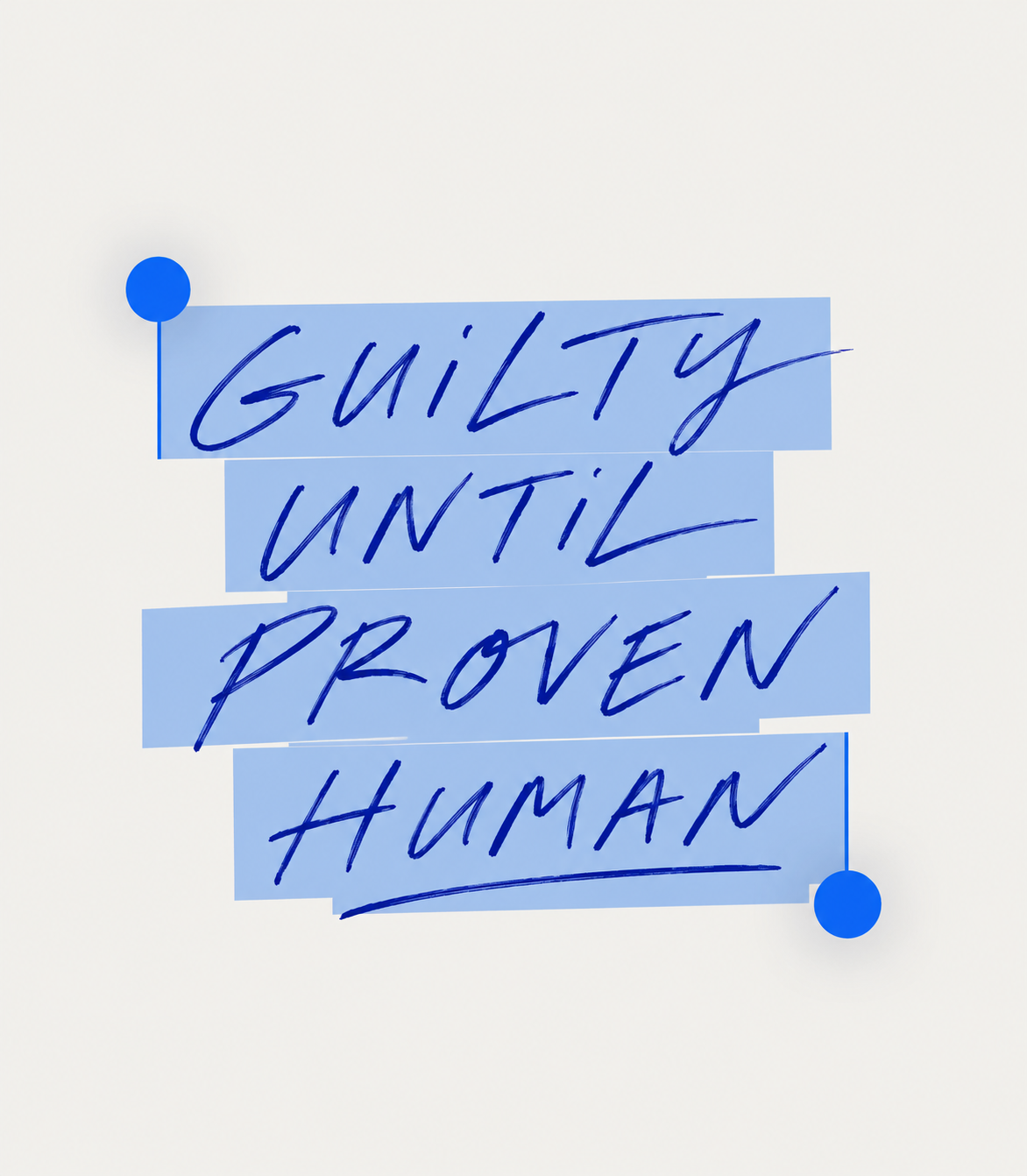
The pause after I send my work to the client used to mean they were thinking, but now I’m not so sure.
You turn in a copy brief and the client goes quiet for a moment. Not the good kind of quiet “let me sit with this”, but the kind that ends with: We actually ran this through our agent and it came up with something slightly different.”
Their agent, Claude or ChatGPT workflow they set up last Tuesday and now treat like a creative director.
I am experiencing clients who have lost all trust in human creative work, replaced the creative relationship with a tool they barely understand, and now use it to second-guess everything you produce.
Did you actually write this?
It usually doesn’t come as a direct accusation. It’s subtler than that, which almost makes it worse.
It comes as a rewrite suggestion that arrived suspiciously fast. A “we had some internal thoughts” that turn out to be a Claude output lightly reformatted. A comment in the doc that says “could this be punchier?” with a paste of something their tool generated, as if that’s a note and not a replacement.
Or sometimes it’s even more direct. A client sent back a full rewrite of a campaign I’d delivered. “We played around with it a bit,” they said. I opened the document and it wasn’t edited, it was regenerated.
Then they asked me to “polish it up a bit.”
The original brief and strategy was mine, and the creative concept had started as mine. By the end, I was being asked to clean up AI’s version of my own idea, and somehow that was presented as collaboration.
Death by a thousand doubts
It’s not the big confrontations that wear you down, but the accumulated weight of being quietly doubted all the time.
You turn in work you’re genuinely proud of. Work that took real time, real thinking, and real craft. Before anyone has even sat with it properly, it’s been run through a tool, compared to an output that took thirty seconds, and the difference is being treated as a question mark over your process rather than a testament to it.
I’ve started second-guessing how I write.
Not the work itself, but how it looks. Whether a particularly clean line will make someone think I prompted it. Whether a piece that came together quickly will raise suspicion, or whether I should deliberately leave a rougher edge in just to prove it’s human.
That’s an absurd place to be in, but it’s real.
There’s a copywriter named Scott Ottersen who wrote something recently that stuck with me. He said he’s run his own work through AI text detectors out of curiosity and spite, and watched them tell him his writing is 40% robot. Then fed those same detectors pieces written entirely by AI, and watched them score 0% robot.
The tools we’re using to identify AI can’t actually identify AI. But we’re using them to judge human writers anyway. Real people.
What gets lost when the draft comes first
Iri Edwards, a content strategist at ForeFront Web, put it well in a recent interview: “Getting a draft used to take a lot longer, but with the advent of AI, you can have something on the page almost immediately. The problem is that the writer still has to work out whether it’s right, whether it fits the client, and whether it should be there at all.”
That last part is the one clients keep skipping.
The brief doesn’t tell you everything. It tells you what someone thought the project needed when they sat down to write it. What it doesn’t capture is the client who mentions almost in passing that a certain phrase caused a compliance issue last year. The audience who arrives at the page mid-crisis, not mid-comparison. The sentence that sounds completely fine and still isn’t right for that situation.
Edwards talks about how she spends most of her time before writing starts. Asking what customers actually bring up, what claims the company has learned to be careful with, who is really reading this and what they need to understand.
That context doesn’t fit in a prompt box.
And when AI generates a draft without it, what you get is something that sounds confident and complete, and may be quietly wrong. A qualifier disappears, or a claim drifts beyond what the business can actually support. The wording shifts just enough to change what’s being promised.
“AI can give you a sentence that sounds completely confident even when the wording isn’t quite right,” Edwards says. “That’s the part you have to watch closely.”
That judgment is exactly what clients think they’re getting when they use AI, but it’s actually what they’re skipping.
The irony that keeps getting to me
The AI copy clients come back with will often pass through a committee without friction because it offends no one and surprises no one.
It also sounds exactly like everyone else.
Same sentence rhythm, structure, and instinct to front-load the benefit and close with a call to action. The same brand of confident-but-safe that you get when you ask a very well-read machine to produce marketing language without any actual opinion about the brand.
According to Canva’s 2026 State of Marketing & AI report, 97% of marketing leaders now use AI in their daily creative work. And yet 41% say brand intuition and creative judgment are among the things AI will never fully replicate.
Those two numbers together tell you everything about where we are right now. Everyone is using it, but almost half of them know it’s missing something essential, and very few are saying it out loud in the client meeting.
I can spot AI copy now in about thirty seconds, because it reads like copy written for a brand rather than from one.
The copy that actually moves people doesn’t sound like that. It’s specific in a way that’s slightly uncomfortable. It has an angle that someone had to argue for and carries a real point of view.
You can’t generate that from a prompt. You can get close enough to pass a Tuesday review, but not close enough to make someone remember it six months later.
The reality
It’s a specific kind of professional disorientation that I struggle to explain to people outside the industry.
The relationship has shifted. You’ve gone from creative partner to first draft to be verified. From trusted voice to one input among several, where one of the others is a free tool anyone can access at any time.
Everyone are using Claude or another AI tool and the difference is no longer obvious to them.
What gets lost is everything that actually makes a creative relationship work: the accumulated context, the knowledge of what’s been tried before, the understanding of where the brand needs to move away from, and the taste that comes from years of knowing what lands and what doesn’t.
None of that fits in a prompt.
But a prompt is faster, and in the current climate, faster keeps getting mistaken for smarter.
Let me be clear
I use AI for research, getting unstuck, for testing structure, and generating ten mediocre options that help me identify the one direction worth pursuing. I’m not precious about the tools, because they’re just tools.
What I’m arguing for is the understanding that a tool is not a creative partner. That running a brief through Claude is not the same as working with someone who has spent years building the taste to know what a brand actually needs.
Edwards frames it well: “AI can get you to a draft faster, but someone still has to look at the work, understand what’s at stake, and decide whether it actually holds up.”
The clients who are getting the most from AI are the ones using it to accelerate the human process, not replace it. To move faster through the things that don’t require judgment, so they can invest more attention in the parts that do.
The ones who handed the whole process to a machine and called it efficiency? Their content is starting to blur. Their campaigns don’t cut through and their brand voice is becoming indistinguishable from every other brand that did the same thing.
What I’m holding back
When the “we played around with it” suggestions come back, I want to say this:
I understand the appeal. It’s fast, cheap, and it never pushes back or needs a revision round to understand the brief.
But I’ve been doing this long enough to know the difference between copy that performs in a review and copy that performs in the world. The headline your tool generated will get approved, and mine will get remembered. Those aren’t the same thing, and they’re not equally valuable.
Trust the process, or ask me to walk you through why I made the choices I made, because that conversation is worth having. What’s not worth having is a silence followed by a paste from a text box.
Sources:
AI Content Drafting Puts More Weight on Human Judgment — DesignRush / Ryan de Smidt, interview with Iri Edwards, ForeFront Web (Oct 2026)
Scott Ottersen via LinkedIn