I’m in my mid-thirties. I only started reading properly six years ago.
That’s not something I’m ashamed of, but it is something I think about. Because when I look at what reading has done for my thinking, my writing, and my ability to understand the world around me, I genuinely wish I had started earlier.
And when I look at the data on how much we’re all reading now, I think we’re heading somewhere that should worry all of us.
The numbers we don’t talk about
We spend an average of four hours a day on our phones. That’s 120 hours a month. 1,440 hours a year. Roughly 60 full days, eyes down, scrolling through content designed to grab our attention for thirty seconds and then disappear.
Meanwhile, daily reading for pleasure has dropped by more than 40 percent over the last 20 years. In the UK, the number of people who read regularly fell 8 percent in a single decade. Only one in five children reads daily for pleasure, the lowest level recorded since 2005.
We are not just reading less. We are systematically replacing one of the most cognitively demanding and rewarding activities humans have ever engaged in with one of the most passive and unrewarding.
And most of us don’t even notice it.
What your phone is actually doing to your brain
Doomscrolling isn’t neutral. It isn’t rest. It’s a specific kind of fragmented, low-reward attention that trains your brain to expect constant stimulation and to struggle with sustained focus.
The irony is that we reach for our phones when we’re bored, but the phone makes boredom worse. It raises the threshold for stimulation. After twenty minutes of scrolling, a book feels slow. A long article feels like work. A conversation without a notification feels incomplete.
This isn’t a moral judgment. It’s neuroscience. The brain adapts to what we repeatedly ask it to do, and we are repeatedly asking it to skim, jump, react, and move on.
Reading asks something different. It asks you to stay in the moment.
What happens when you stay
The research on reading and the brain is genuinely remarkable.
A 2026 study from Baycrest found that reading changes how the brain processes spoken language, not just written text. People who read regularly showed different neural activation patterns even when simply listening to words, suggesting that the benefits of reading extend into how we think and communicate far beyond the act of reading itself.
Children who read encounter up to 40 percent more unique words than those who primarily watch TV for the same age group. But vocabulary is just the surface. Reading, particularly fiction, activates the regions of the brain involved in empathy, social cognition, and understanding other perspectives. The same areas that fire when we try to genuinely understand another person.
Barbara Sahakian, emeritus professor of clinical neuropsychology at Cambridge, has found that people who read regularly report feeling less lonely, more connected, and more capable of understanding others. Reading fiction, she explains, “activates areas in the brain that always come up when you’re doing studies of theory of mind — understanding things from other people’s point of view.”
Books don’t just teach you things. They change how you relate to other people. They build empathy, humility, and a capacity for genuine curiosity about lives that aren’t yours.
The vocabulary argument
One of the quieter superpowers of reading is what it does to your ability to express yourself.
Vocabulary isn’t just about knowing more words. It’s about precision. The difference between “happy” and “elated.” Between “sad” and “grief-stricken.” Between “difficult situation” and “crisis.” When you have a larger, more nuanced vocabulary, you can articulate things that other people feel but can’t name, and there is enormous power in that.
As a copywriter, I see this every day. The writers who produce work that actually moves people are almost always the ones who read widely. Not just industry reports or marketing books, but fiction, essays, history, and biography. The kind of writing where someone spent months finding exactly the right word for exactly the right moment.
Reading trains the ear and teaches rhythm, precision, and the quiet art of knowing when a simple sentence lands harder than a complex one. You cannot fake that. You can only build it, through years of absorbing how great writers work.
What I’m reading right now
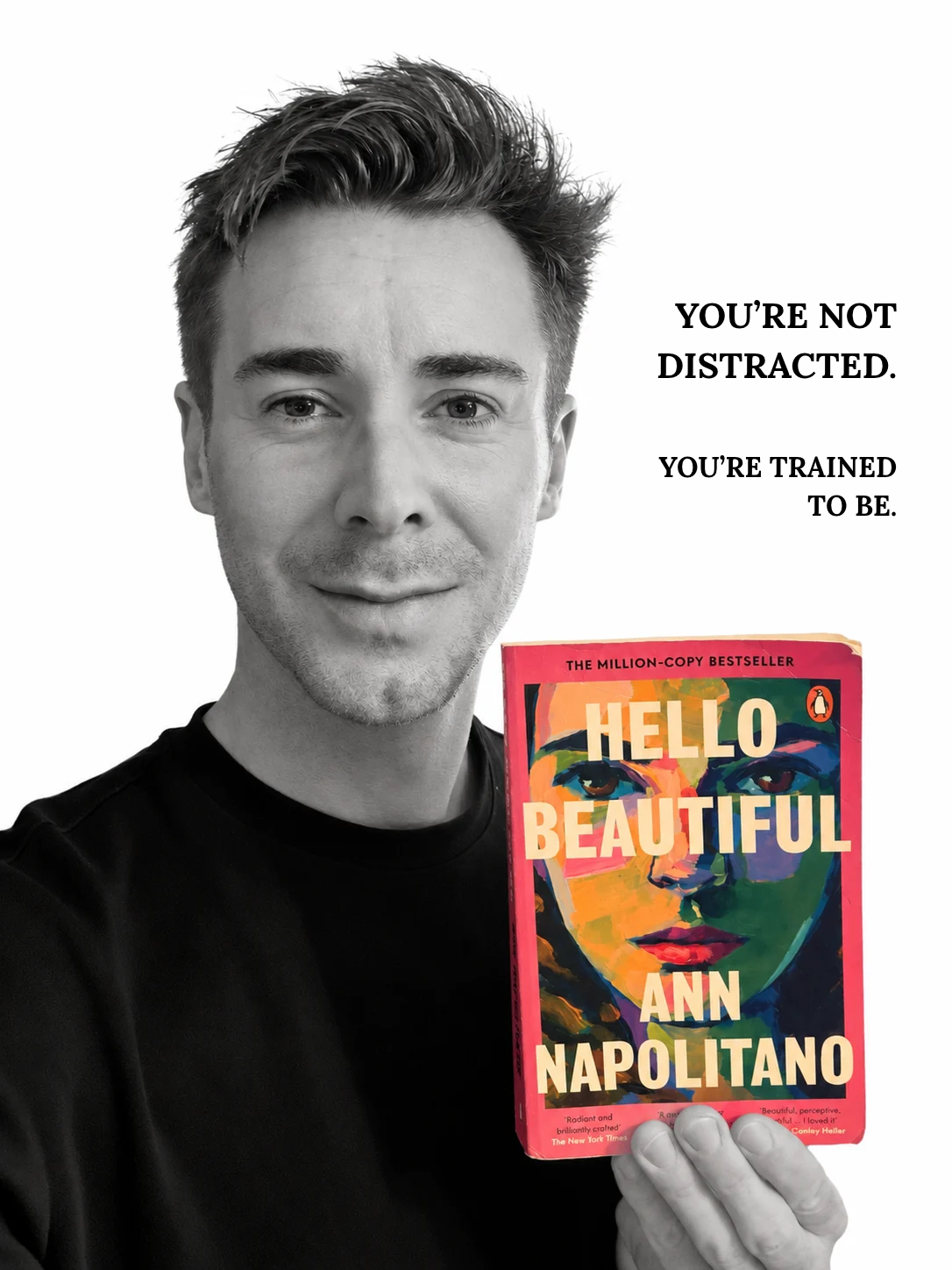
I’m currently finishing Hello Beautiful by Ann Napolitano, a Pulitzer Prize-winning novel about four generations of a Chicago family. Complex people making difficult choices, carrying love and damage across decades.
Every chapter pulls me into a perspective that isn’t mine. People who look different from me, grew up differently, want different things. It’s sometimes uncomfortable. That discomfort is precisely the point.
Fiction doesn’t just entertain. It forces you to inhabit other lives. To understand motivations that feel foreign. To sit with moral complexity without demanding a clean resolution. In a world that increasingly rewards black-and-white thinking, that’s a radical act.
I’m human too
I still pick up my phone without thinking every day. Probably multiple times an hour.
But over the last few weeks I’ve started catching myself, and chosen the book instead.
It’s a small act but it adds up. Even five minutes of reading a day is five minutes of genuine cognitive engagement, building vocabulary, practicing focus, and exercising empathy. All this instead of five minutes of content that will vanish from memory before morning.
I work as a copywriter and screenwriter, so words are my profession. And even I feel the difference between the weeks when I’m reading consistently and the weeks when I’m not. Reading fills something that constant production empties. It reminds me that language is vast, that stories are powerful, and that there are writers out there doing things with words that I haven’t figured out yet.
That humility is important. Letting yourself be inspired by someone better than you at something isn’t defeat. It’s the only way to grow.
The written word is worth defending
Storytelling is how we humans have always made sense of the world. It’s how we preserve what we know, transmit what we value, and challenge what we assume. The written word, such as the novel, the essay, the poem, is one of the most sophisticated and powerful tools our species has ever developed.
We are spending 60 days a year looking at our phones instead. I think we can do better, and I think we owe it to ourselves to do better.
So next time you’re on the sofa on a cold dark autumn evening feeling restless and reaching for your phone, pause. Pick up a book about something you’ve never read about before. Throw yourself into a world that isn’t yours. Let your brain do the slow, difficult, rewarding work of staying in the moment.
Life is too short.
Sources
Meltzer, J.A. et al. (2026). Reading experience shapes spoken language processing in older adults. Cortex. Via FluentCap
Sahakian, B. et al. (2025). The cognitive and wellbeing benefits of reading for pleasure. Psychological Medicine. Via TIME
Weger, W. (2026). Why Reading Matters Even More in 2026. Via Substack
Sonke, J. & Bone, J. et al. (2025). Daily reading for pleasure in the US has dropped over 40% in 20 years. iScience / University of Florida & University College London.
Korochkina, M. CYP-LEX Database: Vocabulary in children’s books vs. children’s TV. Via Tooled Up Education
Oxford University Press (2023). National Year of Reading: What does reading mean to us? Via OUP