Keywords Are Dead. Structure Is Everything.
Keywords aren't dead. Keyword density is. There's a difference. And most brands are optimising for the wrong one.
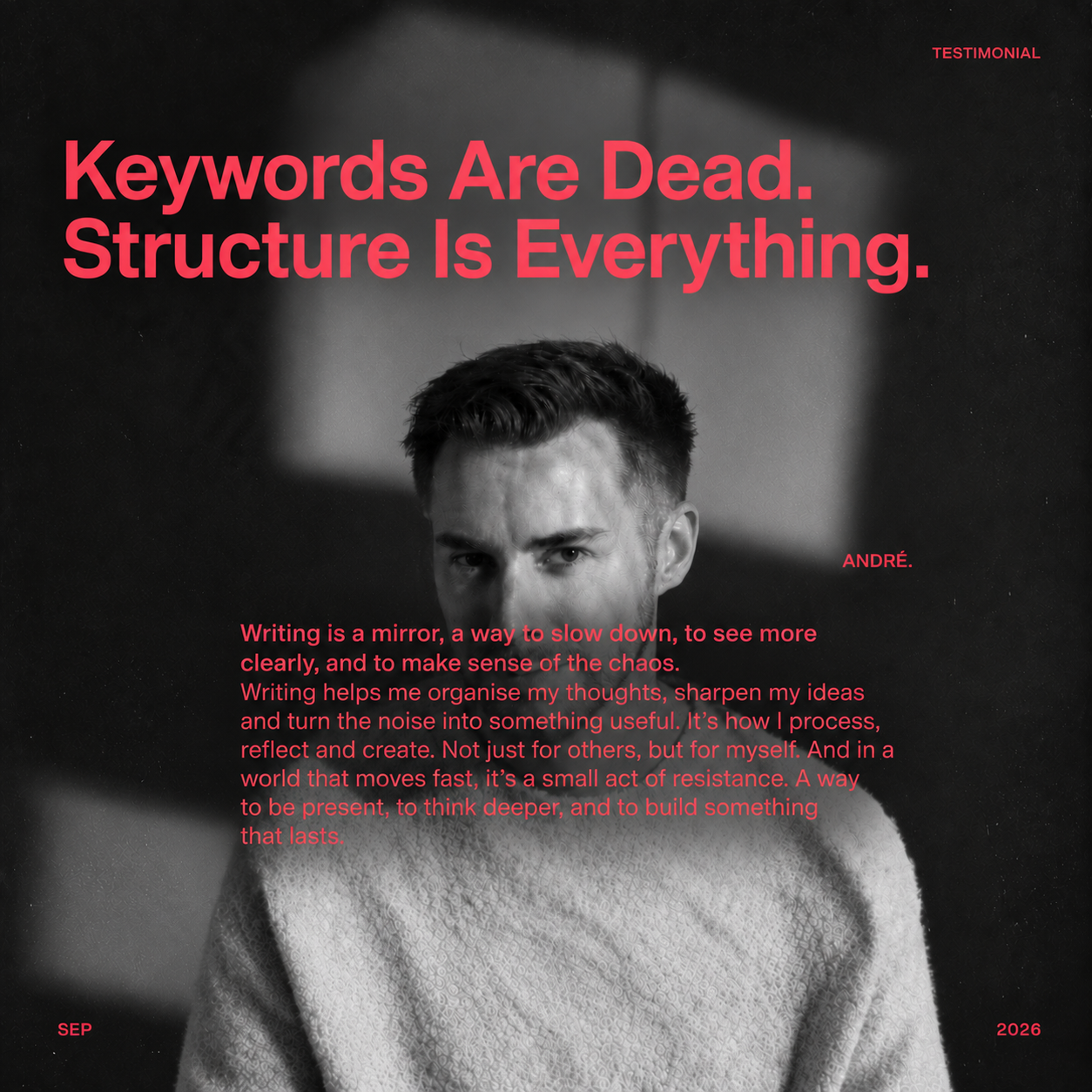
Keywords aren't dead. Keyword density is.
There's a difference.
Most brands are still writing for 2019. Briefing writers with a keyword and a word count. Measuring success by how many times a phrase appears on the page. Treating SEO copywriting as the practice of inserting terms into otherwise normal text at a frequency someone once decided was optimal.
The discipline has moved on. Most of the people executing it have not.
I have spent the last three years working at the intersection of SEO copywriting, AEO and GEO, helping brands build content that ranks on Google and gets cited by AI systems like ChatGPT, Perplexity and Google AI Overview. What I see across clients and industries is a consistent gap between what SEO copywriting actually requires in 2026 and what most teams think it requires.
Here’s what that gap actually costs.
What SEO copywriting actually is in 2026
SEO copywriting in 2026 means writing for search intent, passage indexing and AI citation. Not keyword density.
That sounds simple. It’s not, because it requires understanding three distinct jobs that good SEO copy has to do simultaneously.
The first job is to signal intent match. The opening paragraph, H1 and H2 structure collectively tell search engines what question the page is answering. If the dominant format for a given search query is comprehensive guides and you publish a service page, you have an intent mismatch that no amount of writing quality will overcome.
The second job is to format for passage indexing. Since December 2020, Google has been capable of ranking individual passages from a page independently of the page's overall authority. The practical implication: every H2 section on a page is a separate ranking opportunity if written correctly. Each section needs to open with a direct answer in the first two sentences. Not context, not backstory, not a point being built toward.
The third job is human persuasion, the actual craft of copywriting. Short sentences, active voice, concrete examples, a voice that earns trust. This still matters enormously.
Where most SEO briefs fall apart
Most briefs specify a keyword, a word count and nothing else. They do not define search intent. They do not specify how H2 sections should be structured. They do not ask the writer to lead each section with a direct answer rather than context.
The result is content that is well-written and structurally invisible. It answers the question eventually. Search engines and AI systems need the answer in the first two sentences of each section, not eventually.
A page can be well-written and still fail to rank if the intent match is wrong, the H2 structure buries answers rather than leading with them, the opening paragraph lacks a citable claim, or the entity coverage is thin with no specific data, sources or named concepts.
This is the failure mode I see most often. Not bad writing. Bad structure. And structure is determined by the brief.
What keyword density actually is
A 2025 Ahrefs study of top-ranking pages found that 83% of pages ranking in positions 1–3 had their primary keyword in the first 100 words. But keyword density showed no meaningful correlation with rank beyond that.
That is the distinction most teams miss.
Keyword placement matters - in the first 100 words, in the H1, in at least one H2. Keyword repetition beyond those structural placements adds no ranking value and often produces unreadable copy.
The keyword is a structural signal, not a frequency target. Once you understand that, the entire discipline reframes itself.
What zero-click means for your content strategy
Zero-click searches now make up 65% of all Google queries. AI Overviews answer questions at the top of the page before anyone clicks through.
This is the shift that most brands have not yet metabolized.
Traffic is no longer the only metric that matters. When someone asks Google a question and gets an AI Overview answer at the top of the page, the brand that is cited in that answer has won visibility, credibility and association with the answer, without generating a single session in Google Analytics.
Most marketing teams are still optimizing for traffic. The brands that are winning in 2026 are optimizing to be the source that AI cites.
That requires a different kind of writing. To write for AI citation, three elements are required: specificity in claims, source attribution and entity clarity. Named tools, frameworks, algorithms and specific data points anchor a passage in a defined conceptual context.
"SEO copywriting is important" is not citable. "SEO copywriting structures content around three sequential jobs - intent signalling, passage formatting and human persuasion - in that order" is citable because it makes a concrete claim about a mechanism.
Most brand content makes assertions. Citable content makes claims.
The third layer most brands are ignoring
SEO now overlaps with PR and brand building, content design and UX, data journalism, community-driven authority through Reddit and third-party publications, and LLM optimization. It is no longer just keyword research and on-page optimization.
Reddit threads, industry publications, third-party reviews, LinkedIn thought leadership - these are all signals that AI systems use to build their understanding of a brand. A company with excellent on-site SEO copy but no third-party presence is invisible to the part of the search ecosystem that is growing fastest.
This is what GEO, Generative Engine Optimization, addresses. Where AEO optimizes your own content to be citable, GEO manages how your brand appears across the entire web, everywhere AI systems look when building their answers.
Most brands have not started this work yet. The ones that have are building an advantage that will be very difficult to replicate once the space gets crowded.
What I recommend
Fix your opening sentences first. Improving 10–15 existing openers on priority pages generates more measurable ranking movement than publishing 10 new posts. The first sentence of every page and every H2 section should directly answer the implied question. Always lead with the answer.
Write briefs before you write content. The structure of a piece of content is determined before writing begins, not in revision. Define the search intent, map the H2 structure, specify how each section should open. A brief that does this produces rankable content. A brief that specifies only a keyword and word count produces well-written content that does not rank.
Build presence beyond your website. If you are not in Reddit discussions, industry publications, review platforms and third-party citations, you are invisible to the fastest-growing part of the search ecosystem.
Treat AI citation as a distinct goal. Your most important pages, the ones that answer the questions your ideal customers are asking, should be written with the structural specificity that AI systems extract and attribute.
Stop measuring content by traffic alone. If an AI Overview cites your brand in the answer to a high-intent query, that is a win that does not show up in your analytics.
The honest state of the discipline
SEO copywriting is not dying. It is restructuring around a set of requirements that most practitioners have not yet internalised.
The brands and writers who understand that shift, who can write content that ranks, gets cited by AI and earns human trust simultaneously, are not common. There are not many people who have built that combination of skills.
Keywords aren't dead. Keyword density is.
Structure is everything. And most briefs still do not mention it.