The Quiet Power of Empaths in a World That Rewards Narcissists
In a world optimised for narcissism, empathy is the rarest and most valuable resource available. The empaths are not behind. They are carrying something the world is about to need very badly.
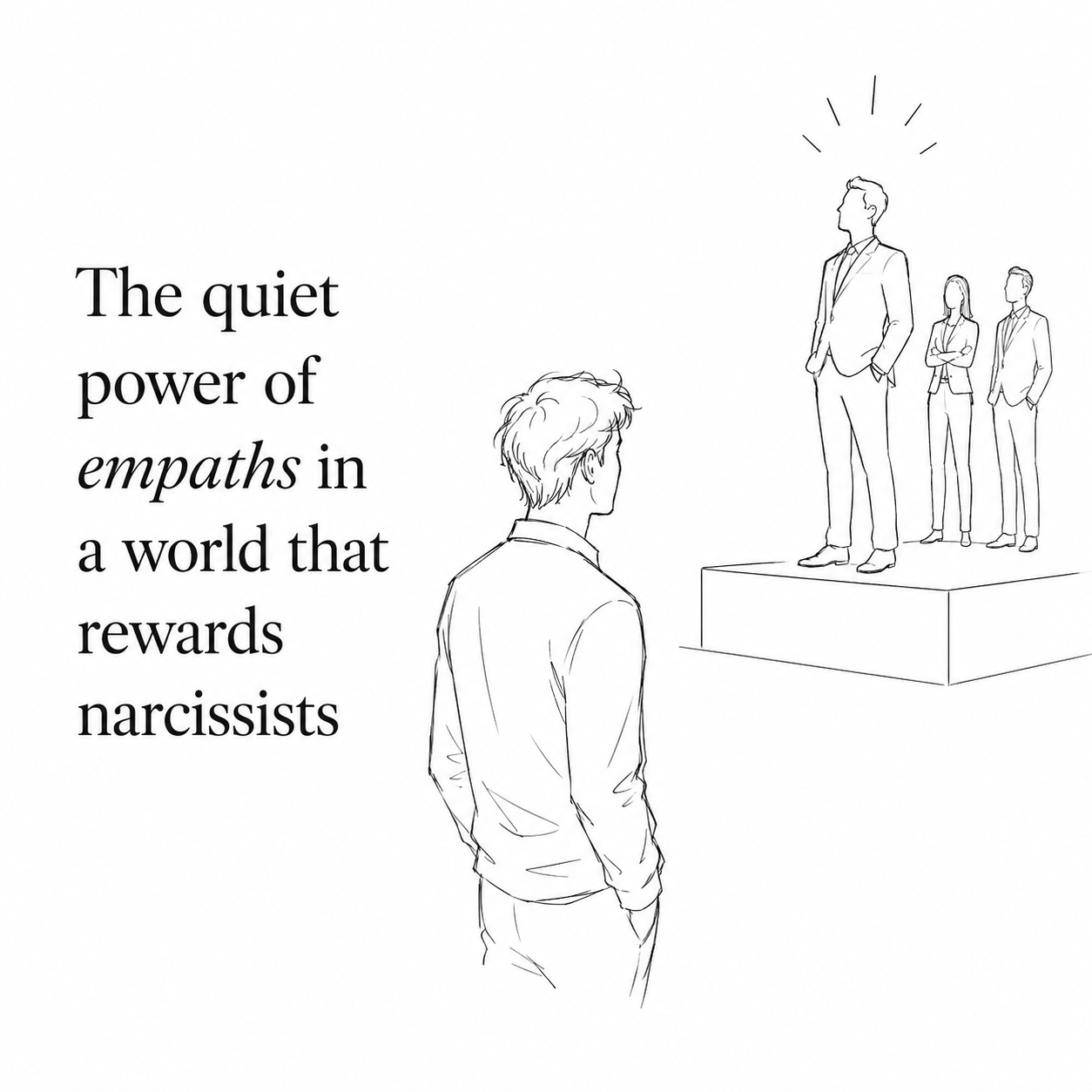
Something is wrong with how we define strength.
Not obviously wrong. Not wrong in a way that is easy to name or argue against in a meeting or a pitch deck. Wrong in the way that things are wrong when they have been normalised for so long that the wrongness itself has become invisible.
We have built a world that rewards a very specific set of traits. Confidence without doubt. Certainty without nuance. The ability to speak loudly and move fast and project the kind of authority that makes other people stop asking questions.
And we have called that strength.
I want to suggest that it is not.
The story we are inside
The most powerful people in the world right now are telling a very compelling story. That AI will solve everything. That speed is survival. That efficiency is the highest virtue. That the people who move fastest will inherit the earth and the rest of us should be grateful for the disruption.
It is told with extraordinary confidence. And confidence, as any filmmaker knows, is one of the most persuasive tools in existence. It does not require truth. It only requires that the audience has no compelling alternative narrative to hold onto.
But I notice something about that story. It has no room for doubt. No room for complexity. No room for the kinds of questions that make powerful people uncomfortable. Questions about cost, about consequence, about who is not in the room when these decisions get made.
Those questions require a particular kind of intelligence to ask.
Not the kind that optimises. The kind that feels.
What empathy actually is
Empathy is not weakness. It is not sentimentality or naivety or an inability to make hard decisions.
Empathy is the capacity to hold another person's reality alongside your own. To understand that your experience of the world is not the only valid one, and to let that understanding actually change how you act.
That is an extraordinarily sophisticated cognitive and emotional skill. It requires more processing, more nuance and more genuine courage than the alternative, which is simply to optimise for your own interests, your own vision, your own certainty, and call that leadership.
The world is full of people who have mistaken the absence of empathy for strength. Who have learned to perform confidence so completely that they have forgotten what they do not know. Who have surrounded themselves with people who reflect their certainty back at them and called that consensus.
That is not strength. That is a very elaborate defence mechanism. And it is extraordinarily fragile, because it depends entirely on never being wrong, never being challenged and never having to sit with a reality that does not confirm what you already believe.
What gets built without it
I think about this in the context of the things being built right now.
The technologies deployed at scale with extraordinary speed and almost no accountability. The platforms that have reshaped how billions of people think and relate and understand the world. The AI systems trained on human creativity and released without asking the humans whose work made them possible.
The people building these things believe they are making the world better, but I and many more believe it’s something much more sinister than that. Belief without empathy is dangerous. It allows you to build things that solve your problem without asking whose problem you are creating. It allows you to move fast without looking at what you are breaking. It allows you to call disruption progress without asking who is being disrupted and at what cost.
The environmental cost of the data centres running AI at scale. The displacement of workers who cannot retrain fast enough. The erosion of trust in images, in language, in the basic shared reality that makes human communication possible.
These are not abstractions. They are consequences felt by real people in real bodies living real lives on a planet that is running out of time.
Empathy is what allows you to care about that. And caring about it is not an obstacle to progress. It is the only thing that makes progress worth having.
The competitive advantage nobody wants to talk about
Here is the paradox that the current moment has created: in a world optimized for narcissism, empathy is the rarest and most valuable resource available.
The ability to genuinely understand another person. What they fear, what they need, what they would never say out loud but desperately want someone to notice, is something no AI can replicate and no algorithm can generate. It requires being human in the fullest possible sense of the word.
In communication and marketing, empathy is the difference between content that fills space and content that changes minds. In leadership, it is the difference between compliance and genuine commitment. In any creative work such as film, writing, strategy, design, it is the difference between something technically correct and something that stays with you long after you have encountered it.
The empaths are not behind. They are not naive or slow or insufficiently ambitious.
They are carrying something the world is about to need very badly.
What this moment actually requires
I am not optimistic by default. I have seen enough of how power works, both privately and professionally, to know that the people with the loudest voices and the most capital do not always lead us somewhere worth going.
But I am not pessimistic either. Because I have also seen what happens when people with genuine emotional intelligence decide to stop apologizing for it. When they stop performing the confidence of people they are not and start using the actual advantage they have. The ability to see clearly, to feel accurately and to act from a place of genuine understanding rather than performed certainty.
The future will not be built by the people who moved fastest. It will be shaped by the people who understood what it means to be human. What we need. What we are losing. What is worth protecting even when it is inconvenient. Even when it is expensive. Even when the people with the loudest voices are telling you it is already too late to care.
Emotional intelligence is not a soft skill. It is the hardest and most important skill there is.
And in a world that is trying very hard to convince you otherwise, holding onto it is a radical act.