Every great brand has a story worth telling.
Screenwriting teaches you something most copywriters never learn: the most important thing in any scene is almost never what's being said. The same is true for great copy.
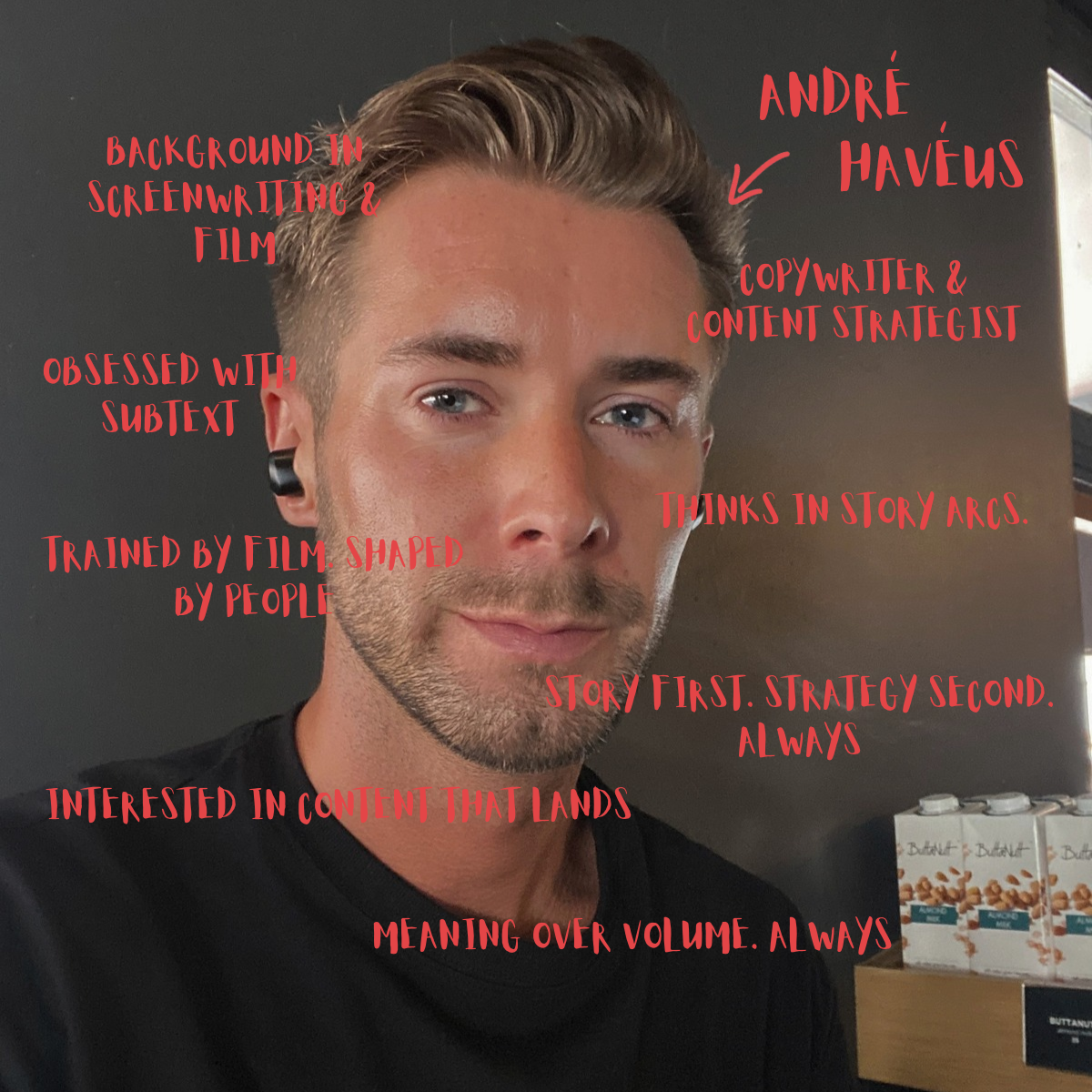
I became a copywriter because I was already a filmmaker. A screenwriter. Someone who spent years obsessing over the gap between what people say and what they actually mean. Over the small gestures that reveal character. Over why some stories stay with you for decades, and others dissolve before you’ve even closed the tab.
That’s a discipline, and it shapes every single word I write.
Trained by film. Shaped by people.
Screenwriting teaches you something most copywriters never learn: the most important thing in any scene is almost never what’s being said.
A character says “I’m fine.” What they mean is: I am holding myself together and I need you to see that without making me say it out loud.
That’s subtext. And I am obsessed with it.
Because good copy works exactly the same way. The best campaigns don’t tell you what to think. They create a moment of recognition with the reader. That recognition is what builds loyalty. Not a clever headline. Not a conversion-optimized CTA. A moment where a real person felt genuinely seen.
You can’t generate that. It requires someone who has been paying close attention to people for a very long time.
That’s what I bring to the table.
Thinks in story arcs. Writes in search-optimized prose.
Most copywriters start with the keyword. I start with the character. Who is this person, what do they actually want, and what are they really afraid of?
From there, structure follows naturally. The hook. The tension. The turn. The resolution. It’s not a framework I learned in a marketing course. It’s what happens when you’ve spent years writing scripts where every scene has to earn its place or it gets cut.
That discipline is rare in content right now. And it’s becoming more valuable by the day.
Because when execution is cheap the question of what those words should mean, and to whom, and why, becomes the only question that matters.
Story first. Strategy second. Always.
Interested in content that lands.
Scroll through any feed right now. The same minimalism that isn’t minimal, it’s just empty. Content that performs the idea of having something to say without ever quite getting there.
And then, occasionally, something cuts through. A piece of writing that makes you send it to someone with no comment except read this. A brand that makes you feel like the people behind it are actually alive and real.
Those moments are becoming rarer. And they are becoming more valuable.
Meaning over volume. Always.
The agencies and clients who still believe in this are out there.
I know you exist. You’re the ones who still lose sleep over whether a campaign means something.
You are going to win. Not because creativity is some romantic ideal worth protecting, but because humans are hardwired to respond to story, to honesty, to the feeling that the thing they’re reading was made by someone who actually cared.
The printing press didn’t end writing. Photography didn’t end painting. And AI won’t end the one thing it cannot replicate: a perspective that comes from a life genuinely lived and paid attention to.
Don’t buy the panic. Read a book. Watch a film. Spend time with people you love.
The future is bright, but only if we let it be.
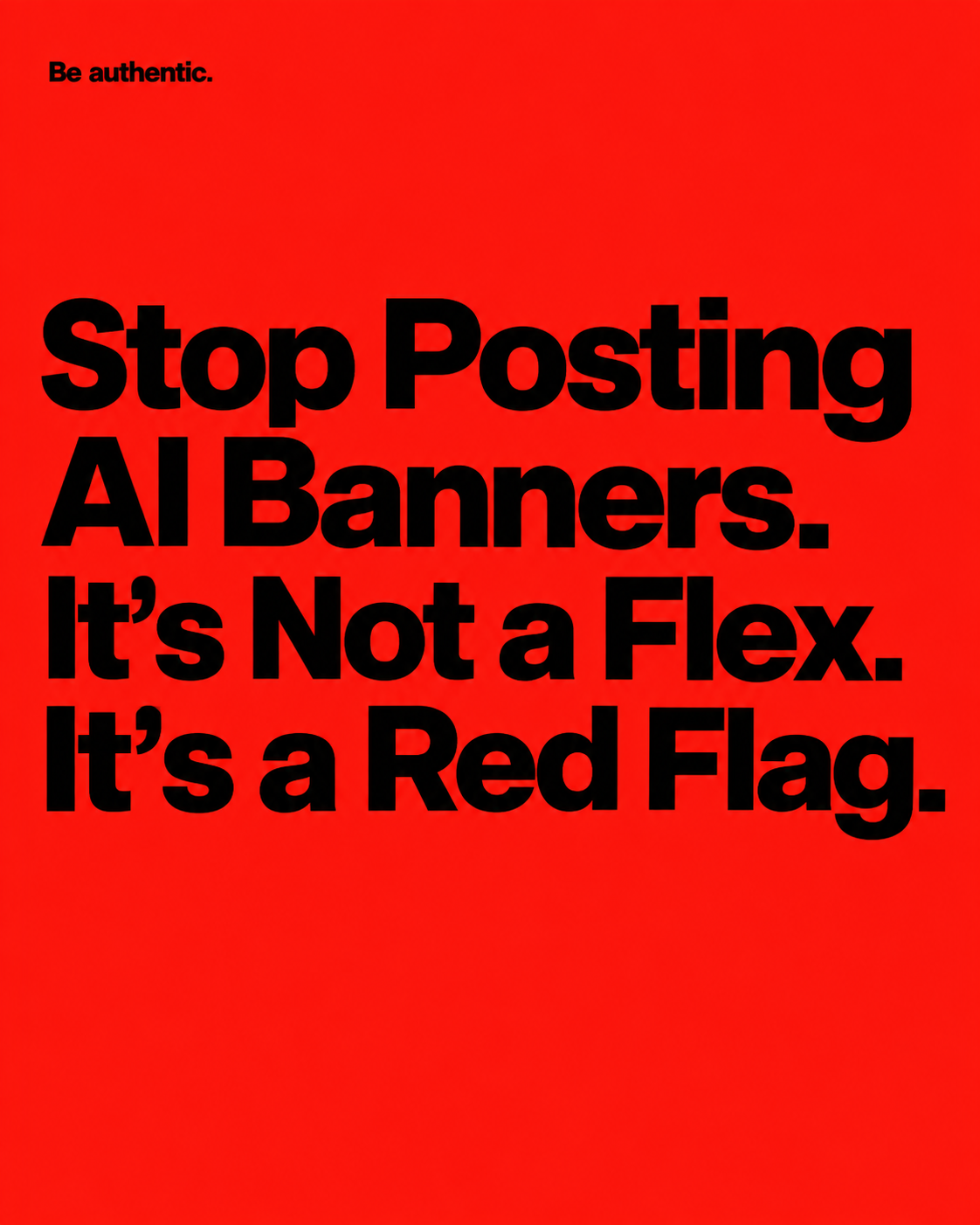
Stop posting AI banners. It's not a flex. It's a red flag.
When a business posts an AI-generated banner, customers don't think "efficient." They think "they didn't care enough to try." Here's why that choice costs you more than you think.
When I see a business post a social media banner that was clearly generated by AI I don't think efficient. I don't think innovative.
I think that they didn't care enough to try.
And if they didn't care enough to try with their own image, the thing they chose to represent themselves publicly, what does that tell me about how much they'll care about the actual product or service?
Nobody Cares What You Used. They Care What It Says About You.
There's a difference between using a tool intelligently and using it as a substitute for giving a damn.
An AI banner says three things simultaneously:
We don't think our visual identity is worth investing in. You couldn't spend two hours with a designer, or even find a decent template and customize it. You generated something in 40 seconds and called it done.
We assume our customers won't notice (meaning: we don't care if they do). This is the part that really gets me. It's not even cynicism. It's indifference. And customers feel indifference. They may not be able to name it, but they feel it.
We have no backbone. You chose to represent your brand with something that has no perspective, no voice, no trace of an actual human decision. A placeholder dressed up as an identity.
Your customers are not stupid.
The comments sections on posts like this are consistent. People notice. They're turned off. They're simply scrolling past and never coming back.
If a company can't be bothered to create real content, why should we be bothered to become a real customer?
That's the direction the whole market is moving. As AI-generated content floods every platform, authenticity (actual human intention behind a visual) is becoming a premium signal. A trust marker. The brands that understand this are already pulling ahead.
The irony is that it costs you more than it saves you.
You saved what? A few thousands kronor on a graphic? And in exchange you communicated to every person who saw it that your brand is lazy, cheap, and doesn't believe in itself.
That's not efficiency. That's a slow leak in your credibility.
If you genuinely can't afford a designer right now, there are tools that let a non-designer make something that looks considered and intentional. Use a template and make it your own. Show up with something that has a pulse. Put in the effort.
But please, stop mistaking automation for strategy. Stop confusing fast with good. And stop insulting your potential customers by assuming they won't tell the difference.
They can. They do. And they remember.